A scope can clear the barrel perfectly and still sit at the wrong height for the person using it. That is because mounting height has two jobs: it creates physical clearance, and it places the optic's centerline where the eye can meet it naturally.
The measurement that connects those ideas is scope height over bore, also called sight height. It is simple in principle, but easy to confuse with ring height, objective diameter or the gap beneath the objective bell. Keeping those measurements separate helps when choosing mounts, entering data in a ballistic tool or diagnosing an awkward head position.
The Short Answer: Measure Centerline to Centerline
Scope height over bore is the vertical distance between two axes:
- the centerline of the rifle's bore; and
- the optical centerline of the scope.
Hornady, Leupold, Vortex and Swarovski Optik all describe sight height in essentially this center-to-center way. The exact number belongs to the finished rifle, base, rings and optic combination. It is not a universal value for a scope model by itself.
That distinction matters because the outside surfaces are only measuring references. The measurement is not the air gap under the objective, the height of one ring, or the diameter of the main tube. Those dimensions help you estimate where the two centerlines are, but they are not interchangeable with the final sight height.
If you are still choosing rings, begin with our scope ring-height guide. It separates objective clearance, tube fit and natural eye position before you calculate the final centerline height.
Scope Height and Ring Height Are Related, but Not Identical
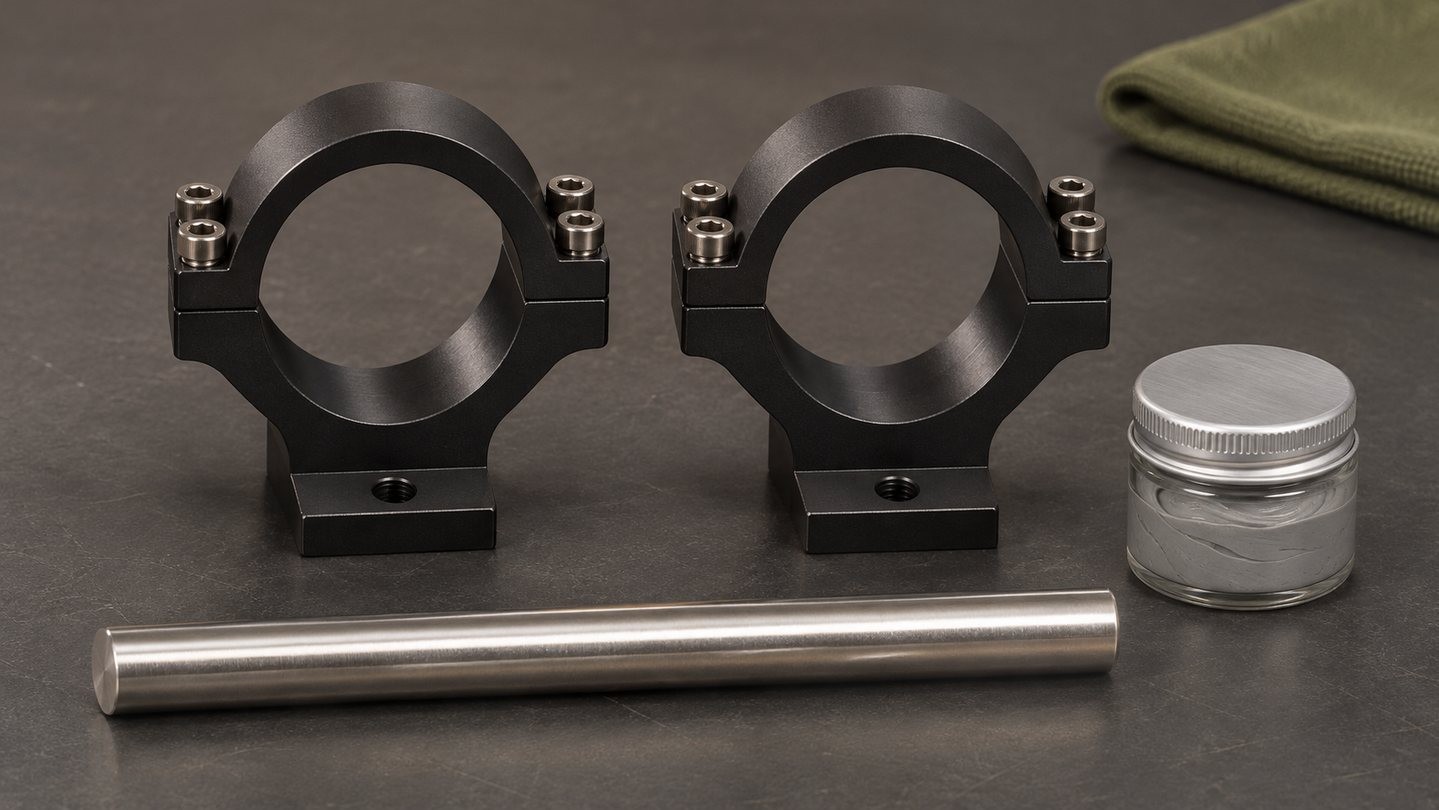
Ring makers do not all define height from the same reference point. One specification may run from the top of the base to the center of the ring. Another may run to the bottom of the scope tube. A complete mount may list its optical-centerline height above the rail instead.
That means a label such as low, medium or high is not a transferable measurement. Even a numerical ring height needs its reference points checked before it can be used in a calculation.
The main-tube diameter also changes the centerline position when ring height is specified to the bottom of the tube. Half of a 30 mm tube is 15 mm; half of a one-inch tube is 12.7 mm. Our 1-inch vs 30 mm vs 34 mm scope-tube guide explains why tube diameter is a mounting specification, not a direct brightness rating.
The safest comparison is therefore based on dimensions with stated reference points. Do not assume two mounts place the optical axis at the same height merely because both are called medium.
Why the Lines of Sight and Bore Do Not Start Together
The scope looks along a line that begins above the bore. Those two centerlines are physically separated at the rifle. When the system is zeroed for a chosen distance, the relationship between the line of sight and the projectile path is established for that specific setup.
Height over bore is one input in that geometry. Zero distance, ammunition, actual velocity, atmospheric conditions and other variables also matter to a trajectory solution. Changing sight height while leaving the other inputs untouched can change the calculated relationship, which is why ballistic programs ask for the measurement separately.
This does not mean a taller mount is automatically inaccurate or a lower mount automatically produces a better trajectory. It means the calculator and the real setup should describe the same geometry. Hornady's 4DOF instructions, for example, request the exact center-of-scope to center-of-bore height rather than a generic ring-size label.
Why Close Distances Make the Offset Easy to Notice
At very short distances, the line of sight is still physically above the bore axis. The vertical separation is therefore easier to notice than it is at the chosen zero distance. This is often called mechanical offset or sight-over-bore offset.
The important point is not to memorize one correction from someone else's setup. A scope mounted at one height and zeroed at one distance does not share an identical relationship with every other combination. Measure the actual sight height, confirm the actual zero and use verified data for the complete setup.
Height over bore is also not the same as parallax. Parallax concerns the apparent relationship between the target image and reticle when the eye moves. Sight height is a physical distance between two axes. Adjusting a side-focus or objective control cannot move the scope's tube closer to the bore.
Lower Is Often Useful—but Not Always Correct
A low-mounted scope can reduce unnecessary height, help maintain a natural cheek position and keep the setup compact. Leupold's mounting guidance recommends placing a scope as low as practical while preserving all required clearance.
The phrase as practical matters. The objective bell, lens cap, barrel, rail, action and controls must not contact one another. Check the finished assembly rather than the bare scope alone; our objective-clearance guide explains why a cap or nearby rail can consume a gap that looked adequate on paper.
The user's eye must also meet the optical axis without forcing the head unnaturally downward or upward. Stock shape, cheek-piece height, posture, clothing and eye protection can all change what feels natural. A slightly taller mount that aligns the eye correctly can be more usable than a lower mount that technically clears but forces an unstable position.
Head Position Still Depends on Eye Relief and the Eyebox
Vertical alignment is only one part of scope fit. Eye relief controls the required front-to-back distance, while the eyebox describes the three-dimensional region where the full image remains visible.
A mount can put the scope at a comfortable height but leave it too far forward or rearward. Conversely, the eye-relief distance can be correct while the optic sits too high for a repeatable cheek position. Use the rifle-scope eyebox guide and the black-ring and eye-relief guide to separate those symptoms.
Before final tightening, follow the scope and mount manufacturers' instructions. With the equipment unloaded and handled safely, verify a full field of view from the normal position and across the magnification range. Do not use ring torque to solve a position problem.
Measure the Finished Setup, Not a Catalogue Guess
For a practical sight-height value, measure from the center of the bore to the center of the scope tube at the mounting area. On a typical bolt-action layout, the center of the bolt body can provide a useful bore-axis reference when the manufacturer supports that method. Use a ruler or caliper carefully and record the units.
If direct access makes one centerline difficult to measure, use consistent outside references and account for the relevant radii. The exact method depends on the rifle, receiver, rail and mount geometry, so a clear manufacturer diagram takes priority over a generic formula.
Re-measure after changing the base, rings, one-piece mount, rail or optic. Also confirm that the rings still land on usable straight tube sections. Our scope mounting-length guide covers that separate fit problem.
Do not copy a default value from a calculator merely because it looks familiar. A rough estimate may be acceptable for initial planning, but a custom dial or detailed trajectory calculation should use the measured finished setup and the tool maker's instructions.
What Height Over Bore Does Not Tell You
Sight height is a geometry input, not a quality score. By itself, it does not prove:
- that the rings match the main-tube diameter;
- that the objective and bolt handle clear;
- that eye relief is correct;
- that the reticle is level;
- that the scope has enough usable adjustment;
- that a 0 MOA or angled base is appropriate;
- that the mount will retain zero; or
- that a ballistic prediction matches real results.
Base angle is especially easy to mix into this topic. A 0 MOA vs 20 MOA scope base changes the angular relationship between the rail and optic; height over bore describes vertical centerline separation. They are different specifications and should be entered or evaluated separately.
A Better Comparison Checklist
When comparing mounts or checking an installed scope, work through these questions:
- Do the base and rings fit the exact rifle and main-tube diameter?
- How does the maker define the listed ring or mount height?
- Does the objective, cap, action, bolt handle and barrel have safe clearance?
- Does the scope have enough straight-tube space for the ring positions?
- Does the optical axis meet the eye from a natural, repeatable position?
- Is eye relief correct at the most demanding magnification you expect to use?
- What is the measured center-of-bore to center-of-optic sight height?
- Has that exact value been used where a ballistic tool or custom dial requests it?
The clean rule is simple: ring height helps place the scope; height over bore describes where the scope's optical centerline ended up relative to the bore. Choose the mount for clearance and human fit first, then measure the finished geometry rather than guessing from a label.
Browse Sporting Optics only after checking the complete mounting dimensions, eye position and manufacturer instructions for the exact setup.


Leave a comment