Have you ever looked through a scope at a fence, window frame or target grid and noticed that a straight line seemed to bow near the edge of the view? The image might still look sharp. The reticle might be perfectly focused. Yet the geometry feels slightly wrong.
That is the clue that you may be seeing image distortion.
Distortion is easy to confuse with edge blur, colour fringing or a parallax problem, but it is a different optical effect. Understanding the difference helps you judge a scope more fairly—and keeps you from trying to fix the wrong setting.
What is image distortion in a rifle scope?
In a perfect optical system, the apparent magnification would remain consistent from the centre of the field of view to the edge. In a real system, magnification can change slightly as the image moves away from the optical axis. Straight lines may then appear curved or displaced even though they remain reasonably sharp.
That distinction matters: distortion changes geometry; blur reduces detail.
A scope can therefore show a sharp but slightly distorted grid. It can also show a geometrically straight image that becomes soft near the edge. Those are separate characteristics, and one does not automatically predict the other.
The effect is usually easiest to see with man-made straight lines. Tree branches, grass and uneven terrain rarely provide a clean reference, so mild distortion may go unnoticed during ordinary outdoor use.
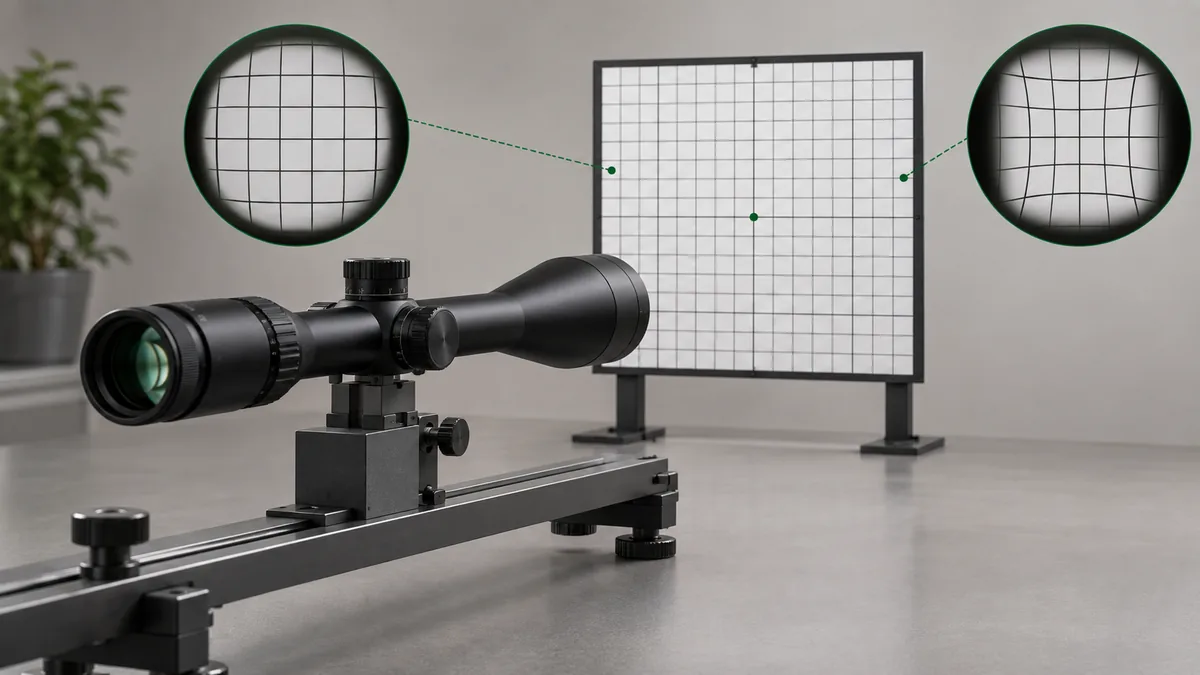
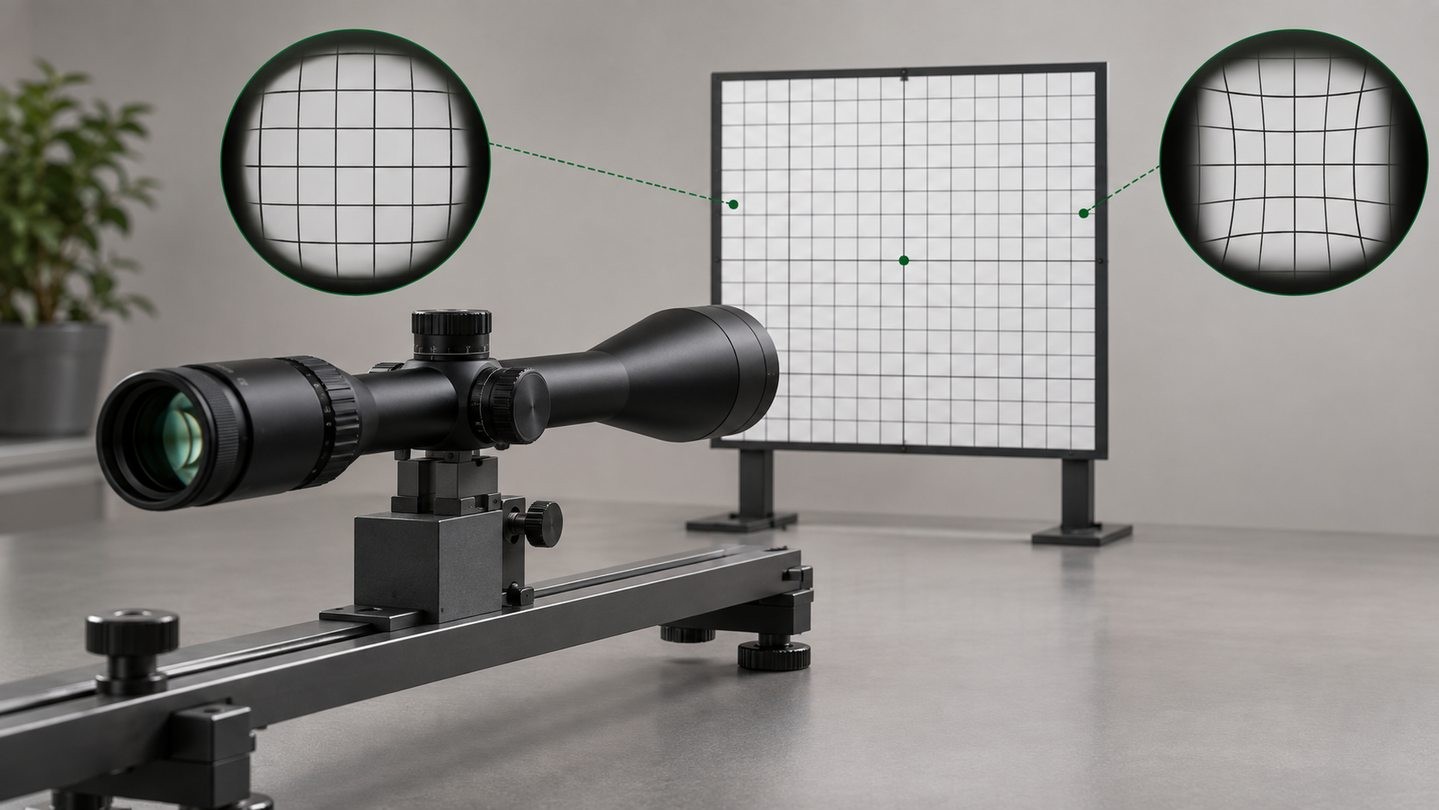
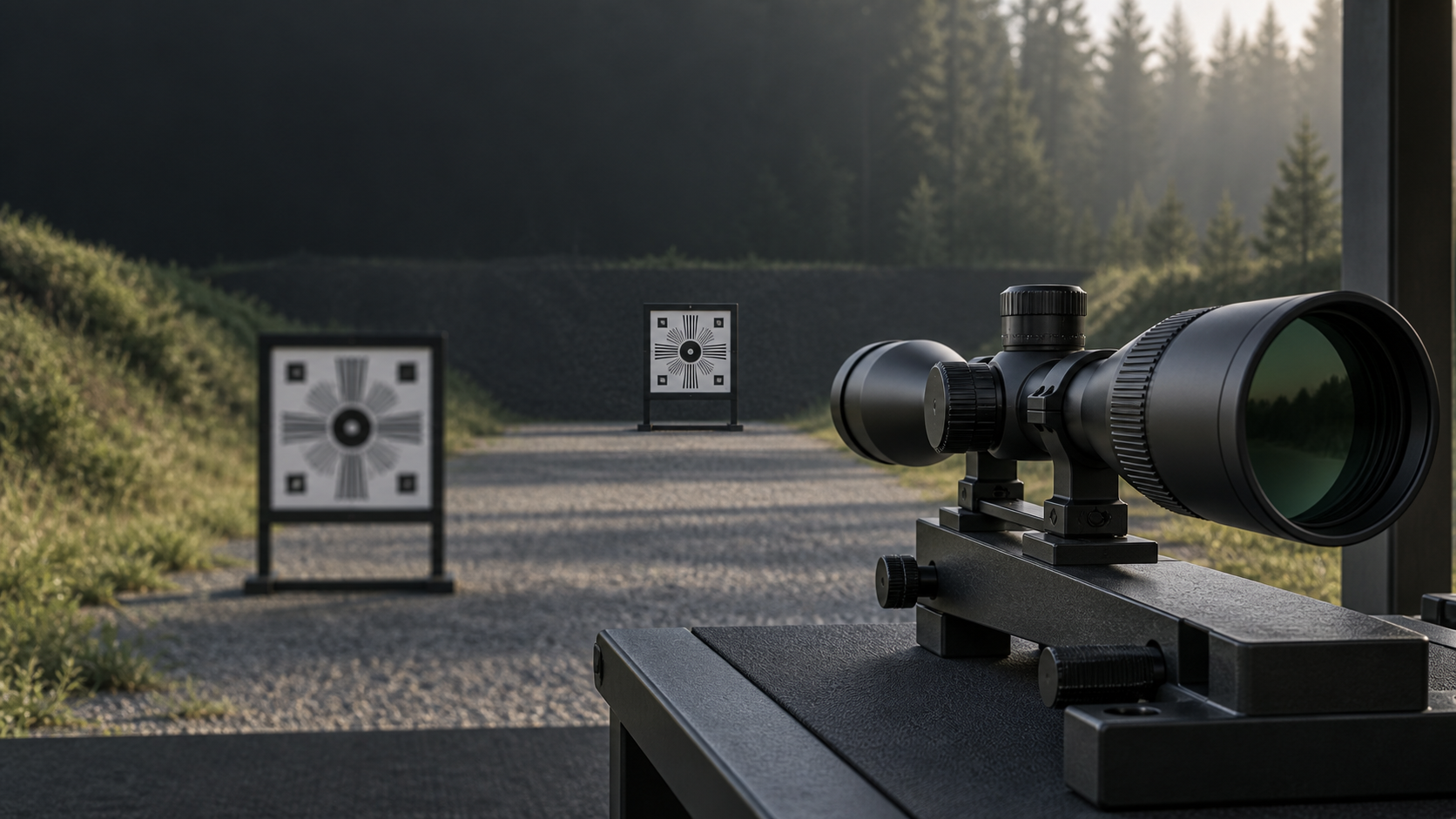
Illustration: a regular grid makes changes in image geometry easier to recognise. This is a generic educational scene, not a test result for a specific scope.
Barrel distortion: the image appears to bulge
With barrel distortion, magnification decreases toward the edge of the field. A rectangular grid can appear to swell outward, as if it were wrapped around the outside of a barrel. Straight lines near the edge bow away from the centre.
The centre may still look normal, which is why the effect can be missed when you inspect only the reticle or a small central subject.
Barrel distortion is often associated with wide-angle optical designs, but it should not be diagnosed from magnification alone. The actual result depends on the complete lens and eyepiece design, not simply on whether a scope has a low-power setting.
Pincushion distortion: the image appears to pull inward
With pincushion distortion, magnification increases toward the edge. The same grid now appears to pinch inward, with edge lines bending toward the centre.
Neither barrel nor pincushion distortion automatically means that a scope is unusable. The practical question is how strong the effect is, where it appears in the field and whether it interferes with the way you use the optic.
Some complex zoom systems can also show a mixed pattern in which the direction of distortion changes across the field. That is sometimes called wave or moustache distortion. For a beginner, it is enough to recognise that not every distorted view will match a perfect textbook barrel or pincushion shape.
Distortion is not the same as edge softness
If fine detail becomes fuzzy near the perimeter while straight lines keep their basic shape, you are more likely seeing edge softness or another aberration rather than geometric distortion.
This is why a single word such as “clarity” can be misleading. It may refer to centre sharpness, edge sharpness, contrast, colour control or simply a reviewer’s overall impression. Our guide to resolution versus magnification explains why a larger image does not necessarily contain more usable detail.
Field curvature is another separate effect. It occurs when the best-focus surface is curved rather than flat, so the centre and edge may not reach their sharpest focus at the same setting. Distortion moves image points geometrically; field curvature changes where those points come into focus.
Distortion is not chromatic aberration
Red, blue or purple fringes along a high-contrast edge are signs of chromatic aberration, not barrel or pincushion distortion. A scope may control colour fringing well and still bend straight lines slightly, or it may preserve geometry while showing noticeable colour at the edge.
ED glass can help optical designers reduce certain forms of chromatic aberration, but an “ED” label is not a promise of zero geometric distortion. The two problems come from different parts of optical performance. See our guide to ED glass and chromatic aberration for the colour side of the comparison.
Distortion is not parallax error
Parallax error is apparent movement between the reticle and the target image when your eye shifts behind the scope and the two are not in the same optical plane. Distortion does not require that eye movement; it changes the shape or position of features across the view.
If the target appears to move behind the reticle when you move your head, check target focus and parallax adjustment. If a stationary grid stays put but its edge lines look bowed, think about distortion instead. Our parallax, focus and diopter guide walks through those controls in the right order.
Poor eye position can also create a dark crescent or incomplete image. That is a viewing-position problem, not proof of barrel or pincushion distortion. If the picture disappears or becomes shadowed as you move, review the rifle-scope eyebox guide.
Why can distortion change with magnification?
A variable-power scope is not one fixed lens. Multiple elements move as the magnification ring turns, and the optical designer has to balance field of view, eye relief, image sharpness, distortion, size, weight and cost across the zoom range.
As a result, a scope may not show the same distortion pattern or strength at every magnification. The widest setting exposes a larger off-axis field, where geometric effects can be easier to notice, but the exact behaviour is design-specific. Do not assume that every LPVO has strong barrel distortion or that every high-magnification scope is distortion-free.
This is also why field of view and distortion should be judged separately. A wide view is useful for locating and following a subject, while low distortion helps that view feel geometrically natural. Read the field-of-view guide if you want to compare how much scene two scopes show at the same power.
A simple way to check a scope for distortion
You do not need a laboratory instrument for a useful first look. You do need a consistent target and a careful setup.
- Use a regular grid or a wall with straight horizontal and vertical lines. A printed grid, tiled wall or large window frame works better than an irregular landscape.
- Keep the optic stable. Use a suitable support and follow all applicable safety rules. Never look at the sun through any optic.
- Set the diopter for a sharp reticle. Then focus the target image and adjust parallax where the scope provides that control.
- Centre your eye. Confirm a full, evenly illuminated field without scope shadow before judging the edges.
- Place a straight line near the centre, then near the edge. Watch whether it remains straight, bows outward or pulls inward.
- Repeat at several marked magnifications. Record where the effect becomes easier or harder to see instead of relying on one quick glance.
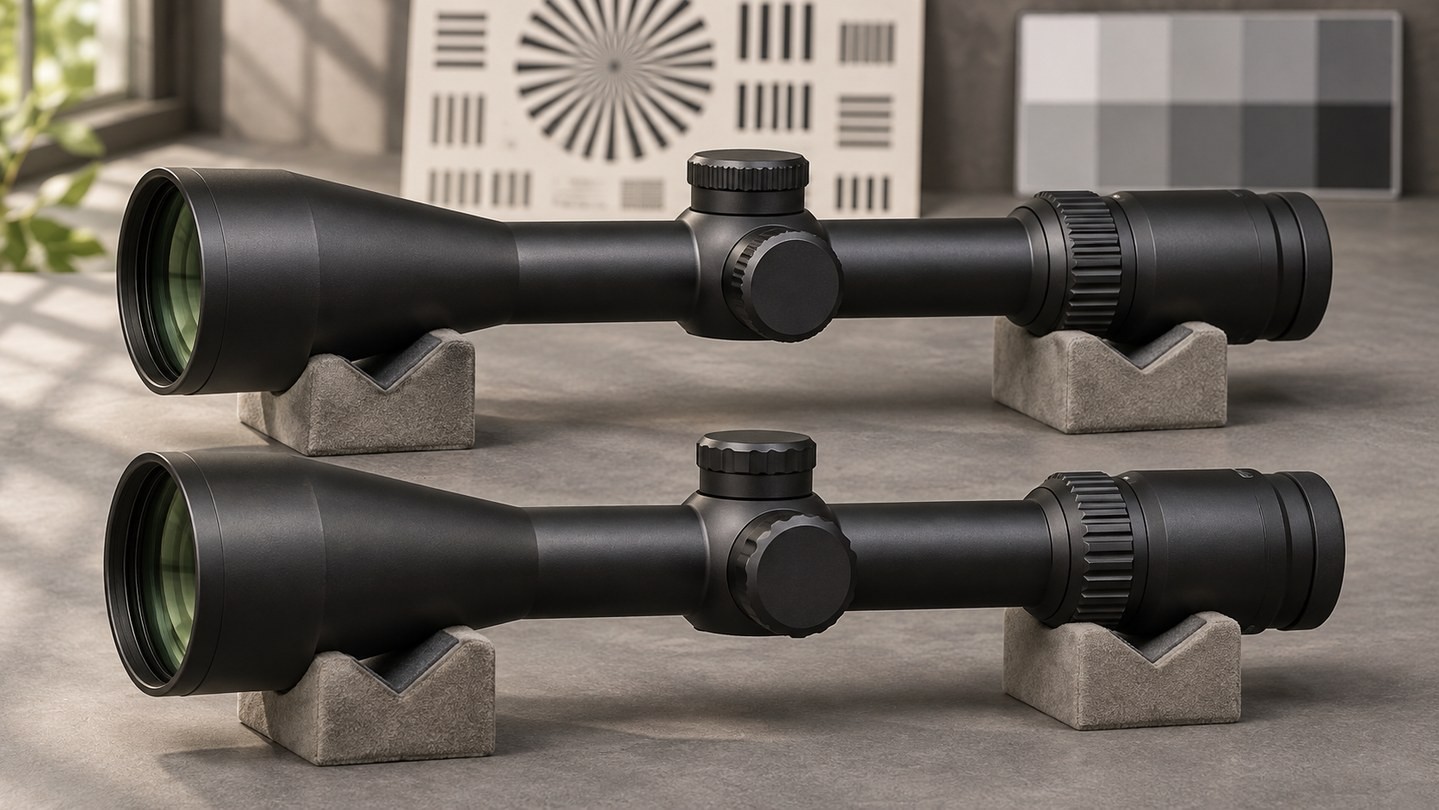
- Compare scopes at the same power and distance. A 1× view and a 6× view are not a controlled comparison.
Be cautious with phone-through-eyepiece photos. A phone camera has its own lens distortion, and small alignment changes can alter the result. A photo can document what you saw, but it is not automatically an objective measurement of the scope alone.
Does mild distortion matter in real use?
Sometimes it matters very little. If the image is comfortable, the central area is clear and straight-line geometry is not important to the task, a small amount of edge distortion may never distract you.
It becomes more relevant when you scan frequently, rely on a very wide field, compare fine geometry across the frame or feel that the scene stretches unnaturally while moving the optic. Even then, distortion is only one part of the viewing experience. Strong edge sharpness, forgiving eye position, useful field of view and good contrast may matter more for a particular user.
The best comparison is therefore not “Does this scope have any distortion?” Almost every practical optical design involves compromises. A better question is: Does the distortion become noticeable enough to interfere with the way I observe?
What should beginners look for when comparing scopes?
Start with the centre of the image, because that is where the reticle and main subject usually sit. Then check the outer field deliberately rather than assuming that a sharp centre means uniform performance everywhere.
Use the same magnification, target, distance and light. Look separately for:
- straight-line bending;
- edge softness;
- colour fringing;
- glare or washed-out contrast;
- sensitivity to eye position;
- target or reticle movement caused by parallax.
Separating those observations makes your notes much more useful. “The image looks strange” is hard to act on. “Vertical lines bow outward near the final 15 percent of the field at the lowest setting” is a specific observation that another person can try to reproduce.
The bottom line
Barrel and pincushion distortion describe changes in image geometry across the field of view. They are not the same as blur, colour fringing, parallax error or a poorly adjusted diopter.
A regular grid and a controlled comparison can reveal more than a quick look across uneven terrain. Check several magnifications, keep your eye centred and judge distortion alongside—not instead of—resolution, field of view, contrast and viewing comfort.
For more practical explanations before choosing an optic, browse the USEEIN Buying Guides.


Leave a comment