A thin purple or green edge around a bright target can be surprisingly distracting. It may show up along a white sign against dark trees, on a branch against a bright sky, or around another hard, high-contrast boundary. That colour fringe is one of the visible forms of chromatic aberration.
ED glass is often promoted as the solution. It can be an important part of the solution, especially in a high-magnification optical system, but the label needs some context. “ED” tells you something about the glass used inside the scope. It does not tell you how well the complete scope was designed, assembled or tested.
What Causes Chromatic Aberration?
White light contains many wavelengths. Ordinary optical glass does not bend every wavelength by exactly the same amount. If the lens system does not bring those colours together closely enough, they do not all form the same image at precisely the same position.
The result can appear as purple, green, blue or reddish fringing around a high-contrast edge. It can also reduce apparent sharpness because the colour channels are not perfectly aligned. The effect is often easiest to notice when a dark subject sits against a very bright background.
This is not the same as a blurry reticle caused by an incorrect diopter setting, and it is not the same as a target image that needs side-focus or adjustable-objective correction. Our guide to parallax, focus and diopter controls explains those adjustments separately.
What Does ED Glass Mean?
ED stands for extra-low dispersion. Dispersion is the tendency of a material to separate light by wavelength. Compared with ordinary optical glass, an ED element is selected to help the optical design keep different colours closer together.
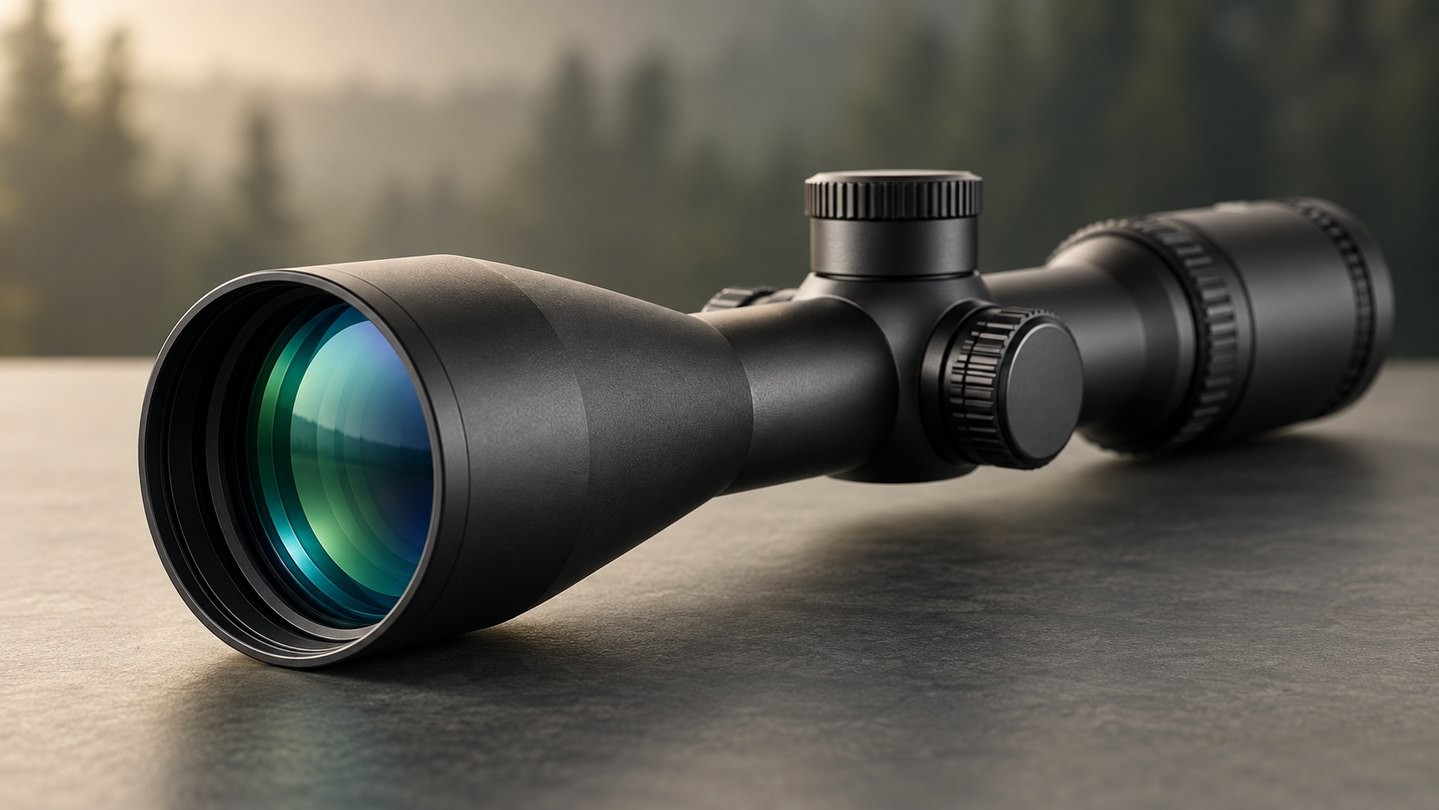
The important word is element. A rifle scope contains a system of lenses rather than one piece of glass working alone. Designers combine materials, lens shapes, spacing and coatings so the elements correct one another. ED glass gives the designer another tool for controlling colour error, but it still has to be used well.
Some manufacturers use related terms such as HD, FL, fluorite or special-dispersion glass. These labels are not a universal grading scale. They may describe different materials, different designs or a manufacturer’s own product language. Two scopes carrying an “ED” or “HD” badge are not automatically optically equivalent.
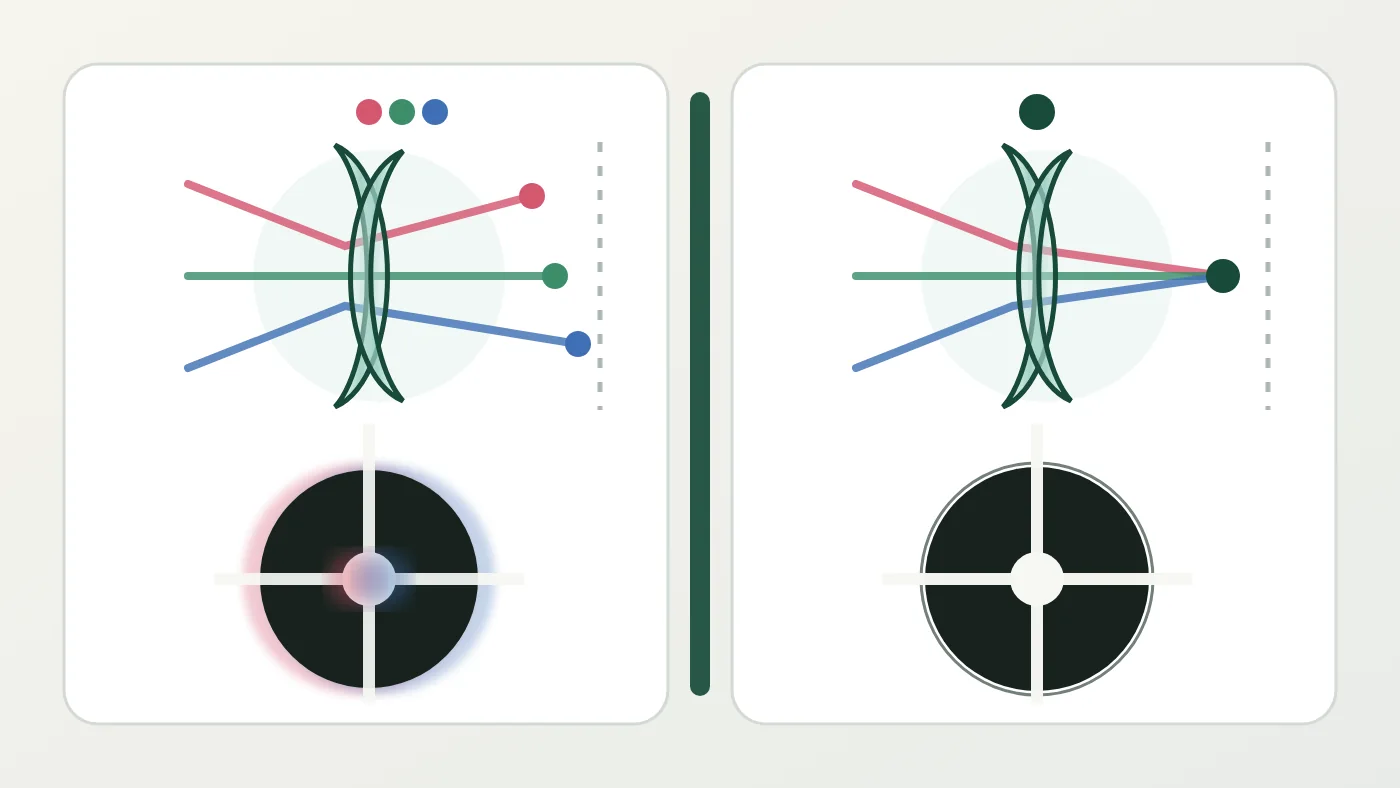
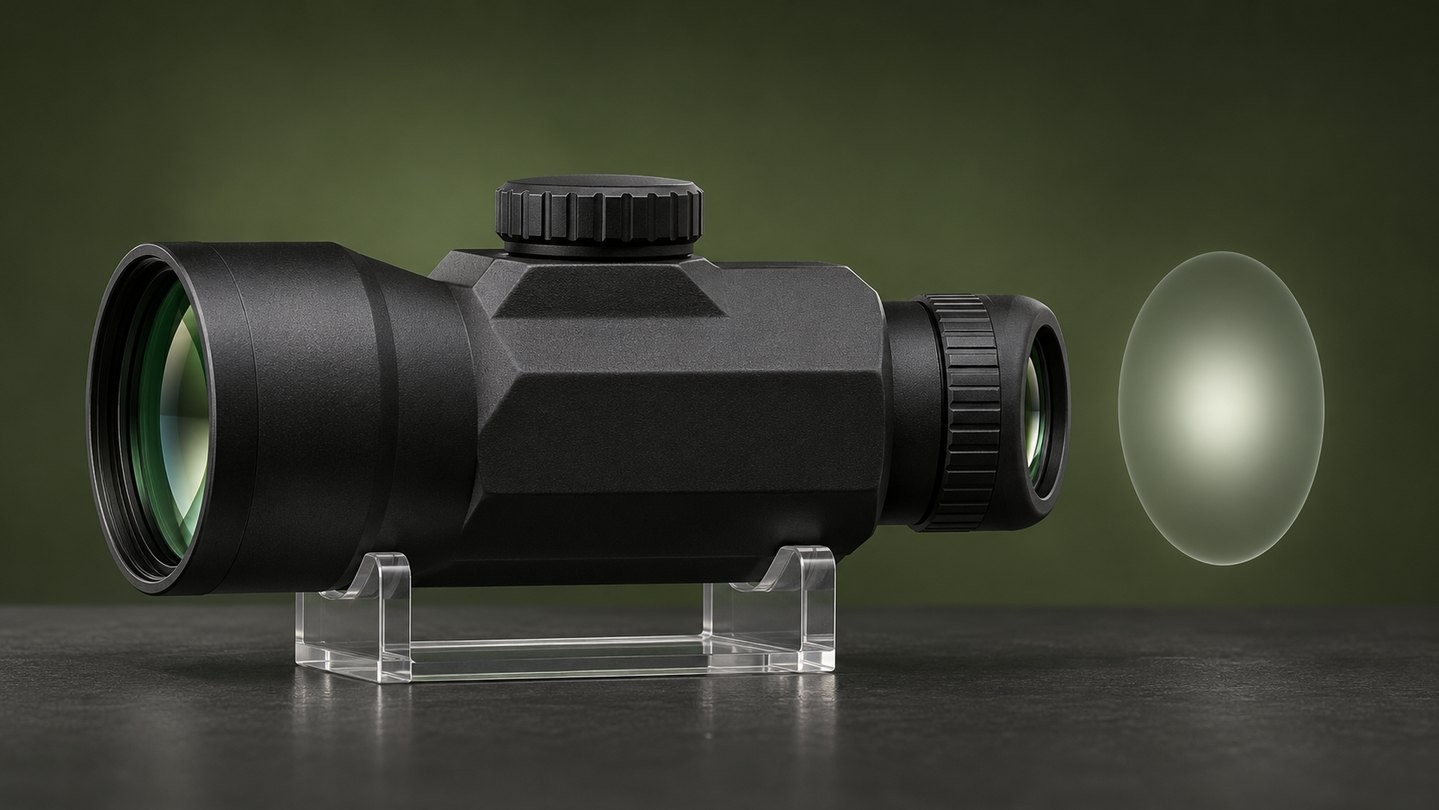
Concept illustration: the left side exaggerates visible colour separation for explanation; the right shows cleaner edge alignment. This is not a laboratory test of a specific scope.
Why ED Glass Can Matter More at Higher Magnification
Magnification makes small image defects easier to see. A fringe that is unobtrusive at low power may become more noticeable near the top of a variable scope’s range. High-contrast details also place greater demands on colour correction, focus and mechanical alignment.
That does not mean every high-power scope without an ED label will show obvious colour fringing, or that every ED scope will look perfectly neutral. A well-corrected conventional design can perform very well. An ED element can improve the design potential, but it is not a substitute for good engineering and quality control.
ED Glass Is Not the Same as Lens Coating
ED glass and lens coatings solve different problems.
- ED glass helps the lens design control dispersion and chromatic aberration.
- Anti-reflection coatings help reduce reflections at glass surfaces and improve light handling, contrast and flare control.
A scope can use both. In fact, a strong optical system normally depends on the glass, lens geometry, coatings, internal baffling and assembly working together. Our rifle-scope lens coating guide explains why terms such as “fully multicoated” should not be treated as a complete quality score either.
ED Glass Does Not Guarantee a Brighter Image
Colour correction and brightness are related to the complete viewing experience, but they are not the same measurement. An ED label does not reveal the scope’s total light transmission, exit pupil, contrast or low-light performance.
Objective diameter and magnification determine the nominal exit pupil. Coatings and the rest of the optical system affect how efficiently the available light is handled. If brightness is your concern, compare those factors separately instead of assuming ED glass automatically makes an image brighter.
The exit-pupil guide and our 40 mm vs 44 mm vs 50 mm vs 56 mm objective comparison provide the useful background.
How to Look for Colour Fringing Without Fooling Yourself
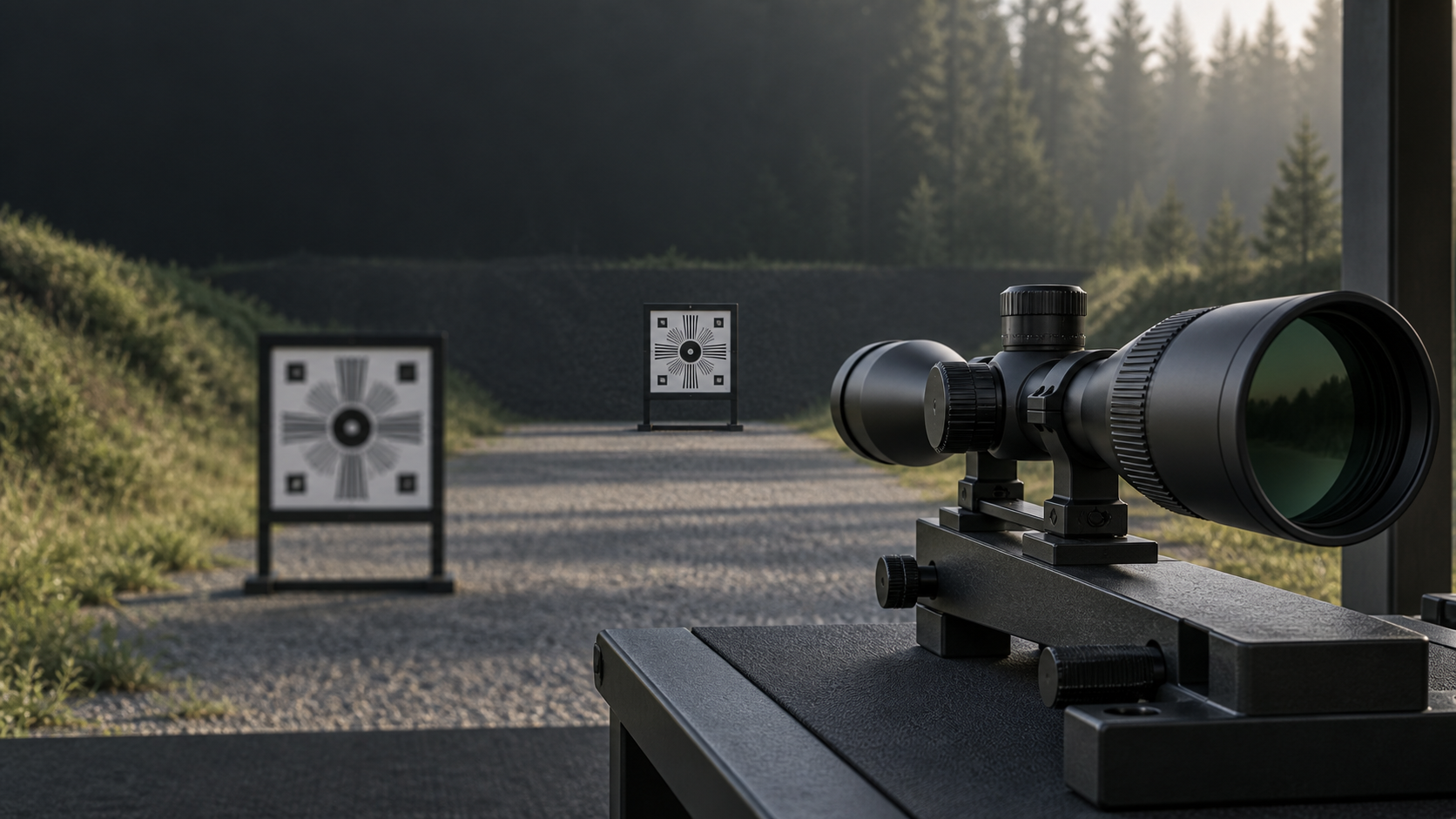
If you can compare optics in person, use the same scene, distance and magnification. Focus each scope carefully before judging it. A poor focus setting can soften an image and make a fair comparison impossible.
Choose a safe, naturally high-contrast subject such as dark branches against an overcast sky or black lettering on a bright sign. Never point an optic at the sun. Check the centre of the image first, then the outer field. Observe whether coloured edges appear, how wide they are and whether fine neutral details still look clean.
Keep the comparison realistic:
- Use the magnification you expect to use, not only the highest number on the dial.
- Set the diopter for your eye and focus the target correctly.
- Keep your eye centred in the practical eyebox.
- Compare the same target under the same light.
- Look at contrast and detail as well as colour fringing.
A phone photo through the eyepiece can be useful for notes, but it is not always a faithful record. Phone-lens alignment, exposure processing and its own optical aberrations can add coloured edges that were less obvious to the eye.
What the ED Label Does Not Tell You
ED glass alone does not confirm:
- centre or edge resolution;
- low-light brightness;
- field of view;
- eye relief or eyebox tolerance;
- distortion or flare resistance;
- turret tracking or mechanical durability;
- the number, location or grade of special-dispersion elements.
For example, a scope may control colour very well but still have a narrow field of view. Another may look sharp on axis but feel difficult to use because the viewing position is unforgiving. Those are separate design questions.
Does a Beginner Need ED Glass?
Not automatically. Start with the conditions in which you will actually use the optic.
ED glass becomes more relevant when you regularly use higher magnification, inspect fine detail or view strongly backlit subjects where colour fringing is easy to see. At modest magnification in ordinary daylight, other differences—focus behaviour, eye relief, field of view, reticle visibility and mechanical consistency—may matter more.
The useful buying question is not “Does it say ED?” but “Does the complete image stay clear, neutral and comfortable at the magnification and in the light I expect to use?” If you cannot compare the optic directly, look for model-specific reviews or tests that show controlled, repeatable comparisons rather than repeating the specification badge.
A Practical Way to Read the Specification
Treat ED glass as a positive design feature, not as a verdict. It tells you the manufacturer has chosen special-dispersion glass to help manage colour correction. Then continue evaluating the whole scope:
- Is the image sharp and neutral at your normal magnification?
- Are high-contrast edges clean enough for your use?
- Does the view remain useful toward the edge?
- Are eye relief and the eyebox comfortable?
- Do the field of view, controls and mechanical features fit the job?
- Are performance claims tied to the exact model rather than a product family?
ED glass can reduce a real optical problem. It just cannot answer every other question about a rifle scope. For more plain-language help comparing specifications, continue with the USEEIN Buying Guides.


Leave a comment