At low power, a scope can feel bright and easy to look through. Turn the magnification up, and the same optic may suddenly demand much more careful eye placement. One reason is the exit pupil: the small circle of light leaving the eyepiece.
It is a useful number, but it is often given more credit than it deserves. Exit pupil can tell you something about available light and viewing tolerance. It cannot, by itself, tell you whether one optic has better glass or a more forgiving eye box.
What exactly is the exit pupil?
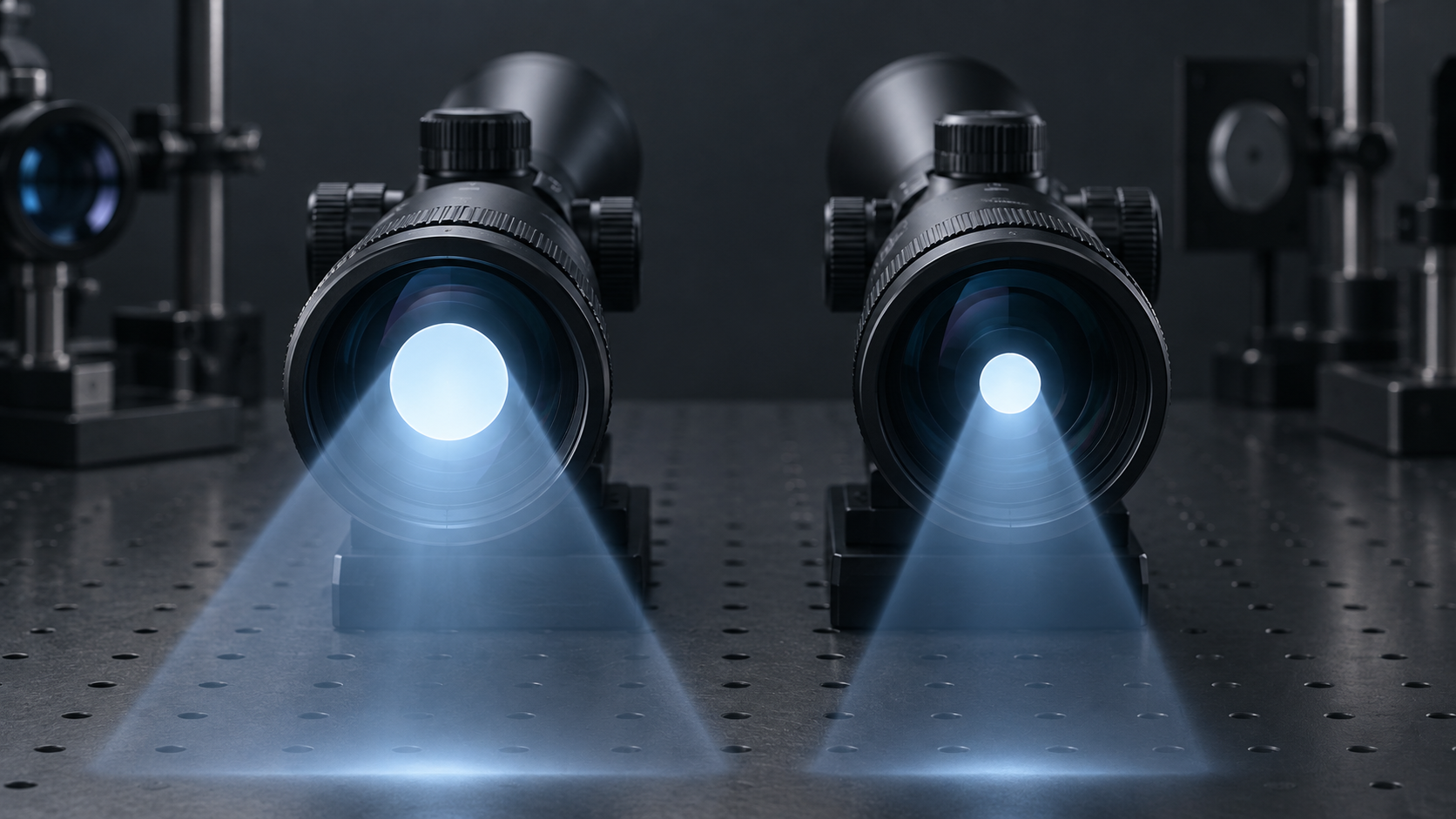
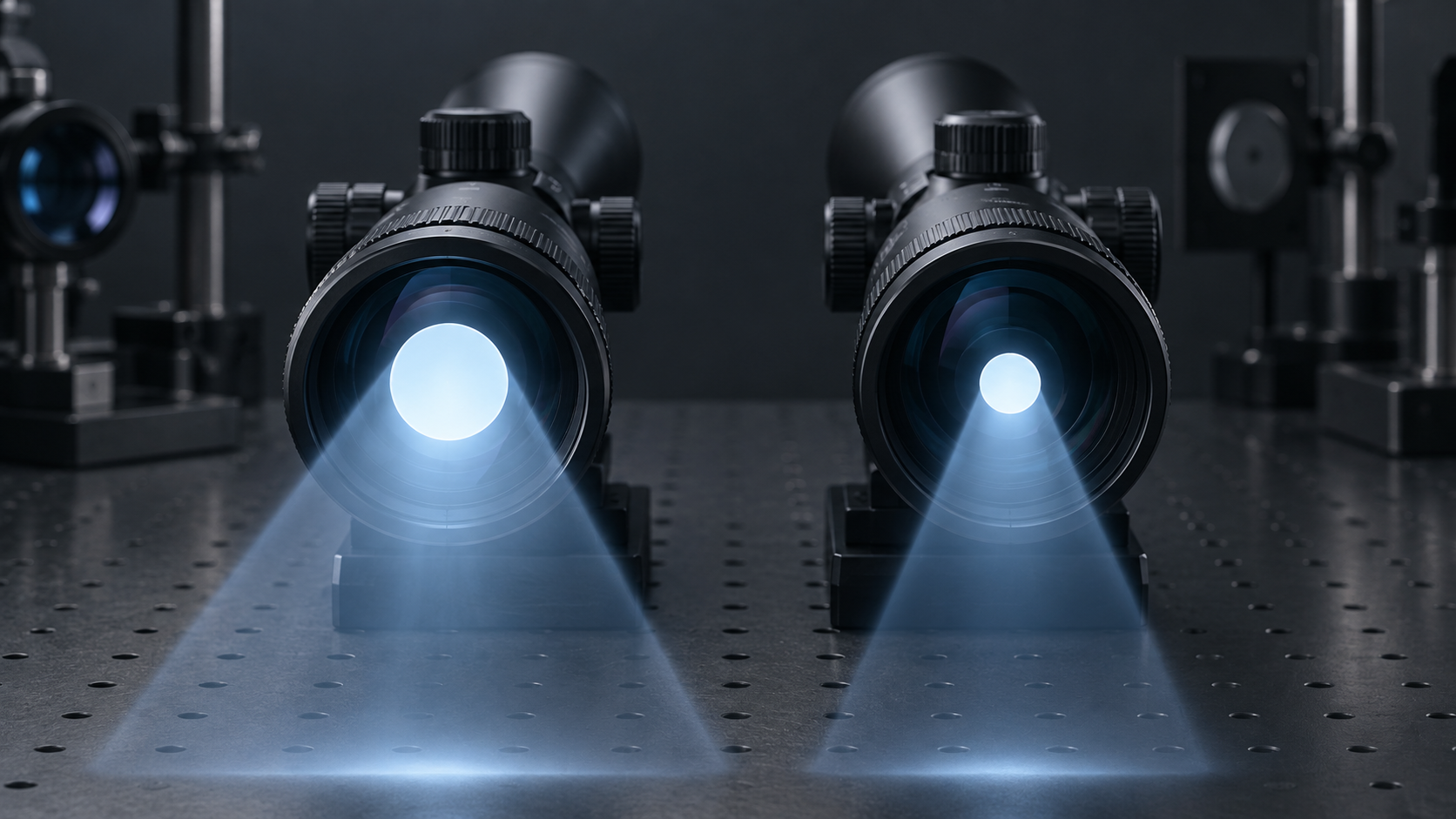
Hold a binocular or magnified optic at arm’s length and point it toward a bright, plain background. The small bright disk floating in the center of the eyepiece is the exit pupil. That disk is the bundle of light the optic delivers toward your eye.
The diameter is measured in millimetres. When your eye is properly positioned, your pupil overlaps that disk and receives the light forming the image.
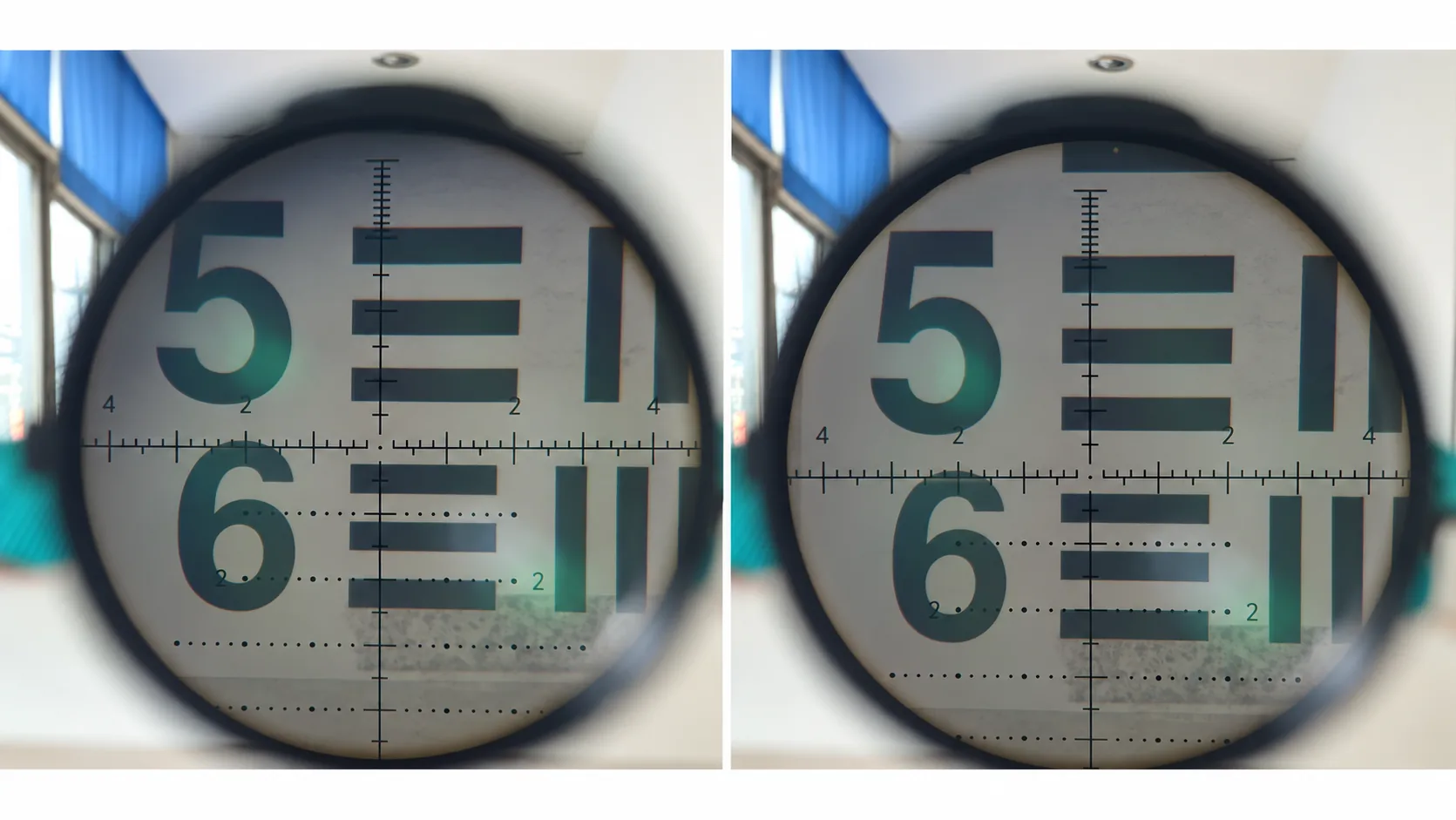
The two views below were captured from the same 7–42×56 optic at approximately 00:01 and 00:50 in the source video. They provide a real-world comparison of the view at different stages of the magnification range; they are illustrative rather than a laboratory measurement of exit-pupil diameter.
How to calculate it
For a straightforward optical estimate:
Exit pupil ≈ effective objective diameter ÷ magnification
Take a 4–16×50 optic as an example:
- At 4×: 50 ÷ 4 = about 12.5 mm.
- At 10×: 50 ÷ 10 = about 5 mm.
- At 16×: 50 ÷ 16 = about 3.1 mm.
The calculation is excellent for quick comparisons, although a manufacturer’s published figures may differ slightly. Internal apertures and the effective use of the objective can change across the zoom range.
Why it shrinks as magnification rises
The objective diameter does not grow when you turn the power ring. Higher magnification uses the available aperture to enlarge a smaller portion of the scene, so the light leaving the eyepiece forms a smaller disk.
That smaller disk leaves less room for your eye to move sideways before it begins to miss part of the light bundle. This helps explain why high power often feels less forgiving, although exit pupil is only one part of the experience. Eyepiece design, field of view and the rest of the optical system matter too.
Does a larger exit pupil always look brighter?
Only up to the amount of light your eye can use.
In bright daylight, your own pupil is relatively small. If the optic produces a light disk larger than your pupil, the extra light falls outside the eye and does not make the image look brighter. In dim conditions, your pupil opens wider, so a larger exit pupil can become more useful.
Brightness and image quality still depend on transmission, lens coatings, contrast, stray-light control, focus and your eyesight. Exit pupil is best treated as a geometric clue—not a complete score for optical performance.
Objective size and magnification belong in the same conversation
A 56 mm objective sounds large, yet at 24× its theoretical exit pupil is only about 2.3 mm. A 24 mm objective at 4× produces about 6 mm. In that comparison, the smaller objective delivers the larger exit pupil because it is being used at much lower magnification.
That is why objective diameter should never be judged on its own. Compare it at the power you actually plan to use.
Exit pupil and eye relief are not the same thing
Exit pupil describes the width of the light beam leaving the eyepiece. Eye relief describes how far behind the eyepiece your eye should be to see the full field of view.
A scope can offer generous eye relief and still produce a small exit pupil at high magnification. You may be at the correct front-to-back distance but still need careful side-to-side alignment. The reverse is also true: a large exit pupil cannot make up for a scope mounted too far forward or too far back.
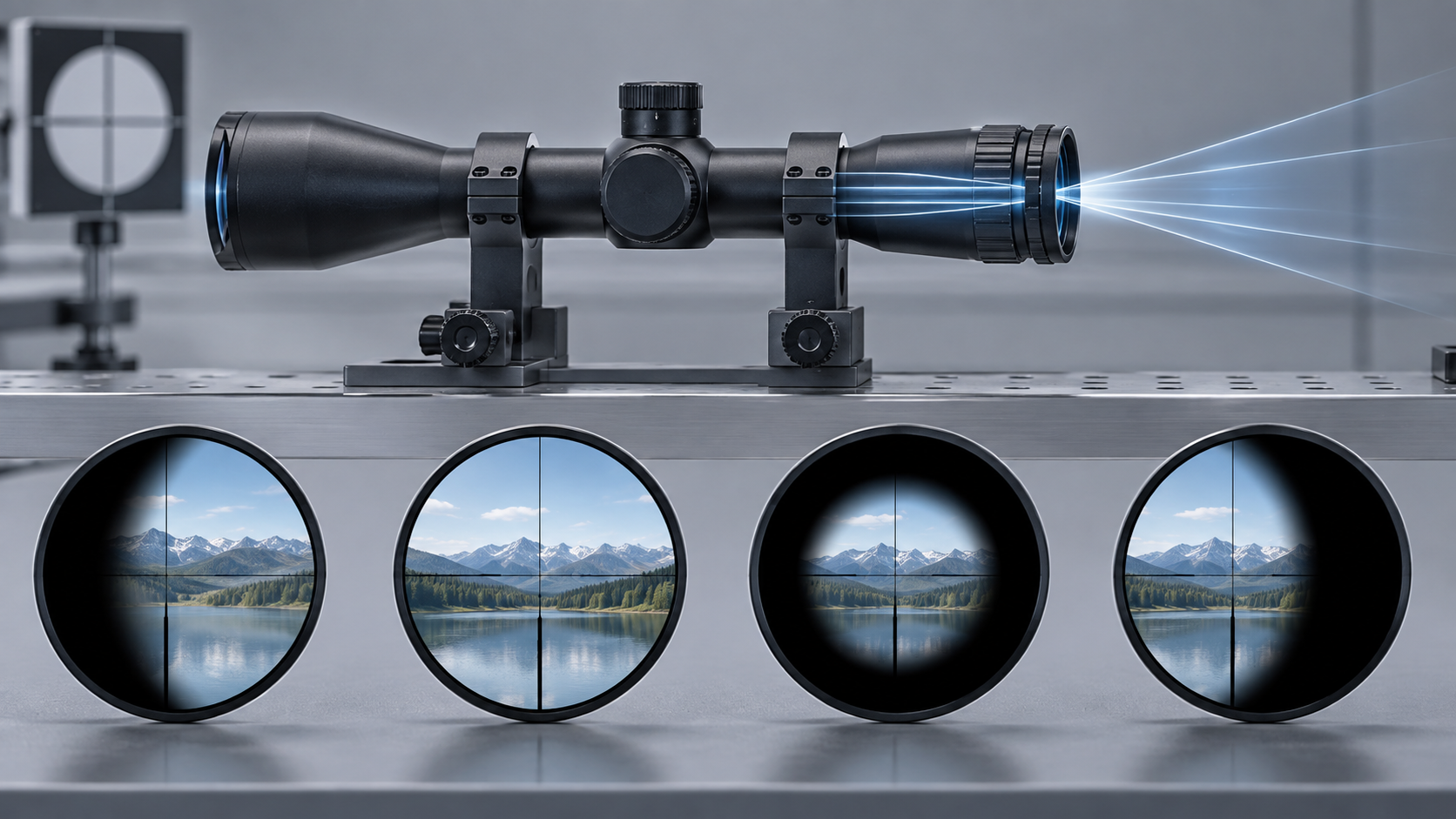
If the view is surrounded by a black ring or dark crescent, our guide to eye relief and scope shadow explains how to read that shadow and correct your eye position.
How does it relate to the eye box?
The eye box is the three-dimensional area in which your eye can move while keeping a usable view. Exit-pupil size contributes to lateral tolerance, but it is not the eye box itself. Eye relief, eyepiece design, field of view and optical geometry all shape the practical viewing window.
This is why two optics with similar calculated exit pupils can still feel very different when you bring them to your eye.
A practical way to compare optics
- Calculate exit pupil at the magnification you expect to use—not only at minimum power.
- Think about the lighting conditions that matter for your use.
- Check whether you can hold a full image without forcing your head into an unnaturally rigid position.
- Judge clarity, contrast and stray-light control instead of assuming the largest number must be best.
- Check eye relief separately, especially at maximum magnification.
The takeaway
Exit pupil is the diameter of the light beam delivered by the eyepiece, and it normally becomes smaller as magnification increases. A larger exit pupil can make alignment feel easier and may be useful in low light, but it does not determine image quality on its own.
Use it as one part of a complete comparison alongside eye relief, field of view, transmission, contrast, focus range and the real-world eye box.
You can browse our sporting optics and compare objective size, magnification, eye relief and other specifications for your intended use.


Leave a comment