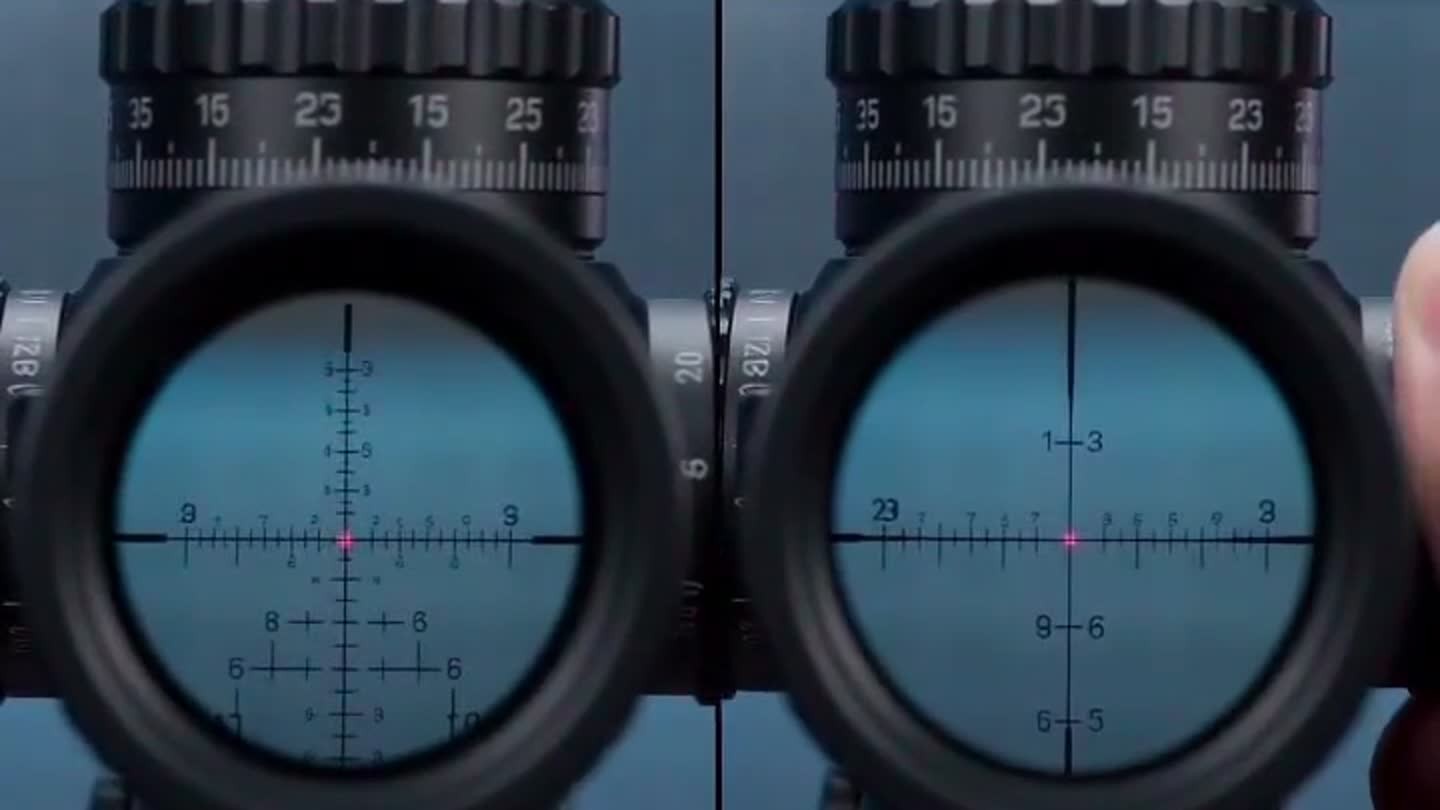
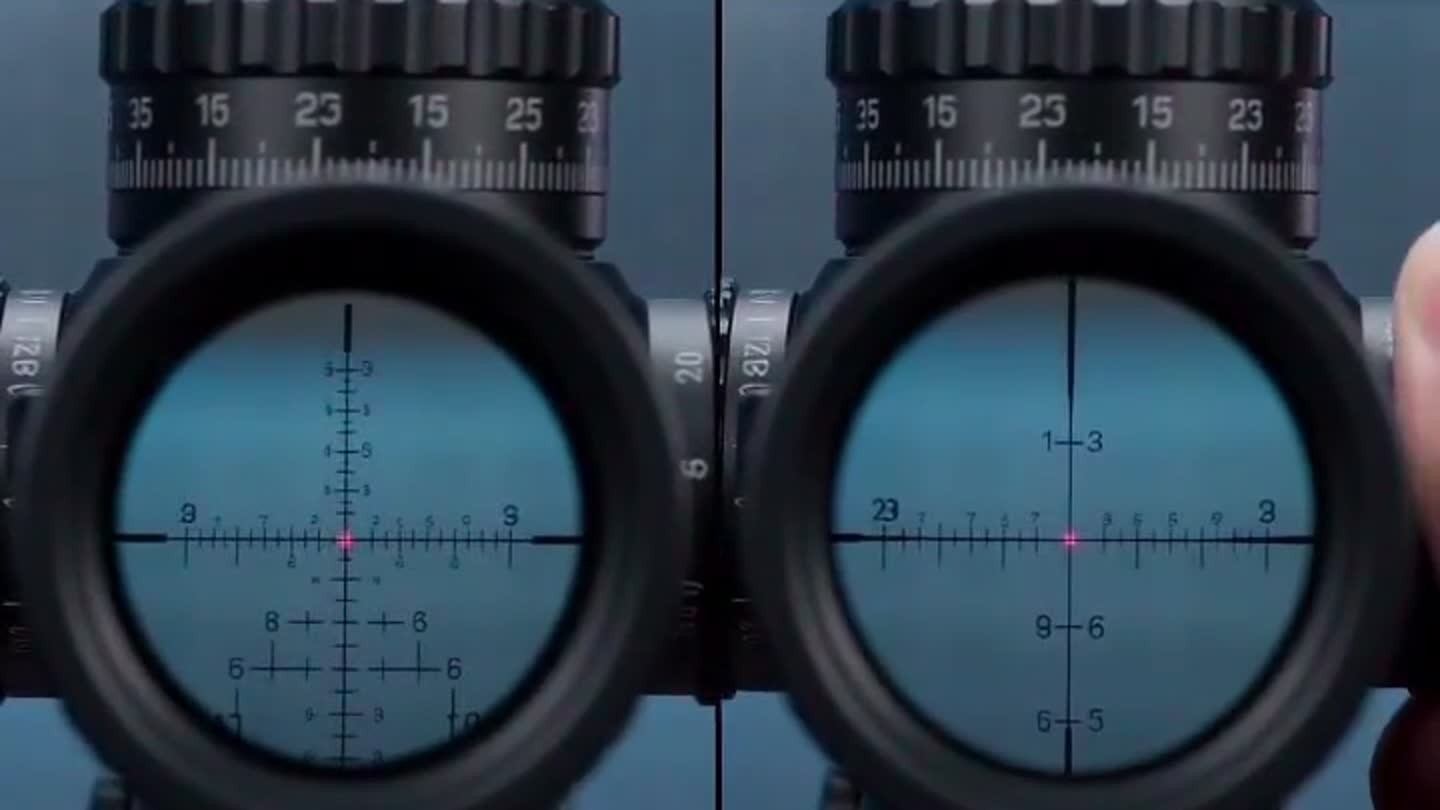
The difference between a first focal plane and second focal plane scope sounds more complicated than it is. Turn the magnification ring while looking through both types and the key distinction becomes obvious: an FFP reticle appears to grow and shrink with the target image, while an SFP reticle appears to stay the same size.
That visual change affects how you use the markings in the reticle, but it does not automatically make one design better than the other. The useful question is not “Which focal plane is best?” It is “Which behavior makes more sense for the way I use a scope?”
What do FFP and SFP mean?
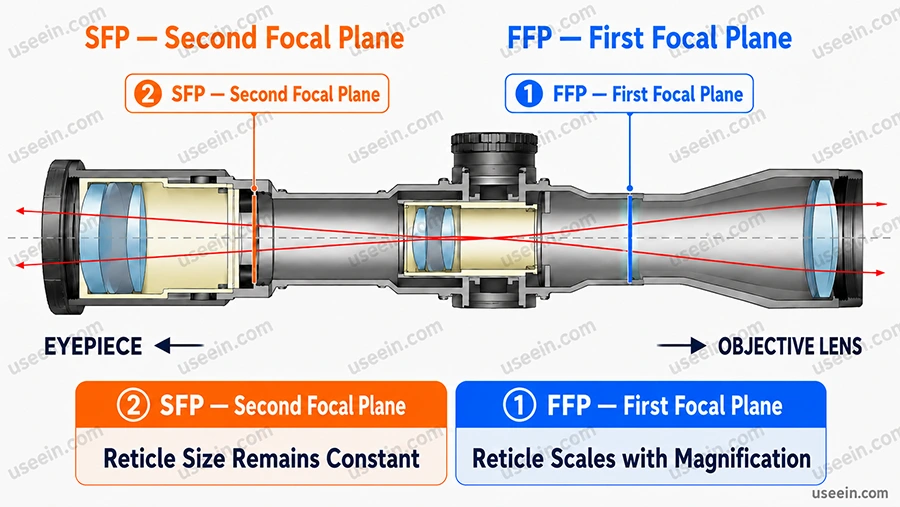 The reticle position determines whether it scales with the magnified target image.
Inside a variable-power scope, the reticle can be placed in one of two positions relative to the magnifying lens system.
- FFP — first focal plane: the reticle is positioned so that it is magnified along with the target image.
- SFP — second focal plane: the reticle is positioned after the magnifying system, so its apparent size stays constant as magnification changes.
You do not need to picture every lens element to understand the practical result. In an FFP scope, the target and reticle remain in the same visual proportion. In an SFP scope, the target changes size behind a reticle that looks unchanged.
What you see when magnification changes
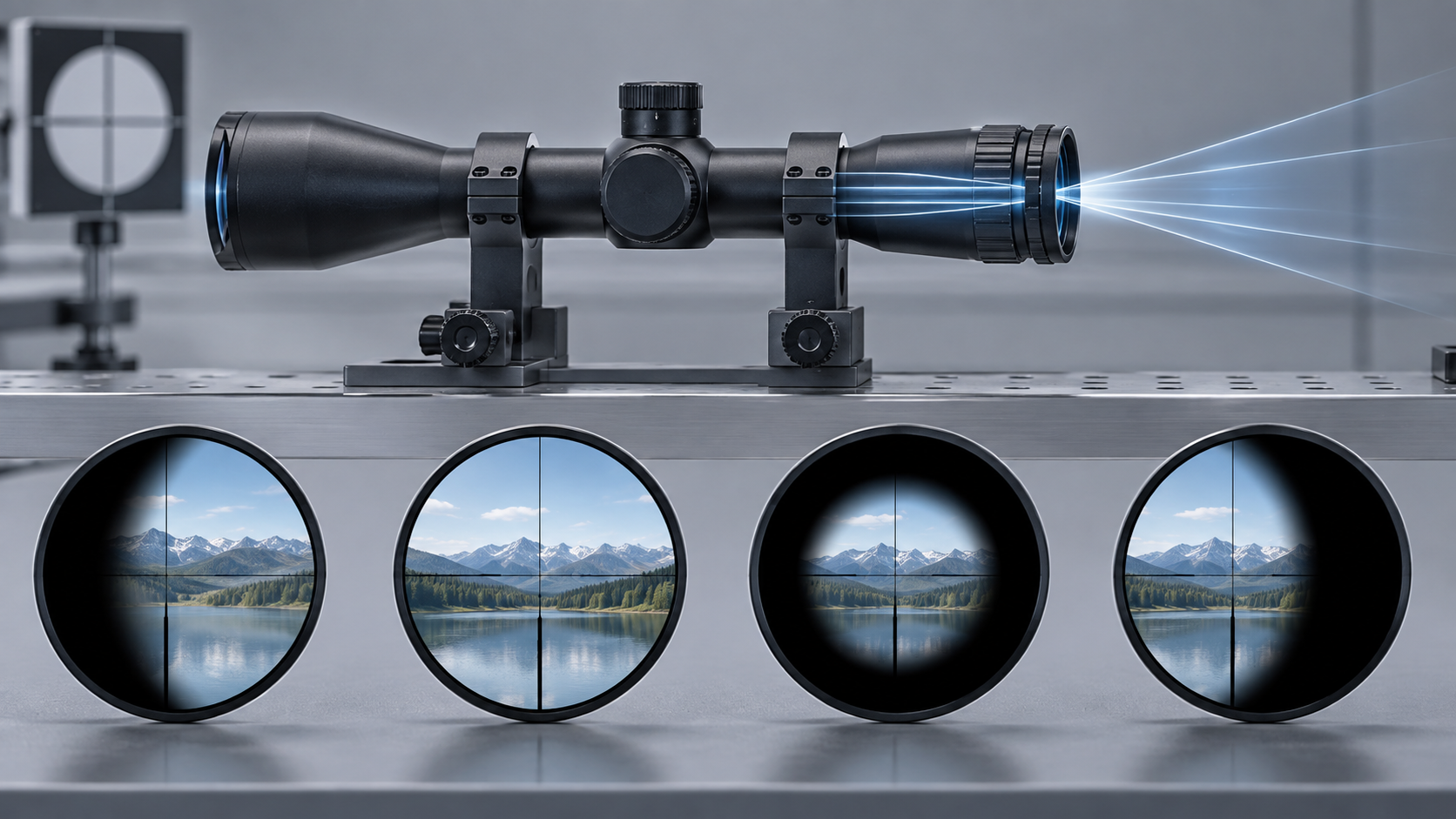
At low power, an FFP reticle looks relatively fine. Increase the magnification and its lines, numbers and holdover marks appear larger along with the target. The reticle has not physically changed; you are magnifying the image plane that contains it.
An SFP reticle behaves differently. The target becomes larger as you increase magnification, but the reticle keeps the same apparent thickness. That can make a simple aiming point easy to see throughout the magnification range.
This is also why judging an FFP reticle from a single product photo can be misleading. Its visibility at minimum power and its appearance at maximum power are both important.
Why FFP reticle markings work across the magnification range
Many reticles include MIL or MOA marks for holding over elevation, correcting for wind or estimating distance. Those marks represent an angular relationship.
In an FFP design, the reticle scales with the target, so that angular relationship stays consistent as magnification changes. A one-MIL space remains one MIL at low, middle and high power, assuming the reticle itself is correctly designed and the scope is functioning as intended.
That is the main practical advantage of FFP. If you regularly use reticle holds at different magnifications, you do not have to remember a special power setting or recalculate the value of every mark.
It is still worth confirming any important hold on the range. Reticle layout, turret units and the data you use all need to agree. Our guide to the three controls on a rifle scope is a useful starting point if elevation, windage and side focus are still unfamiliar.
When are SFP markings accurate?
With an SFP scope, the reticle does not scale while the target image does. This means calibrated holdover or ranging marks are normally correct at one specified magnification. On many scopes that is maximum power, but you should check the reticle manual rather than assume.
At other magnifications, the central aiming point still works normally. What changes is the angular value represented by the additional marks. A hunter or range shooter who uses the center crosshair and adjusts the turrets may barely notice this limitation. Someone who regularly holds for elevation at several power settings will need to account for it.
This distinction is often oversimplified. An SFP scope is not “inaccurate” away from its calibrated power. The point of aim remains the point of aim; it is the measurement value of the surrounding reticle marks that changes.
The low-power visibility tradeoff
FFP reticles have to cover a wide visual range. A design that is bold and easy to see at minimum power may become quite heavy at maximum power. A design that looks beautifully fine at high power may be difficult to pick up quickly at the low end.
Good reticle design balances those two conditions. Illumination can help, especially when a fine central feature is used at low magnification, but brightness does not replace a sensible line weight and layout.
SFP reticles avoid that particular scaling problem because their apparent thickness remains constant. For a straightforward duplex reticle or a scope that will often be used around one familiar magnification, that consistent sight picture can be an advantage rather than a compromise.
Which one is easier for a beginner?
SFP often feels more immediately familiar. The crosshair looks the same every time the magnification ring moves, and a simple center hold requires very little explanation. If you do not plan to use the reticle as a measuring tool, there may be no practical reason to pay for a more complex design.
FFP makes more sense when learning to use MIL or MOA holds is part of the plan. The scaling reticle can remove one source of mental arithmetic because the marks retain their intended values across the magnification range.
Neither option eliminates the need for a proper setup. Eye position, diopter focus and parallax still affect what you see. If the reticle itself looks blurry, start with the diopter adjustment guide. If the reticle seems to move across the target as your eye shifts, read our explanation of fixed and adjustable parallax.
A practical way to choose
Before comparing labels, think through how you expect to use the scope.
Choose an FFP design when you expect to:
- use reticle holds at several magnification settings;
- range or measure with the reticle;
- move between close and distant targets without returning to one calibrated power; or
- learn a consistent MIL- or MOA-based workflow.
Choose an SFP design when you prefer to:
- keep the reticle visually consistent at every power;
- aim mainly with the center of the reticle;
- dial corrections instead of using complex holds; or
- use the scope at one familiar magnification for most precision work.
Magnification range matters as well. A reticle that works comfortably in a 3–9x scope may face a different design challenge in a much broader zoom range. If you are still deciding how much power you actually need, our beginner's guide to scope magnification can help narrow the choice before focal plane becomes the deciding factor.
Common misconceptions
“FFP is always more accurate”
Focal plane placement does not guarantee mechanical accuracy, tracking quality or optical quality. FFP mainly determines how the reticle relates to the target image as magnification changes.
“SFP is only for cheap scopes”
SFP is a deliberate optical design used across many types of scopes. A stable-looking reticle can be exactly what a user wants.
“An FFP reticle changes the scope's magnification”
The magnification system changes the apparent size of both the target and an FFP reticle. The reticle does not create extra magnification.
“Every SFP reticle is calibrated at maximum power”
Maximum power is common, but not universal. The correct setting comes from the reticle documentation supplied for that scope.
The short answer
FFP keeps the reticle's measurements consistent relative to the target as magnification changes. SFP keeps the reticle's apparent size consistent to your eye.
If you use holdovers, wind holds or ranging marks at different powers, FFP is usually the more convenient system. If you value a steady, easy-to-see reticle and normally use the center aiming point or one known magnification, SFP may be the more natural fit.
The best choice is the one whose behavior matches your routine. Look through both at minimum and maximum power if you can, pay attention to reticle visibility, and choose the system you can use without stopping to think about it.
Related buying guide
See a concise visual comparison of how first and second focal plane reticles behave as magnification changes.
READ THE GUIDE →





Leave a comment