

FFP and SFP describe where the reticle sits inside a variable-power scope. The difference changes how the reticle appears as magnification changes and when its measurement marks are valid.
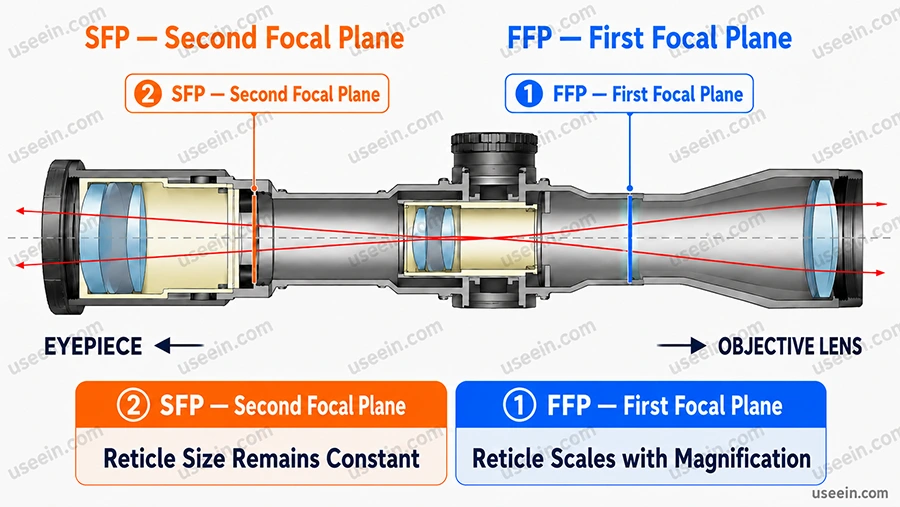
FFP reticles scale with magnification, while SFP reticles remain visually constant.
First focal plane (FFP)
In an FFP scope, the reticle grows and shrinks with the target image. Because both scale together, holdover and ranging references remain consistent throughout the magnification range.

FFP: the reticle changes apparent size together with magnification.
FFP advantages
- Reticle references remain valid at different magnifications.
- Useful for precision work and structured reticles.
- Supports changing magnification without changing reference values.
FFP considerations
- The reticle may look very fine at low power.
- A complex reticle can feel busy at maximum power.
- Good illumination and thoughtful reticle design matter.
Second focal plane (SFP)
In an SFP scope, the reticle appears the same size while the target image changes. The sight picture remains visually consistent, but measurement marks are normally calibrated for one stated magnification.

SFP: the reticle maintains the same apparent size while magnification changes.
SFP advantages
- Consistent reticle visibility across the zoom range.
- Simple, familiar sight picture.
- Practical for general use and straightforward aiming.
SFP considerations
- Holdover values change with magnification.
- You must know the calibrated magnification before using reticle measurements.
Which should you choose?
Choose FFP when using reticle references at different magnifications is important. Choose SFP when a stable, uncomplicated sight picture is the higher priority. Focal plane alone does not determine optical quality, so compare clarity, eye box, illumination and adjustment consistency together.
Browse our Sporting Optics to compare current FFP and SFP options.