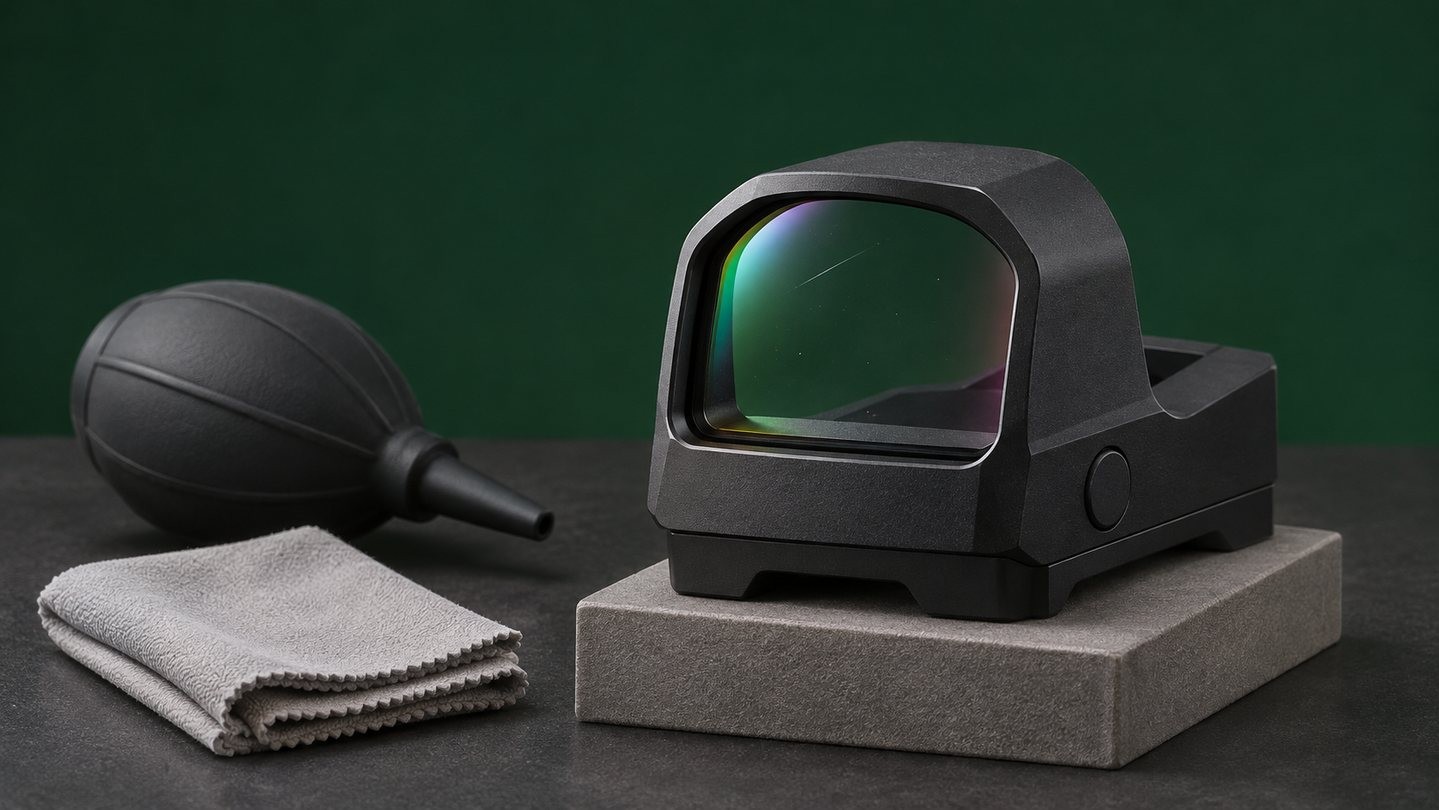
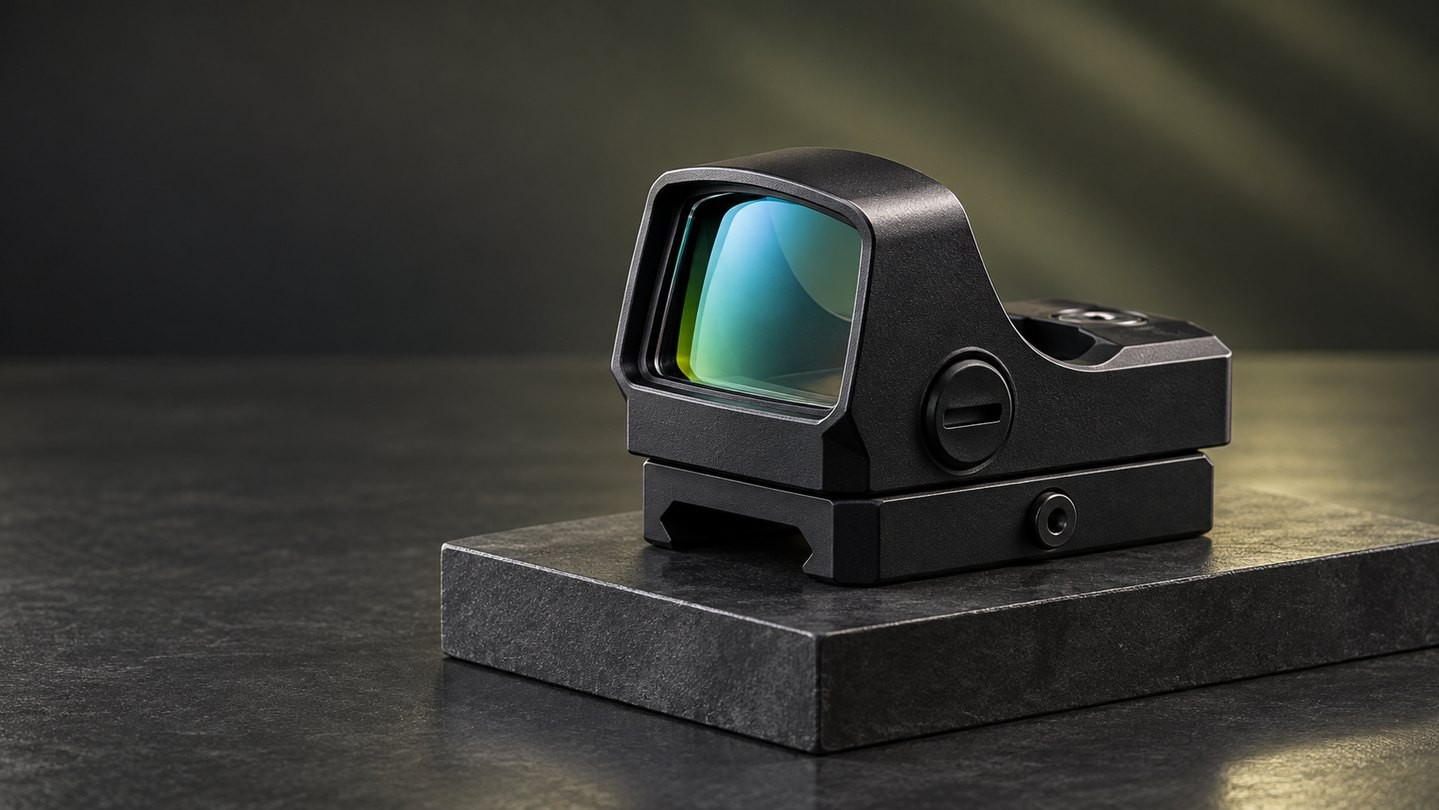
Look at an open red dot sight from the side and the front lens may seem crooked. One edge can sit farther forward than the other, and the blue, green or amber reflection can make the angle look even more obvious. On a conventional reflex sight, that appearance is usually intentional.
The short explanation is that the sight needs to send light from its internal LED back toward your eye. The front lens is positioned and coated to do that job while still allowing you to see the scene beyond it. A tilted lens is therefore not automatically loose, bent or installed incorrectly.
That does not mean every uneven-looking window should be ignored. The useful distinction is between a consistent factory-designed angle and signs of physical movement or damage.
The Lens Is Part of the Reticle's Light Path
A reflex red dot does not paint a visible dot on the target. Inside the sight, an LED produces light at a selected wavelength. The coated front lens reflects that light toward the viewing side, where your eye sees it as an aiming reference apparently placed over the scene.
Holosun's official support material describes the canted objective as part of a reflective sight's design. Its model manuals also show the LED, the angled lens and the reflected path to the user's eye. The exact internal layout varies, but the basic relationship is the same: the emitter and reflective surface must be positioned so the intended light reaches the observer.
This is why the apparent tilt is easier to understand as optical alignment rather than cosmetic alignment. The lens is not trying to look square to the housing from every viewing angle. It is serving the internal light path.
Why the Direction of the Tilt Can Vary
One model may appear to lean back. Another may look slightly higher on one side. That difference can be normal because the LED is not placed in the same location in every sight.
Holosun notes that lens orientation can change with emitter position. If the LED sits near the base, the lens may cant toward it. A different internal package can require a different direction. Open and enclosed housings also arrange the emitter, window and protective structure differently.
The angle should therefore be judged against the exact model, not against a different sight on the same counter. Housing style is a separate buying decision; our guide to open and enclosed red dots explains what the enclosure changes.
The Coating Can Make the Angle Look Stronger
The front window has to transmit the outside scene while reflecting enough of the emitter's light to create a usable reticle. Manufacturers use optical coatings to manage that balance. Aimpoint, for example, lists anti-reflection coatings and a multilayer objective coating in its official optical specifications, while Holosun describes a coating that helps the objective act as a reflector for the LED wavelength.
Thin-film optical coatings do not behave like plain untinted glass. Their visible color can change with viewing angle and lighting. Under a ceiling light, the window may flash blue or green; from the normal viewing position, the tint may look milder. That color is not proof that the lens is defective, nor does a stronger color automatically mean better optical quality.
If reflections are distracting, compare the sight in its normal orientation rather than rotating it under every available lamp. Excessive glare deserves its own inspection, but a colored reflection at an unusual angle can be a normal result of the coating.
A Tilted Lens Does Not Mean the Dot Is Projected Forward
The reflected dot is intended for the viewer. It is not a laser spot placed on the object in front of the sight. Someone standing downrange does not see the same aiming dot floating on the target.
This distinction also explains why photographing a red dot can be tricky. A phone camera may sit above, below or to the side of the optical path your eye normally uses. Exposure, focus and sensor behavior can make the coating, emitter reflection or dot look different from the view you see directly.
Use photographs to document damage or a repeatable problem, not as the only test of normal optical appearance.
Lens Angle and Parallax Are Different Questions
The canted lens helps establish the reflected light path, but its visible angle alone does not tell you how much parallax error a sight will show. Parallax behavior depends on the complete optical design and the distance at which the system is optimized.
Claims such as "parallax free" should therefore be read with care. A dot can appear to move relative to the target when the viewing position changes, especially at short distance, even when the front window looks perfectly normal. Our guide to red dot parallax covers how to test that behavior without confusing it with lens alignment.
The same separation applies to dot shape. A canted objective is not, by itself, the reason a reticle looks stretched or star-shaped. Brightness, contamination, eyesight and camera behavior are more useful first checks. See the red dot starburst troubleshooting guide for that process.
When Should the Lens Actually Concern You?
A regular, model-consistent angle with a stable reticle is usually normal. Investigate further when the issue involves change, movement or visible damage rather than angle alone.
Check for:
- a lens that shifts or rattles when the optic is handled normally;
- a seal, gasket or retaining feature that has lifted out of place;
- a new crack, chip or spreading internal haze;
- a reticle that disappears through part of the normal viewing area;
- a sudden zero shift or control problem after an impact;
- water or debris inside a sealed optical compartment;
- a window that no longer resembles verified images or documentation for the exact model.
Do not press on the glass or disassemble the housing to make the lens look straighter. Internal parts may be aligned, sealed and treated at the factory. Opening the sight can create a problem that was not there before and may affect warranty coverage.
A Better Inspection Before Requesting a Return
Start with the manual for the exact model. Look for an objective-lens diagram, a support note about a canted window or a clear product photograph taken from a comparable angle. Then inspect the sight without trying to alter it.
- Confirm that the reticle turns on and responds to its controls.
- Set a moderate brightness level suited to the room or outdoor light.
- Look through the sight from a normal viewing position and focus on the scene, not on the glass surface.
- Move your eye within the usable window and check whether the reticle remains available.
- Inspect the lens edge, seal and housing for impact marks or displacement.
- Compare the result with the maker's instructions for that exact model.
If the reticle seems to vanish only at the lowest settings, check whether those levels are intended for night-vision equipment before assuming failure. The night-vision-compatible red dot guide explains why some settings can be invisible to the unaided eye.
What Matters More Than Whether the Lens Looks Square?
Once the angle is confirmed as part of the design, compare the sight on factors that affect fit and use:
- mounting footprint and required plate or adapter;
- open or enclosed emitter protection;
- window size and housing obstruction;
- reticle pattern and dot size;
- manual or automatic brightness behavior;
- battery type, access and published runtime conditions;
- optical-centerline height and magnifier compatibility;
- dimensions, weight, environmental rating and support.
Selectable patterns deserve model-specific checking. "Multi-reticle" does not guarantee the same choices or memory behavior across different products; the red dot reticle modes guide explains what to verify.
The Practical Takeaway
A front lens that looks tilted is normally doing optical work. Its angle helps the coated surface return LED light toward the user so the reticle appears in the viewing window. The direction can vary with the emitter's location and the complete design.
Treat a consistent factory angle as a design feature, not a defect. Look for movement, damage, seal failure or unstable operation before escalating the issue. When comparing a new sight, use the exact model manual and evaluate the whole system rather than demanding a window that appears perfectly square from every angle. After those checks, you can browse Red Dot Sights with a clearer idea of which specifications actually matter.


Leave a comment