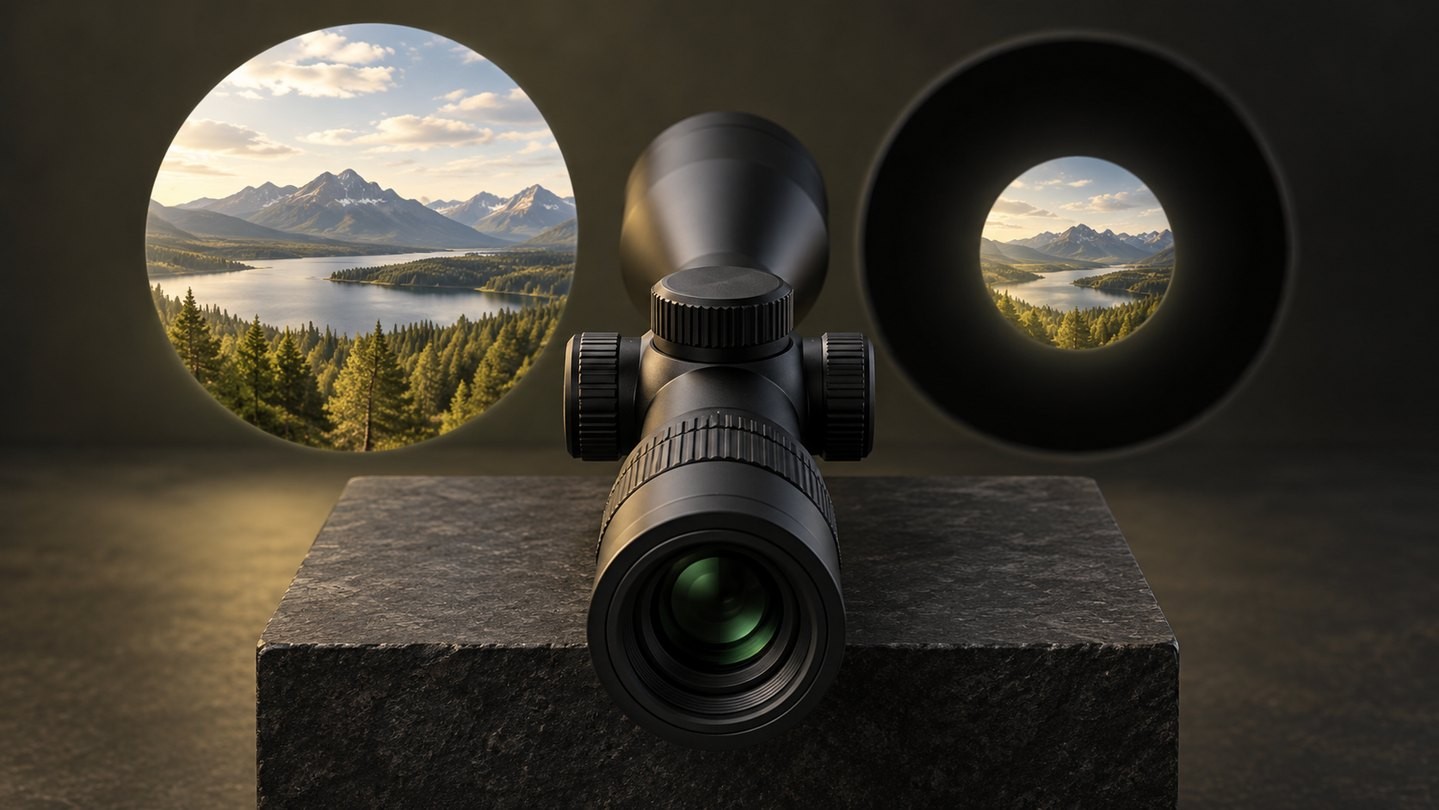
Set a variable scope near its lowest magnification and the view may still feel as if it sits at the end of a short tube. A dark border remains visible around the image, and the scene does not seem as open as the magnification number suggests. This impression is often called tunnel effect or tunnel vision.
The name is useful, but the diagnosis is easy to get wrong. A genuinely narrow apparent view, incorrect eye relief and an unforgiving eyebox can all produce a dark-looking boundary. They are related viewing problems, not interchangeable terms.
What does tunnel effect mean in a rifle scope?
In general optical use, ZEISS describes tunnel vision as the impression created when a very small field of view leaves a large amount of black around a small central image. In a rifle scope, users usually apply the term to a similar subjective effect: the visible image circle appears noticeably smaller than the eyepiece housing, so the view feels recessed rather than open.
This is not the same as seeing a moving black crescent because your eye is off-centre. A scope can be correctly positioned and still have a somewhat constricted apparent view at a particular magnification. Conversely, a wide-field scope can show a heavy black ring when your eye is too close or too far away.
Field of view is the first specification to check
Field of view tells you how much of the scene is visible without moving the optic. For rifle scopes, manufacturers commonly publish it as feet at 100 yards or metres at 100 metres.
Lower magnification generally provides a wider field of view, but magnification alone does not determine the result. Eyepiece design, the zoom system, internal apertures and the permitted image angle also matter. ZEISS notes that field of view cannot be inferred from the product designation alone; it is determined by the optical design.
That means two scopes marked 1–6×24 can present different views at 1×. One may show a broad image that seems close to the eyepiece, while another may show more housing and a smaller-looking image circle. Compare the manufacturers' published field-of-view specifications at the same magnification and distance.
Apparent field of view changes how open the image feels
The linear field of view describes the width of the scene at a stated distance. The apparent field of view describes how large that scene looks to your eye through the eyepiece.
This distinction helps explain why two scopes with similar published linear fields can still feel different. Eyepiece geometry and the visible edge of the image can make one view appear more immersive. Marketing terms such as “wide angle” are not a substitute for comparable specifications or an actual viewing test.
If a retailer lists only magnification and objective diameter, there is not enough information to predict the tunnel effect reliably.
Do not confuse tunnel effect with incorrect eye relief
Leupold's riflescope troubleshooting guidance explains that a black ring can appear when the observer is too close to or too far from the scope's optimum eye-relief distance. Moving the optic—or your head—until the full field becomes visible can correct that problem.
Use this simple distinction:
- The black border changes strongly as your head moves forward or backward: check eye relief and mounting position first.
- A crescent appears mainly on one side: your eye is probably off the optical axis.
- The complete image remains centred but still looks small or recessed: the optical presentation may be producing a genuine tunnel-like impression.
Our guide to black rings, eye relief and scope shadow explains the mounting and head-position symptoms in more detail.
Tunnel effect and eyebox are not the same
The eyebox is the three-dimensional region in which your eye can move while retaining a usable full image. A forgiving eyebox helps you acquire the view without placing your head at one exact point.
Tunnel effect concerns how large and open the correctly acquired image appears. Eyebox concerns how much movement the optic tolerates before that image becomes clipped or shadowed.
A scope may therefore have:
- a wide-looking image but a position-sensitive eyebox;
- a more recessed-looking image that remains easy to hold;
- both a wide view and forgiving eye placement;
- both a narrow-looking view and demanding eye placement.
Do not use one impression as proof of the other.
Why can the effect appear near minimum magnification?
Variable optics change magnification by moving elements in the internal zoom system. The usable field and apparent image size can change non-linearly across that movement. Some designs look most constricted at the very bottom of the range and then open slightly after the power ring is increased.
This is one reason the lowest printed number should not be treated as a complete description of low-power performance. A scope labelled 1× can still differ in image scale, distortion, field of view and viewing tolerance. Our guide to what “true 1×” means covers those separate checks.
The effect is also not proof that the objective lens is too small. Objective diameter affects light gathering and exit pupil, but the open or tunnel-like character of the view is primarily connected to field angles and the complete eyepiece and zoom design.
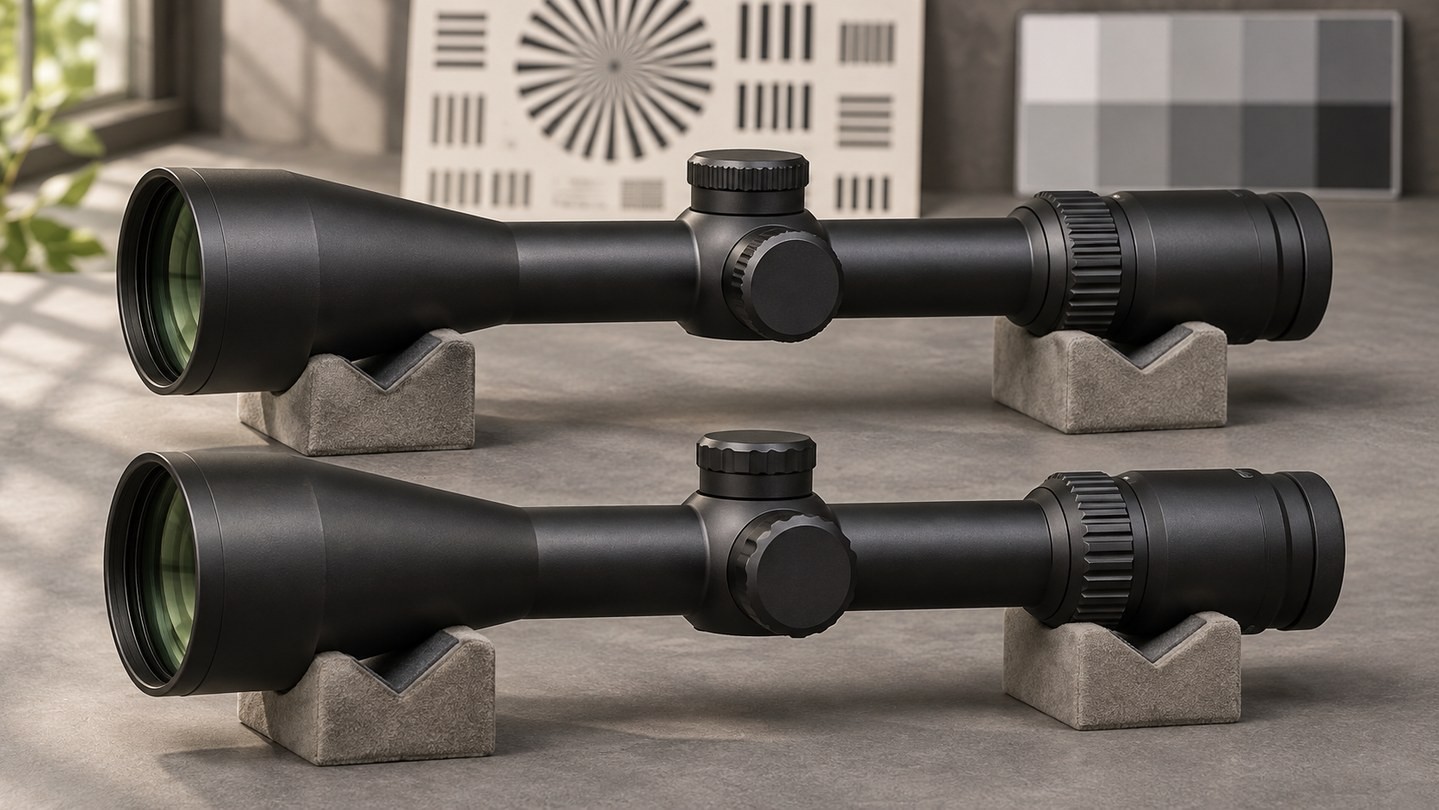
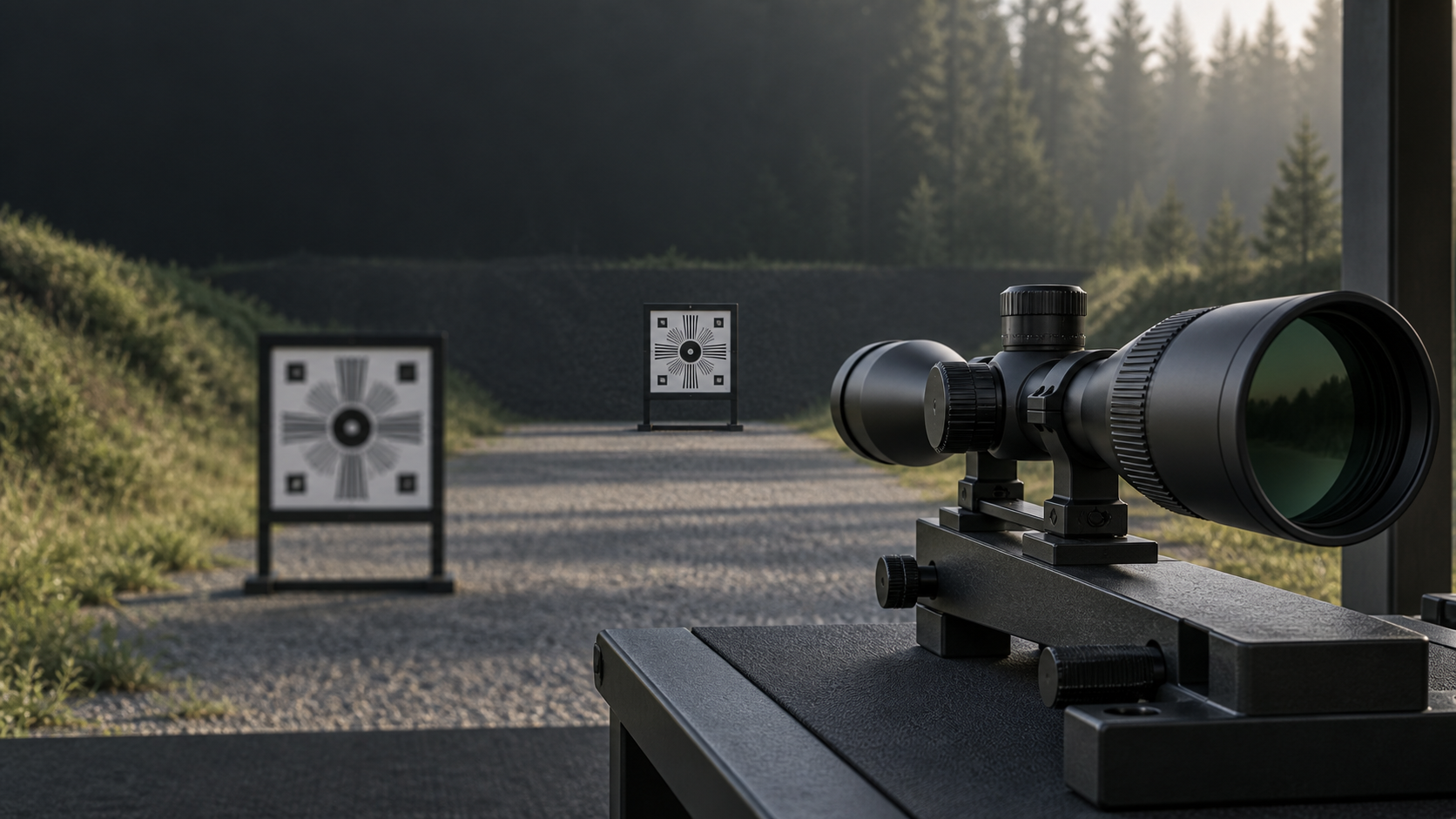
A practical comparison test
Compare scopes under the same conditions rather than relying on memory:
- Set both optics to the same stated magnification.
- Place each one securely on an inert support; do not conduct the comparison while handling a loaded firearm.
- Use the correct eye-relief distance and centre your eye behind the eyepiece.
- Look at a broad scene with recognisable objects near the left and right edges.
- Note how much of the eyepiece appears as black border after the full image is acquired.
- Move the magnification ring slightly above minimum and see whether the apparent image opens or contracts.
- Move your eye modestly forward, backward and sideways to evaluate eyebox separately.
Avoid comparing one scope at 1× and another at 1.5×. Also avoid judging through a phone camera unless the camera position is fixed carefully; small alignment errors can create vignetting that is not representative of the view seen by the eye.
What tunnel effect cannot tell you
A tunnel-like view does not by itself measure:
- resolution or fine-detail performance;
- light transmission or low-light contrast;
- reticle accuracy or focal-plane behaviour;
- tracking, adjustment repeatability or durability;
- distortion at the centre or edges;
- the size of the usable eyebox;
- whether the mounting position suits the observer.
It is one part of the viewing experience. A wider view can be helpful for situational awareness and rapid visual acquisition, but it does not automatically make every other optical property better.
Practical buying takeaway
When low-power use matters, compare more than the number printed on the magnification ring. Check the published field of view at minimum power, establish correct eye relief, test the eyebox and observe how large the centred image appears.
If the dark border disappears after correcting head position, the issue was probably eye relief or alignment rather than optical tunnel effect. If the full image remains centred yet still looks recessed, compare the design with another scope at the same magnification. That side-by-side test is more informative than treating “1×” or a large objective as a guarantee of an open view.
Continue learning
Compare related viewing characteristics in Optics Field Notes.


Leave a comment