Open a reticle manual and you may see a drawing covered with letters, arrows and values such as 0.2 MIL, 1 MOA or 0.05 MOA. It can look like an engineering diagram for something far more complicated than a crosshair.
The idea behind it is actually simple. Reticle subtension describes how much of the target is covered by, or lies between, a feature in the reticle. Once you understand that one sentence, the rest of the diagram becomes much easier to read.
What does reticle subtension mean?
A reticle is more than its general shape. Its center dot has a diameter. Its lines have thickness. The gap between two hash marks has a size. An open center, circle or lower grid also occupies a measurable part of the view.
Subtension gives those features a value. That value is normally expressed as an angle—most often minutes of angle (MOA) or milliradians (MIL/MRAD)—rather than as a fixed number of inches or centimetres.
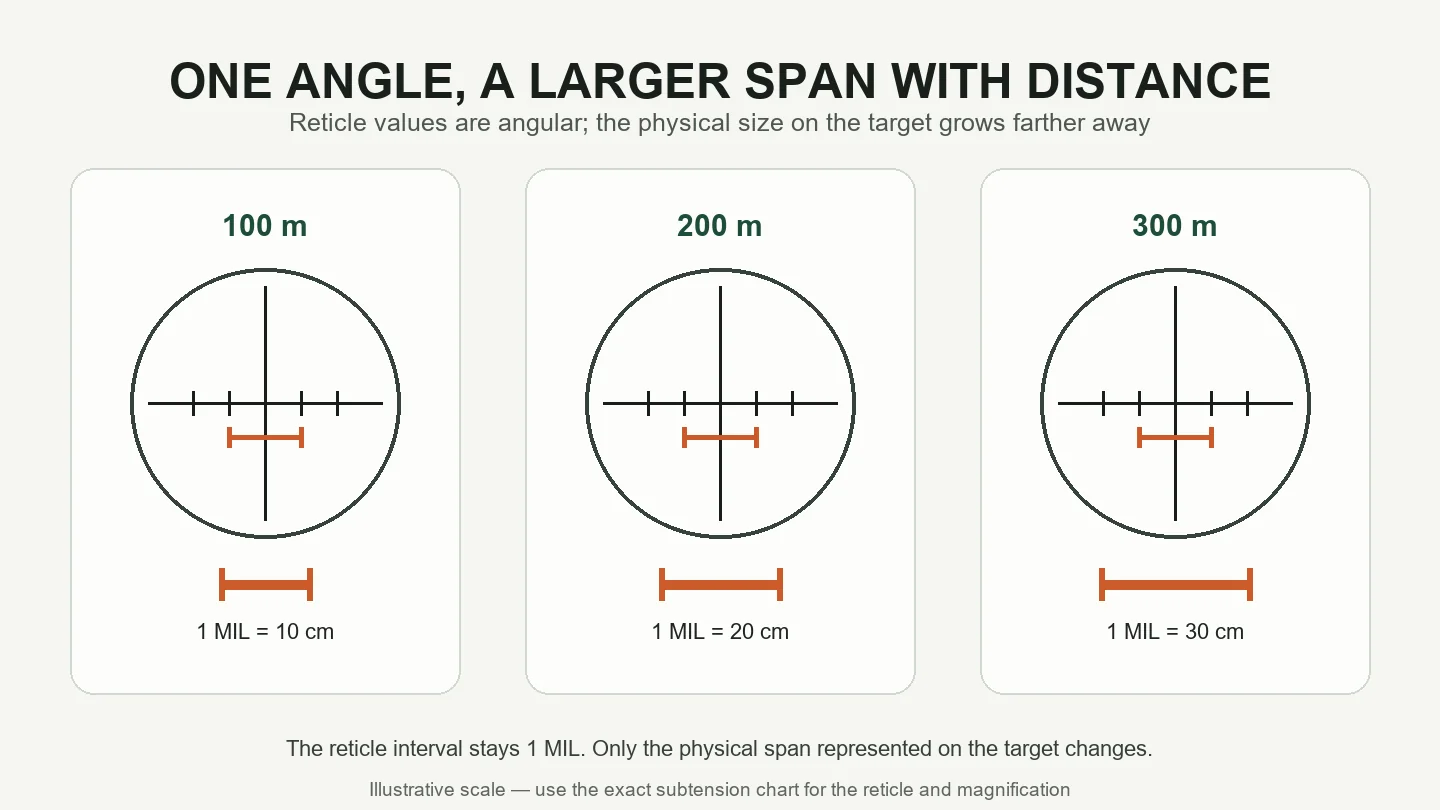
This distinction matters. A 1 MIL space is not always 10 centimetres wide, and a 1 MOA mark is not always about one inch wide. Those physical dimensions are true only at a stated distance. The angular value stays the same while the span on the target grows as distance increases.
If MOA and MIL are still unfamiliar, start with our MOA vs MRAD guide. Neither unit is automatically more precise; the useful choice is normally the one that matches the reticle, turrets and measurements you prefer to use.
The same angle covers more target at a longer distance
Imagine two straight lines leaving your eye with a small angle between them. Close to you, the gap between the lines is narrow. Farther away, the gap is wider. Reticle subtension works the same way.
Useful reference values are:
- 1 MIL spans 10 centimetres at 100 metres, 20 centimetres at 200 metres and 30 centimetres at 300 metres.
- 1 MOA spans about 1.047 inches at 100 yards, 2.094 inches at 200 yards and 3.141 inches at 300 yards.
The common “one inch at 100 yards” description for MOA is a practical shortcut, not the exact value. For ordinary comparisons the shortcut may be close enough, but a reticle drawing or precise calculation should use the stated angular value.
Now reduce the mark size. A 0.2 MIL hash interval spans 6 centimetres at 300 metres. A 0.5 MOA center feature spans about 1.047 inches at 200 yards. The numbers do not tell you whether a reticle is good or bad; they tell you how much detail the feature occupies at a particular distance.
Spacing and line thickness are different measurements
Two reticles can both have 1 MIL hash marks and still look very different.
One may use thin 0.05 MIL lines with a small floating center dot. Another may use heavier lines and a bold center cross. The distance between the marks can be identical while the amount of target hidden by the lines is not.
When reading a subtension drawing, look for at least four separate details:
- Hash spacing: the angular distance from one reference mark to the next.
- Line thickness: how much of the target the crosshair itself covers.
- Center feature: the diameter of a dot, the width of a cross or the size of an open center.
- Overall layout: how far the numbered scale or lower grid extends from the center.
A very fine center can help when aiming at a small, well-lit detail, but finer is not always easier. A line that looks excellent at high magnification may be hard to pick up quickly at the low end, especially against a dark or busy background. Reticle visibility and reticle measurement are related, but they are not the same question.
For a broader overview of duplex, dot, BDC and grid designs, read our rifle scope reticle types guide.
Why focal plane and magnification change the answer
Reticle subtension cannot be separated from focal-plane design.
In a first focal plane (FFP) scope, the reticle appears to grow and shrink with the magnified target image. The reticle and target remain in the same visual proportion, so a correctly designed 1 MIL or 1 MOA interval keeps that angular value throughout the magnification range.
In a second focal plane (SFP) scope, the reticle appears to stay the same size while the target image changes. Off-center measuring marks therefore have their stated subtension at one specified magnification. That setting is often maximum power, but not always. The correct value comes from the manual or subtension chart for that exact scope and reticle.
This does not mean an SFP scope suddenly stops aiming correctly at other magnifications. The center aiming point remains the center. What changes is the angular value represented by the marks around it.
Our FFP vs SFP guide explains the visual difference in more detail. The short rule is simple: use FFP marks at different powers only when the reticle is designed and specified to do so; with SFP, confirm the calibrated magnification instead of guessing.
How to read a subtension drawing
A manufacturer diagram normally assigns letters to reticle features and provides a table of values. Read it in a deliberate order.
Start at the center
Identify whether the center is a dot, cross, open space or illuminated feature. Check whether the number describes its diameter, width or distance from another point. A circle marked “0.5 MIL” may describe its outside diameter, while a nearby value may describe the line thickness. The arrows on the drawing matter.
Follow one axis at a time
Read the vertical and horizontal scales separately. Their spacing may be the same, but some reticles use different patterns or labels on each axis. Do not assume every short mark equals the same value without checking the legend.
Separate repeated intervals from totals
A label beside one gap usually describes that single interval. A value shown from the center to the end of a grid may describe the total angular span. Confusing the two can multiply an error several times.
Check the exact model and magnification note
The same reticle name may be offered in more than one scope model, and fine dimensions can differ. Use the chart that names the exact reticle and optic. If the drawing says the values apply at a specified magnification, treat that note as part of the measurement—not as optional fine print.
What subtension does not tell you
A detailed chart is useful, but it is not a complete quality rating.
Subtension does not tell you how well the scope tracks, how clear the glass is, whether the reticle is easy to see at dusk, or whether the available magnification and field of view fit your normal use. It also does not turn a BDC mark into a universal distance label.
A BDC reticle combines angular marks with an assumed trajectory. Ammunition, velocity, zero distance and environmental conditions can change where those references correspond in the real world. Our BDC reticle guide explains why the marks still need to be checked rather than treated as automatic yardage numbers.
Common subtension mistakes
Treating an angular value as a fixed length
“One MIL equals 10 centimetres” is incomplete. It equals 10 centimetres at 100 metres. Double the distance and the physical span doubles.
Assuming every short hash is the same
Reticles may use alternating full, half or finer divisions. Numbered marks are not always adjacent marks. Read the drawing rather than judging by appearance alone.
Ignoring SFP calibration power
If an SFP reticle is specified at one magnification, changing power changes what its off-center marks represent. Check the manual before using those marks as measurements.
Mixing reticle and turret units
A MIL reticle with MOA turrets can work, but corrections require conversion. A matched MIL/MIL or MOA/MOA system is usually easier to read and communicate.
Choosing the finest reticle on paper
A tiny dot or hairline crosshair may cover less target, yet become difficult to see at low power or in poor contrast. Compare minimum- and maximum-power visibility, not just the smallest number in the chart.
What should a beginner check before buying?
You do not need to memorize every number. Ask five practical questions:
- Does the manufacturer provide a clear subtension diagram for the exact reticle?
- Are the marks in MOA or MIL, and do the turrets use the same unit?
- Is the reticle FFP or SFP?
- If it is SFP, at which magnification are the marked values correct?
- Will the center and main references remain visible at the magnifications and lighting conditions you actually use?
If those answers are clear, the complicated-looking chart has done its job. It lets you understand what the reticle is showing instead of relying on names such as “precision,” “tactical” or “long range.”
The plain-language takeaway
Reticle subtension is simply the angular size of a reticle feature or the angular space between features. The angle stays consistent under the conditions specified for that reticle, while the physical area it covers grows with distance.
Read spacing, line thickness and center size as separate values. Confirm whether the reticle is FFP or SFP. Match the chart to the exact scope and magnification. Most importantly, choose a reticle you can actually see and understand—not merely the one with the densest specification sheet.
For more category-level comparisons, browse Sporting Optics or continue with the USEEIN Buying Guides.



Leave a comment