A reticle can look almost empty or surprisingly busy. One scope gives you a thin crosshair and little else. Another adds a bright centre dot. A third fills the lower half of the view with numbered marks and a branching grid.
It is tempting to treat those patterns as a ladder: simple at the bottom, advanced at the top. That is the wrong way to look at them. A reticle is a user interface inside the optic. The best one is the design that gives you the information you need without making the sight picture harder to use.
There is another complication. Reticle names are not a universal classification system. “MOA,” for example, describes an angular unit, while “duplex” describes a visual layout. A duplex-style reticle can also be illuminated, and a BDC reticle may use dots, lines or a tree-like pattern. The categories overlap.
So instead of memorising every trade name, it is more useful to understand the main design families.
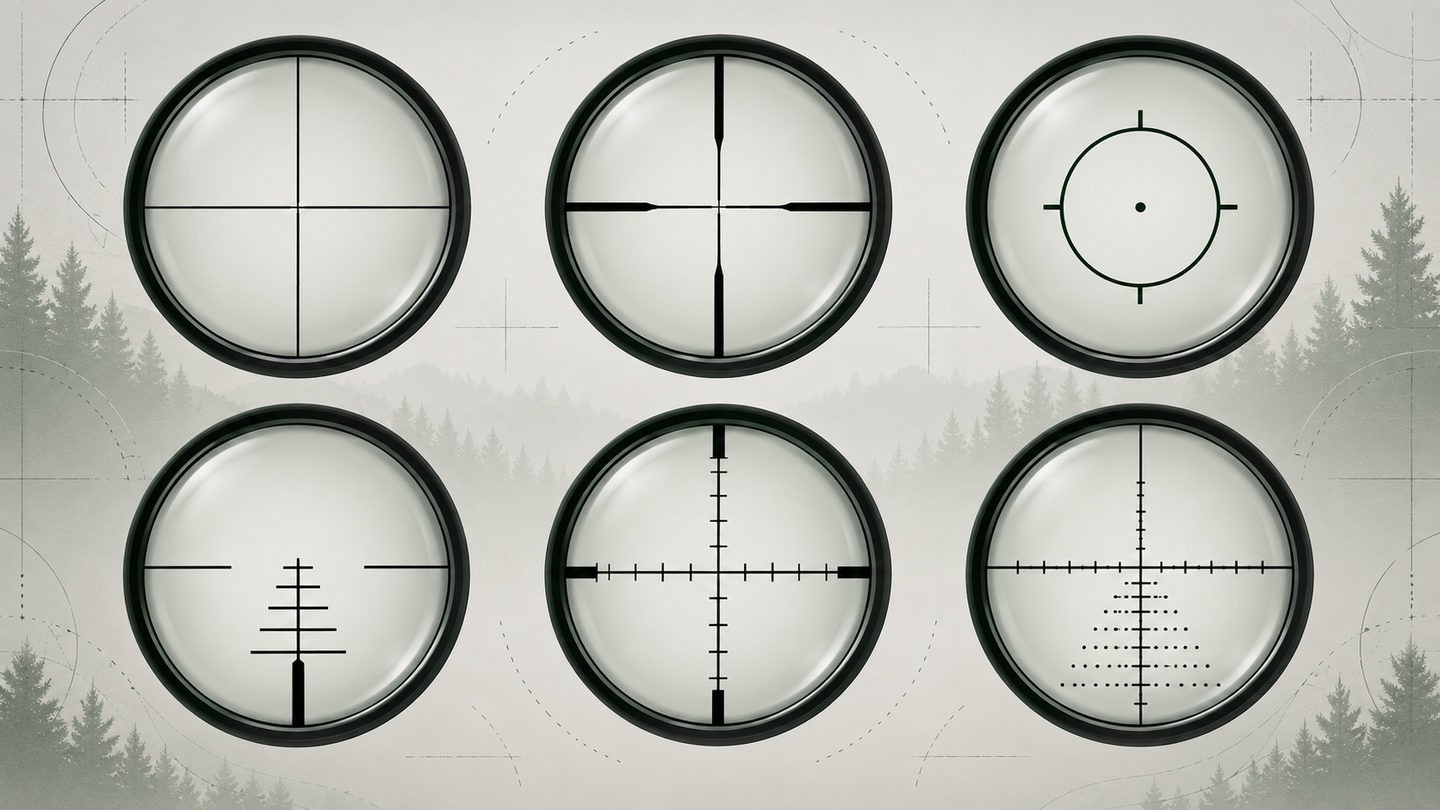
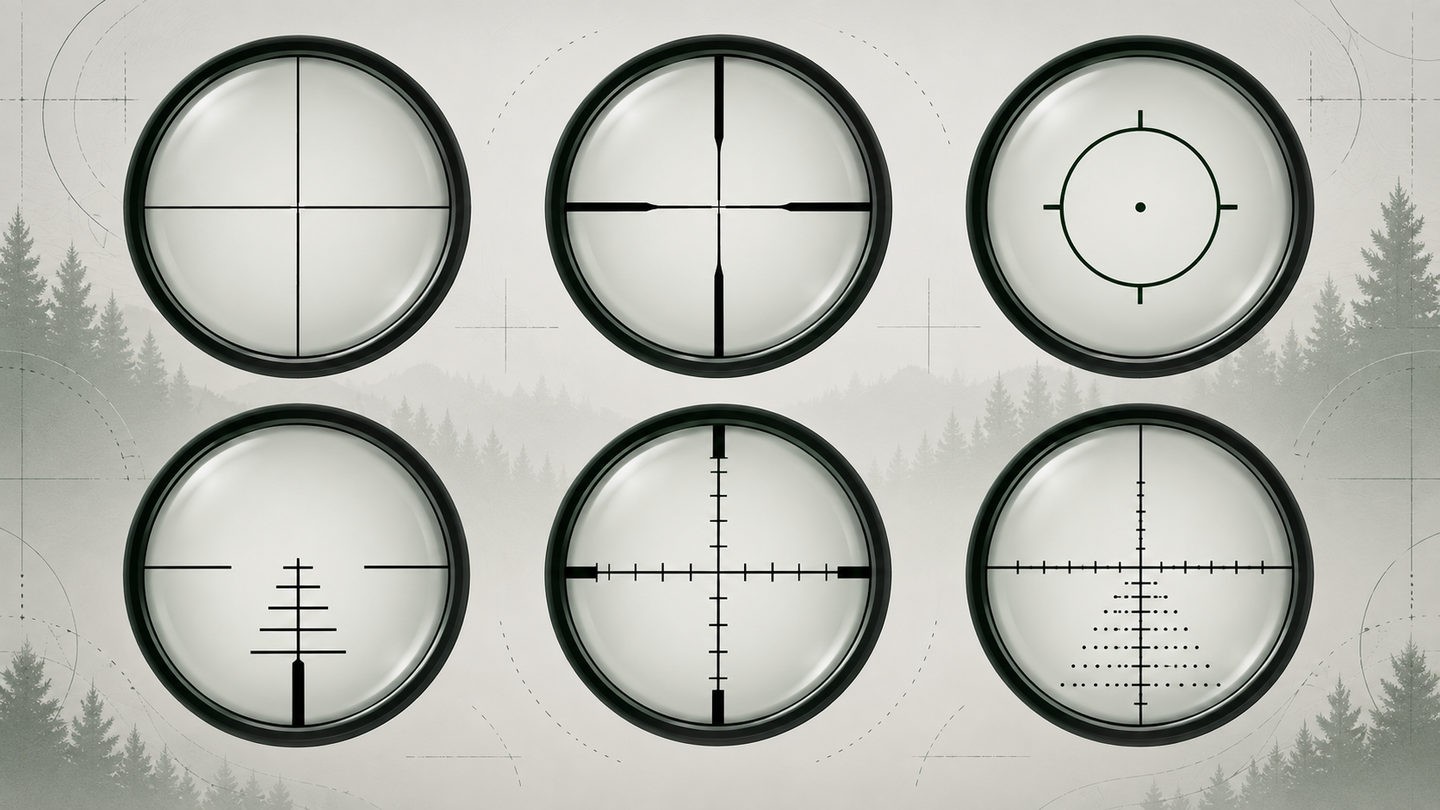
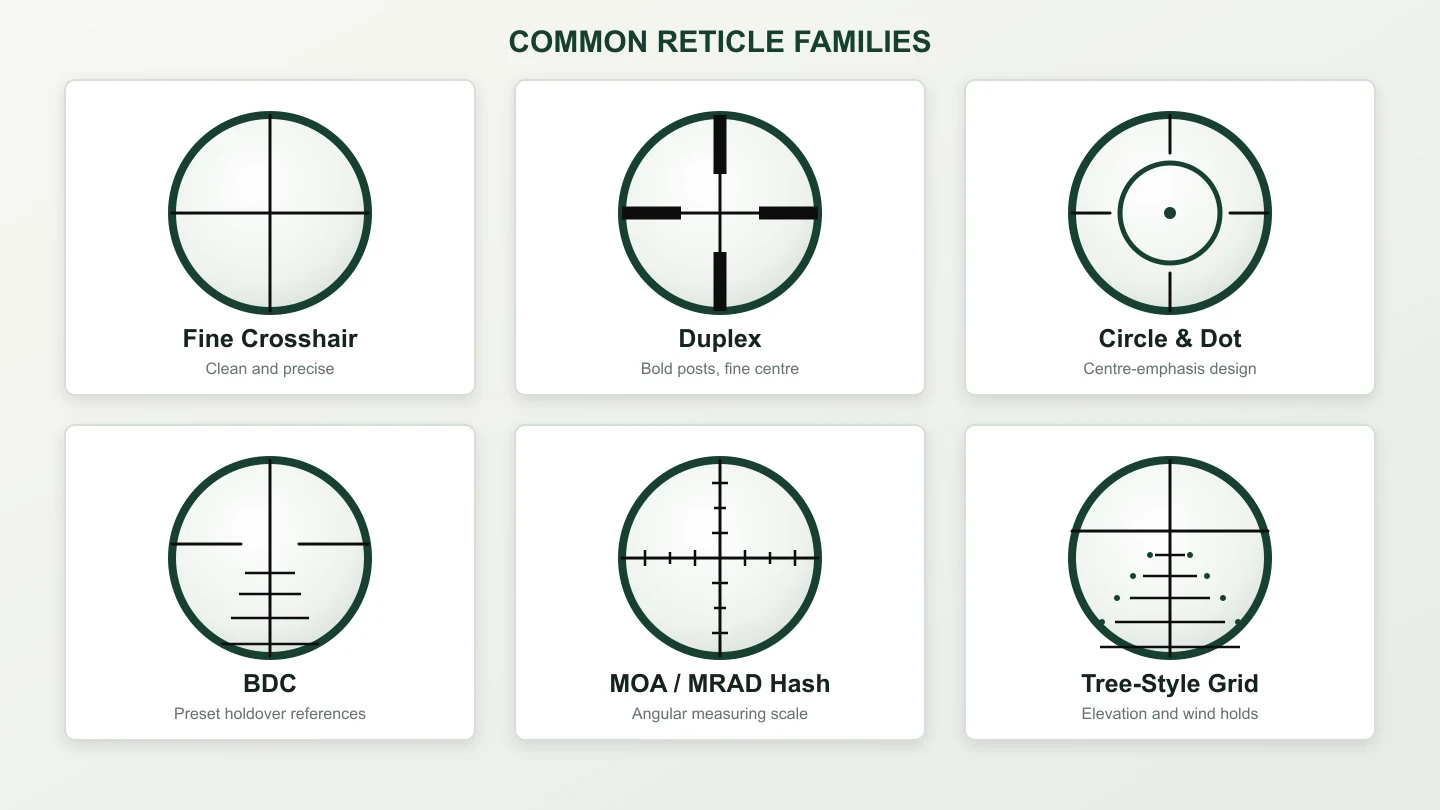 Six useful reticle families, shown as design concepts rather than model-specific patterns.
1. Fine crosshair: the simplest sight picture
A fine crosshair uses thin horizontal and vertical lines that meet at the centre. With very little covering the target, it can feel precise on a clear, high-contrast aiming point.
The trade-off is visibility. Fine lines can become difficult to find against dark vegetation, shadows or a visually busy background. In a first focal plane scope they may also look extremely fine at low magnification. Illumination can help, but it does not completely replace sensible line weight.
This style suits deliberate target work in good light, especially when the shooter wants the centre of the view to remain open and uncluttered.
2. Duplex: a practical general-purpose design
The duplex layout keeps the centre lines relatively thin but uses heavier outer posts. Your eye can pick up the bold posts quickly, while the finer centre still allows a more precise aim.
That balance explains why duplex-style reticles remain common. They are easy to understand, do not demand ballistic data, and work well for general hunting and range use. A plain duplex offers fewer reference marks for elevation or wind holds, but that can be an advantage for someone who normally uses the centre and adjusts with the turrets.
If a beginner is unsure what to choose, a clear duplex or an illuminated duplex is often a sensible reference point—not because it is universally best, but because it makes the fewest demands on the user.
3. Dot, circle-dot, horseshoe and chevron centres
These designs emphasise the centre with a distinct shape. A dot is visually direct. A circle or horseshoe can guide the eye toward the middle at low magnification. A chevron provides a pointed tip that can serve as a more precise reference than the centre of a large dot.
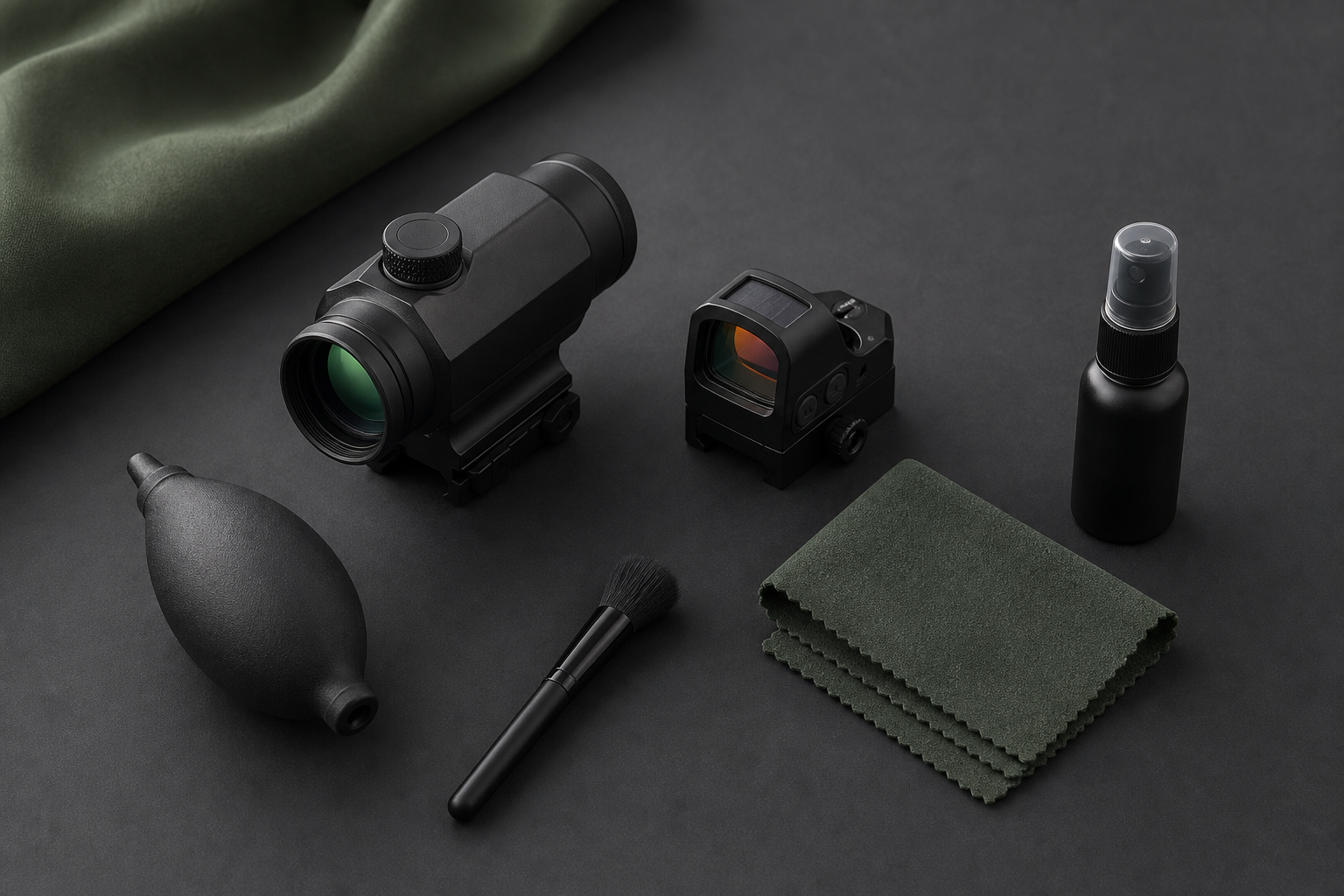
These shapes are often associated with illuminated low-power optics, but shape and illumination are separate features. An etched circle-dot can remain visible with the power switched off, while a conventional red dot sight forms its aiming point electronically and is a different type of optic.
Centre-emphasis designs can feel fast and intuitive at short to moderate distances. The important details are the apparent size of the centre feature, how much of the target it covers and whether the surrounding marks remain readable across the optic's magnification range.
4. BDC reticles: convenient holdover references
BDC means bullet drop compensation. A BDC reticle places additional aiming references below the centre so the user can hold higher for longer distances without turning the elevation turret each time.
The convenience is real, but the markings are not magic distance labels. Their actual relationship to impact depends on the ammunition, projectile speed, sight height, zero distance and environmental conditions used to create the design. Even when a manufacturer associates the marks with particular distances, the results should be confirmed with the user's real setup.
Some BDC reticles use dots. Others use short horizontal bars, circles or a compact vertical tree. The function matters more than the artwork: these are prearranged holdover references intended to be quick to learn, not a universal ballistic solution.
5. MOA and MRAD hash-marked reticles: an angular ruler
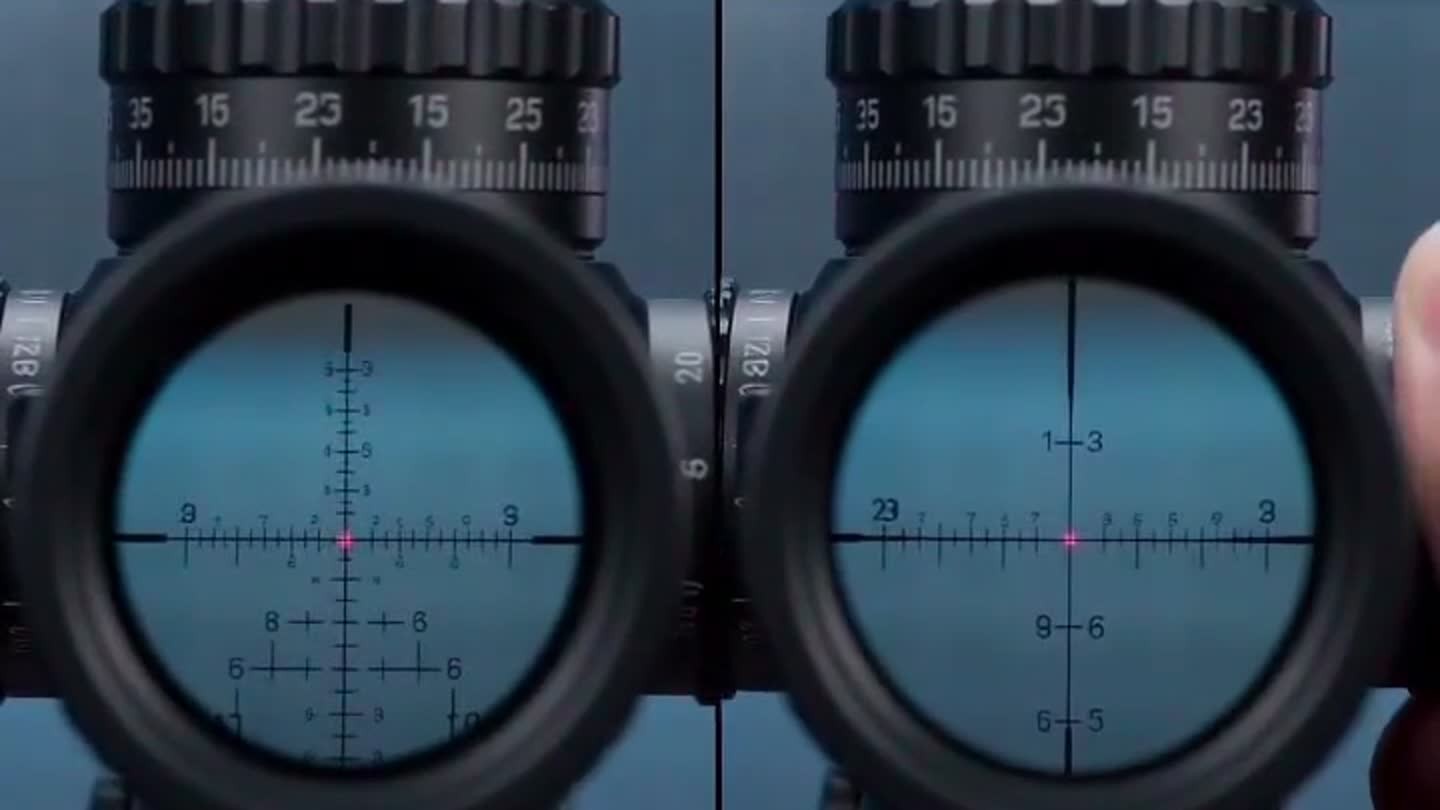
MOA and MRAD reticles use evenly defined angular marks along the horizontal and vertical stadia. Those marks can be used to hold for elevation or wind, estimate corrections and communicate an observed offset.
MOA and MRAD are measurement systems, not reticle shapes. Either system can appear in a relatively open crosshair or a dense grid. The simplest buying rule is to match the reticle and turret units. A scope with an MRAD reticle and MRAD turrets—or MOA reticle and MOA turrets—keeps observation, correction and adjustment in one language.
Focal plane also matters. In an FFP scope, the angular relationship between the reticle and target stays consistent as magnification changes. In an SFP scope, calibrated marks are normally correct at one specified magnification. Our FFP vs SFP guide explains that difference in more detail.
Hash-marked reticles suit shooters who want to learn a repeatable measurement system rather than rely only on a few preset holdover points.
6. Tree-style reticles: more information in the lower field
A tree-style reticle expands the lower vertical scale with horizontal wind references. This lets the user combine an elevation hold with a wind hold without turning both turrets. The pattern is sometimes called a “Christmas tree” because of its widening shape.
The advantage is access to more correction references. The disadvantage is visual density. Small numbers, dots and branches can distract a new user, obscure detail or become difficult to read at the wrong magnification. A well-designed tree is a specialised measuring interface, not automatically an upgrade over a clean crosshair.
This family makes the most sense after the shooter already understands the angular unit, knows how the reticle is calibrated and genuinely uses combined holds.
Where do German-style, PSO-style and ranging reticles fit?
Some familiar patterns do not fit neatly into one box. A German-style reticle may combine bold posts with an open upper field. A PSO-style or other ranging reticle may include a scale designed around a particular ranging method. Special-purpose reticles may combine a centre shape, BDC references and measuring marks in one layout.
These designs should be read according to their own manual. A curved scale or numbered mark is useful only when the user understands the target-size assumption, unit and magnification condition behind it. Similar-looking artwork does not guarantee identical values.
Three things a reticle name does not tell you
Illumination is a feature, not a separate geometry
The same basic layout may be offered with or without illumination. Brightness should make the centre easier to find without blooming over fine detail. More brightness is not always better.
FFP and SFP describe placement, not the pattern
A duplex, BDC or hash-marked design may be built in either focal plane. Focal plane determines how the reticle appears and how its measurements behave as magnification changes; it does not decide whether the artwork is simple or complex.
MOA and MRAD are units, not quality grades
Choosing one unit over the other does not make a scope more accurate. Consistency between the reticle, turrets and the user's data matters more than the label. If the adjustment controls are still unfamiliar, start with our guide to the three common scope controls.
How to choose without overthinking it
Start with the way the optic will actually be used.
- For a clean, general-purpose sight picture: begin with duplex or a simple illuminated centre.
- For quick centre acquisition at lower magnification: consider a dot, circle-dot, horseshoe or chevron layout that remains visually balanced at both ends of the magnification range.
- For a few easy holdover references: a BDC design may be more approachable than a full measuring grid, provided you confirm the marks with your setup.
- For repeatable angular corrections: choose a clearly documented MOA or MRAD reticle and match the turret units.
- For frequent combined elevation and wind holds: a tree-style reticle may be useful once its extra information solves a real problem.
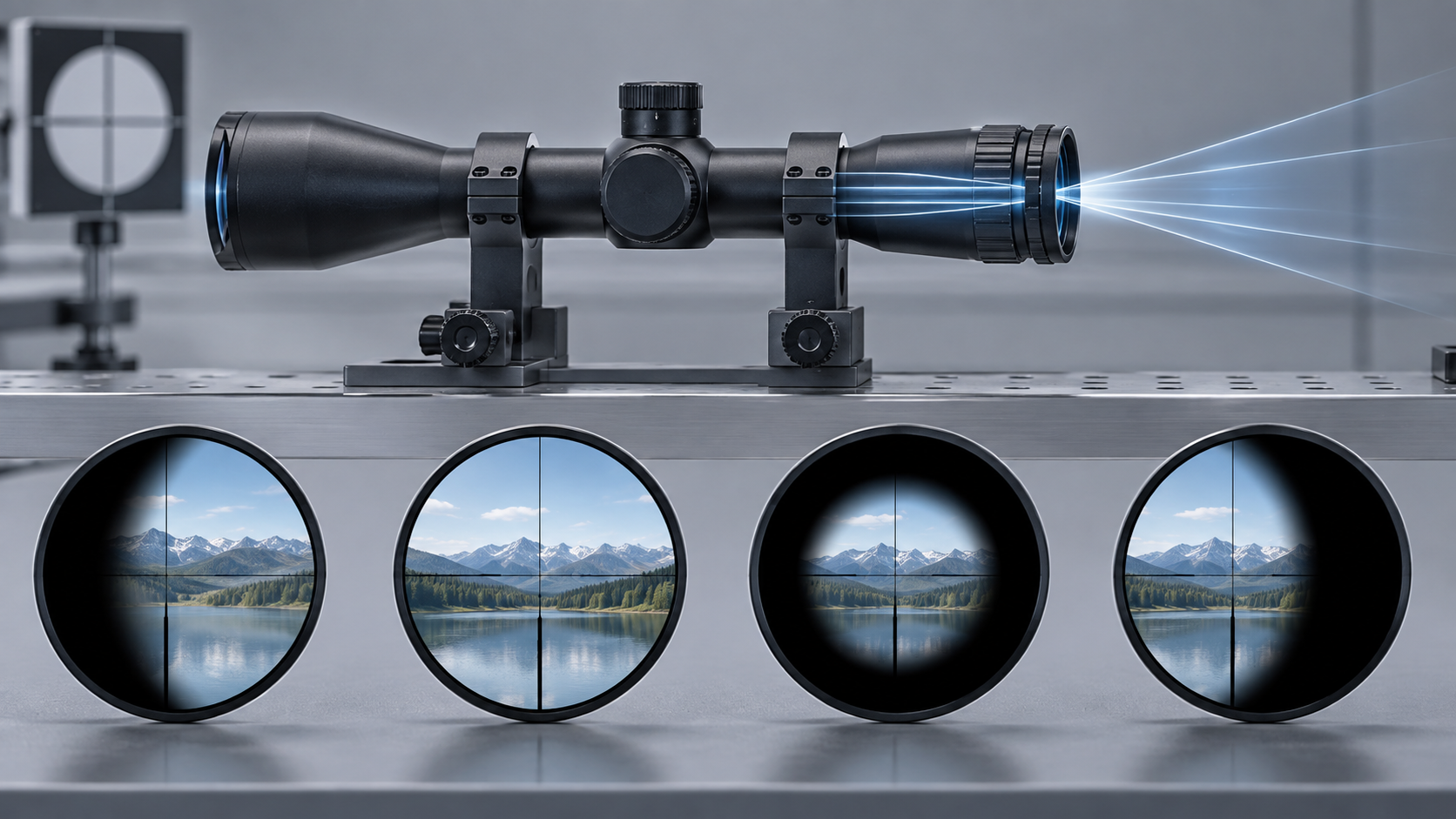
Then inspect the reticle at minimum and maximum magnification. Product illustrations usually show a clean, idealised pattern; they do not always show how fine an FFP reticle looks at low power or how much of the target a thick centre covers at high power.
Finally, check the manual. Confirm the focal plane, subtension values, illumination behaviour and the magnification at which any BDC or ranging references are valid. Do not assume two similar-looking reticles work the same way.
If magnification is still the bigger question, read our beginner guide to choosing scope magnification before paying for a more complicated reticle.
The practical takeaway
A simple reticle is not an entry-level compromise, and a busy reticle is not automatically more capable. Every additional mark should earn its place by making a real task easier.
For many beginners, a duplex, centre-dot or uncomplicated BDC design is easier to use well. MOA, MRAD and tree-style reticles become valuable when the shooter is ready to use the optic as a measuring and correction tool. Choose the least complicated pattern that still supports the way you intend to use the scope.
You can explore the broader Sporting Optics category or continue with our Buying Guides for more beginner-friendly comparisons.





Leave a comment