MOA or MRAD can sound like a choice between two levels of performance. It is not. Both are angular measurement systems, and either one can support accurate, repeatable scope adjustments.
The real question is much more practical: which system is easier for you to understand and use without stopping to convert numbers?
For many shooters, the answer depends on the measurements they already think in, the language used by the people around them, and whether the scope's reticle and turrets speak the same language.
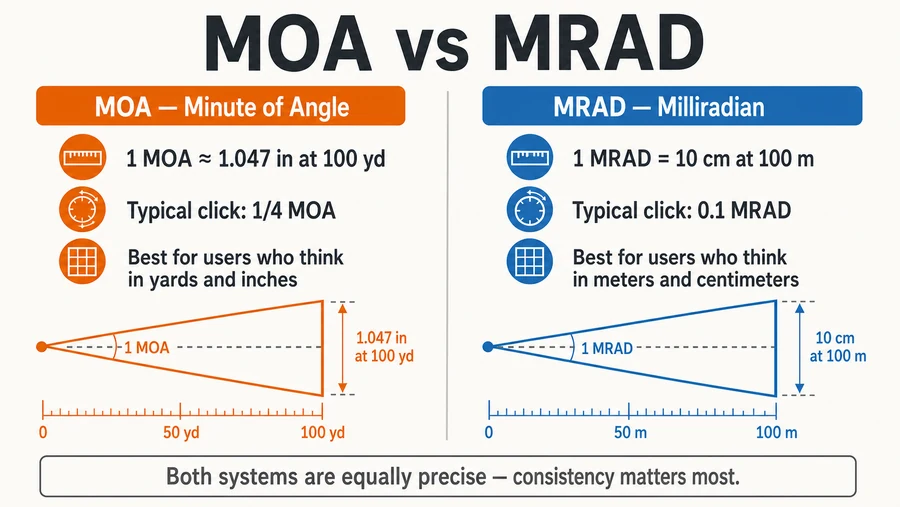
MOA and MRAD divide an angle differently, but neither system is inherently more precise.
What MOA actually measures
MOA stands for minute of angle. A full degree contains 60 minutes, so one MOA is 1/60 of a degree.
At 100 yards, one MOA spans about 1.047 inches. Shooters often round that to one inch for quick range calculations. The angular value stays the same at every distance, while the size it covers grows with distance: about half an inch at 50 yards, roughly two inches at 200 yards, and so on.
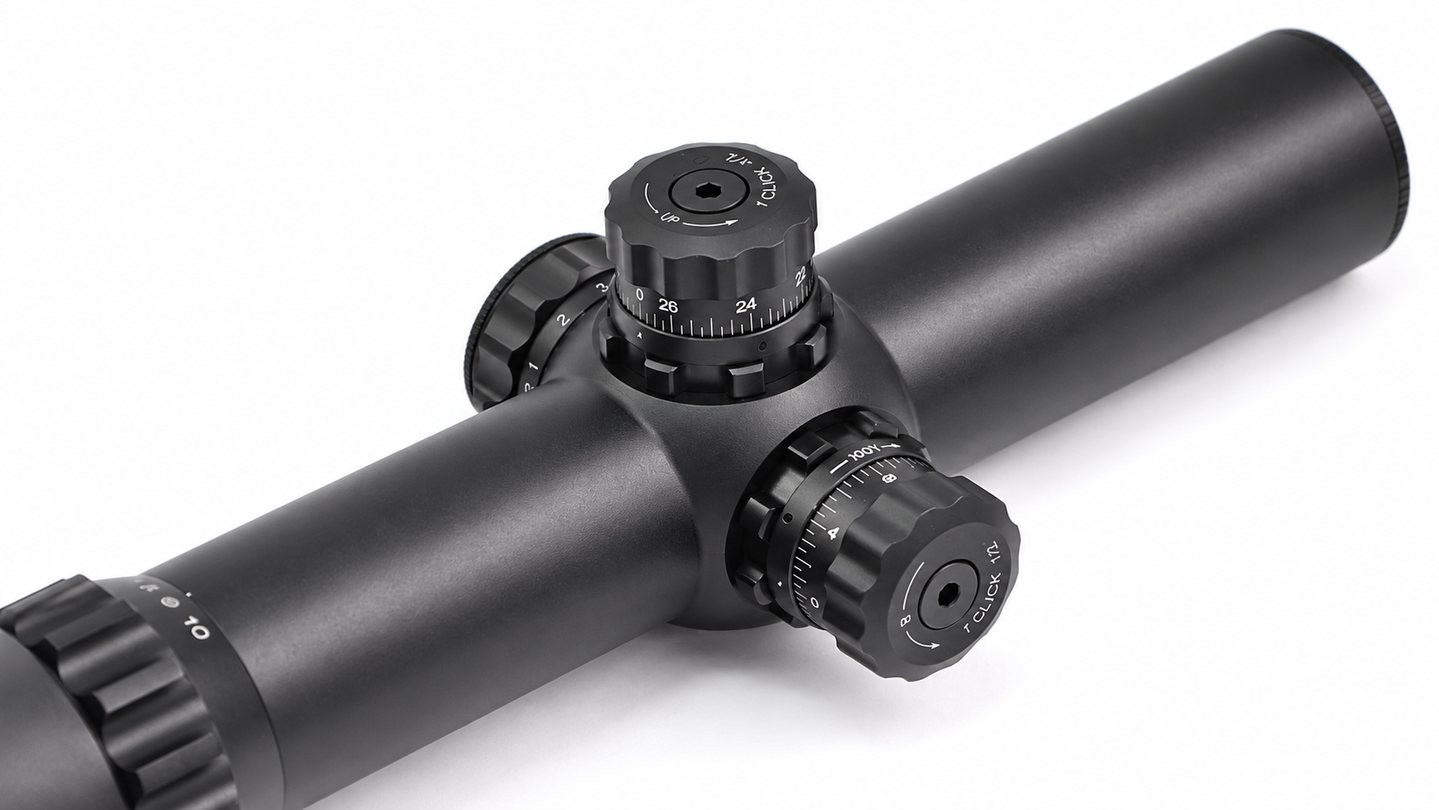
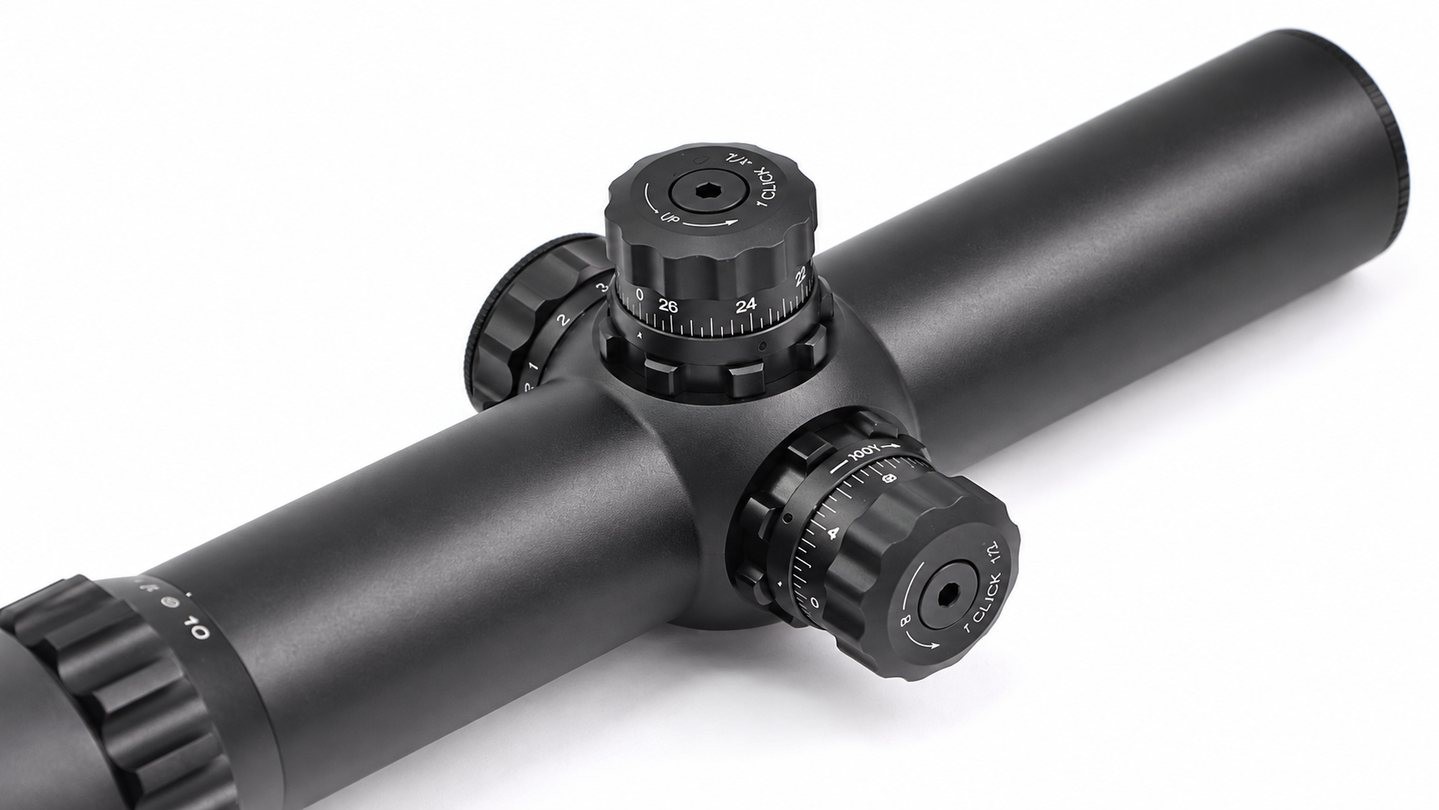
A common scope adjustment is 1/4 MOA per click. On that turret, four clicks equal one MOA. This is only a common example, not a universal specification. Some optics use 1/2 MOA, 1/8 MOA or another value, so the marking on the actual turret and its manual should always take priority.
What MRAD actually measures
MRAD stands for milliradian and is often shortened to “mil.” One milliradian is one-thousandth of a radian. The useful part is the decimal relationship: one mil spans 10 centimetres at 100 metres, while 0.1 mil spans one centimetre at that distance.
Many MRAD turrets adjust in 0.1-mil clicks, giving ten clicks per mil. As with MOA, that is a common arrangement rather than a promise about every scope. Check the control itself before calculating a correction.
MRAD is often described as the metric choice, but it works with yards and inches too. MOA also works with metric distances. Both are angles; the familiar unit system simply makes the mental arithmetic feel easier.
So which one is easier?
If you naturally picture an offset in inches at 100 yards, MOA may feel familiar almost immediately. A group that lands about two inches low at 100 yards is close to two MOA low. With a 1/4-MOA turret, the first correction would be about eight clicks up.
If you prefer decimal corrections, MRAD is often quicker. A group that is 0.6 mil low calls for a 0.6-mil correction. With a 0.1-mil turret, that is six clicks. You do not need to convert the observed value into inches or centimetres if the reticle already measured it in mils.
That leads to the most useful distinction:
- MOA often feels intuitive to shooters who already work in yards and inches.
- MRAD often feels efficient to shooters who prefer base-ten arithmetic or work with people who communicate corrections in mils.
Neither advantage is universal. A shooter who has years of MOA notes will not automatically become faster by switching to MRAD. A new shooter learning alongside an MRAD-using group may find mils easier from day one.
The matching-units rule matters more than the choice
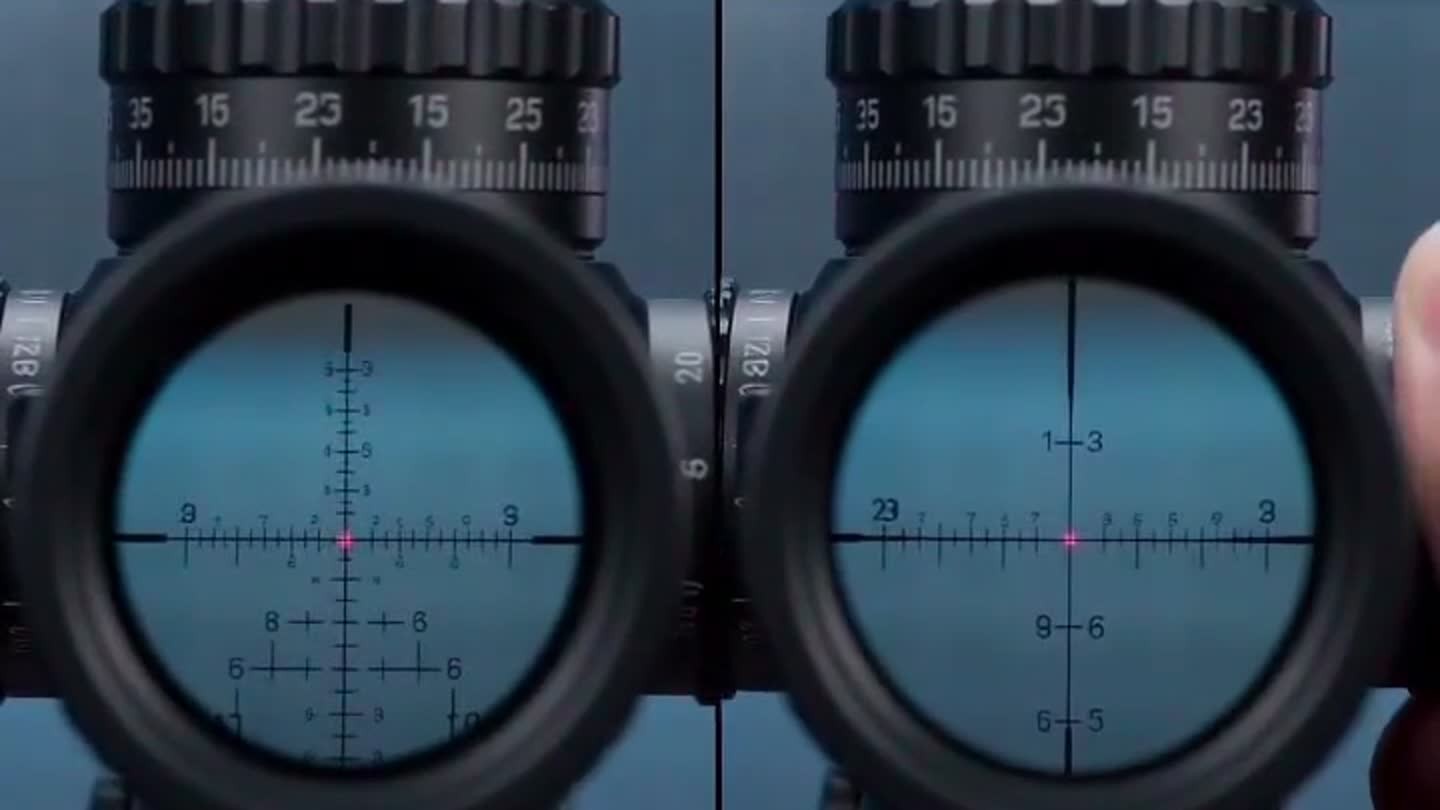
The simplest setup has an MOA reticle with MOA turrets, or an MRAD reticle with MRAD turrets. Then an offset measured through the reticle can be dialled directly on the turret.
Imagine the impact appears 1.2 mil low in an MRAD reticle. With an MRAD turret, dial 1.2 mil up. If the same scope had MOA turrets, you would have to convert the correction before touching the dial. The system still works, but it adds avoidable arithmetic at exactly the moment you want a clear, repeatable routine.
The same principle applies to MOA. If the reticle shows a two-MOA offset and the turret is marked in MOA, the correction remains in one unit from observation to adjustment.
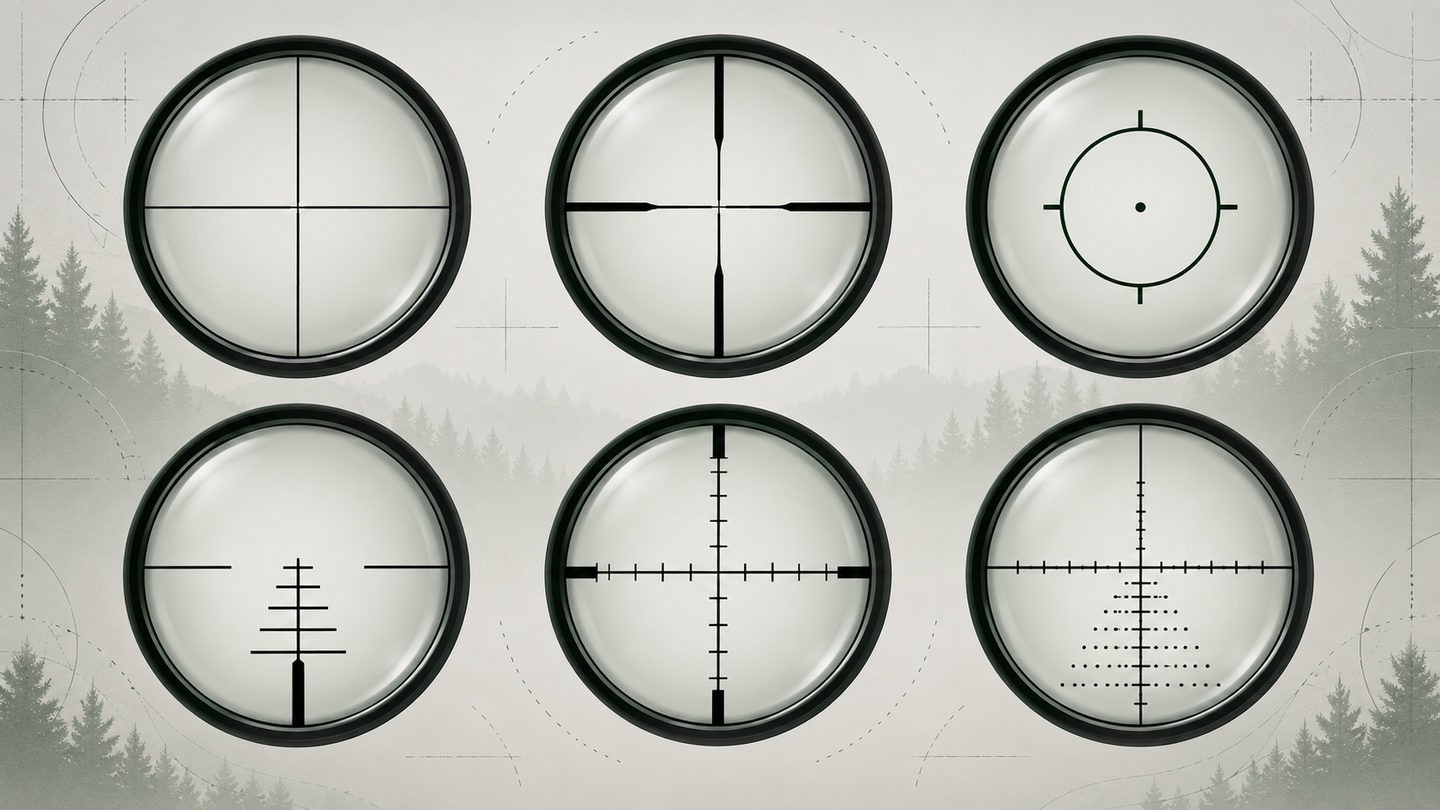
Reticle design and focal plane are separate questions. Our guide to common rifle scope reticle types explains the layouts, while the FFP vs SFP guide explains when reticle measurements remain valid as magnification changes.
Does one system offer finer adjustment?
Not by itself. The unit name does not determine the quality of the mechanism, the tracking accuracy or the practical precision of the scope.
A common 1/4-MOA click is a little finer than a common 0.1-mil click: roughly 0.26 inch versus 0.36 inch at 100 yards. That comparison can be useful, but it does not prove that an MOA scope is “more accurate.” Different models use different click values, and real performance also depends on mechanical consistency, usable adjustment range, reticle design and the shooter's ability to measure and apply a correction.
For ordinary use, a system you can read correctly and repeat confidently is more valuable than a small theoretical difference between two common click sizes.
Do you need to convert between MOA and MRAD?
Usually, no. If the reticle, turrets and ballistic data all use the same system, stay in that system.
For reference, one mil is about 3.44 MOA, and one MOA is about 0.291 mil. Those conversions are useful when reading data from another system, but they should not become part of every adjustment. Constant conversion makes a simple angular correction feel harder than it needs to be.
A practical way to choose
Before buying or setting up an optic, answer these questions:
- Which unit is on your existing notes and tools? Staying consistent protects the work you have already done.
- What do your regular shooting partners use? Sharing observations is easier when everyone speaks in the same unit.
- Do the reticle and turrets match? This should normally take priority over a personal preference for the unit name.
- Can you read the click value clearly? Never assume that every MOA or MRAD turret uses the same increment.
- Will you dial, hold, or do both? A clearly marked, matching reticle-and-turret system supports either method without unnecessary conversion.
Related buying guide
Keep the key measurements, click examples and matching-unit rule together in one quick reference.
READ THE GUIDE →
The short answer
Choose MOA if yards, inches and MOA-based notes already feel natural. Choose MRAD if you prefer decimal corrections or the people and tools around you use mils.
More importantly, choose a scope whose reticle and turrets use the same unit, learn the exact click value, and keep your data in that system. Once those pieces match, MOA and MRAD become two equally capable ways to solve the same problem.
If scope controls are still unfamiliar, start with our beginner guide to elevation, windage and the third knob, or browse the broader Buying Guides. No specific product page is required to learn the system first.




Leave a comment