Turret reviews often use two phrases as if they mean the same thing: good tracking and returns to zero. They are related, but they answer different questions.
Tracking asks whether a scope moves by the amount you dial. Return to zero asks whether it comes back to the original reference after you dial away and then reverse the adjustment. A scope can appear to do one reasonably well while still raising questions about the other, especially when the test itself is noisy.
Understanding the difference makes specification sheets, reviews and range observations much easier to interpret.
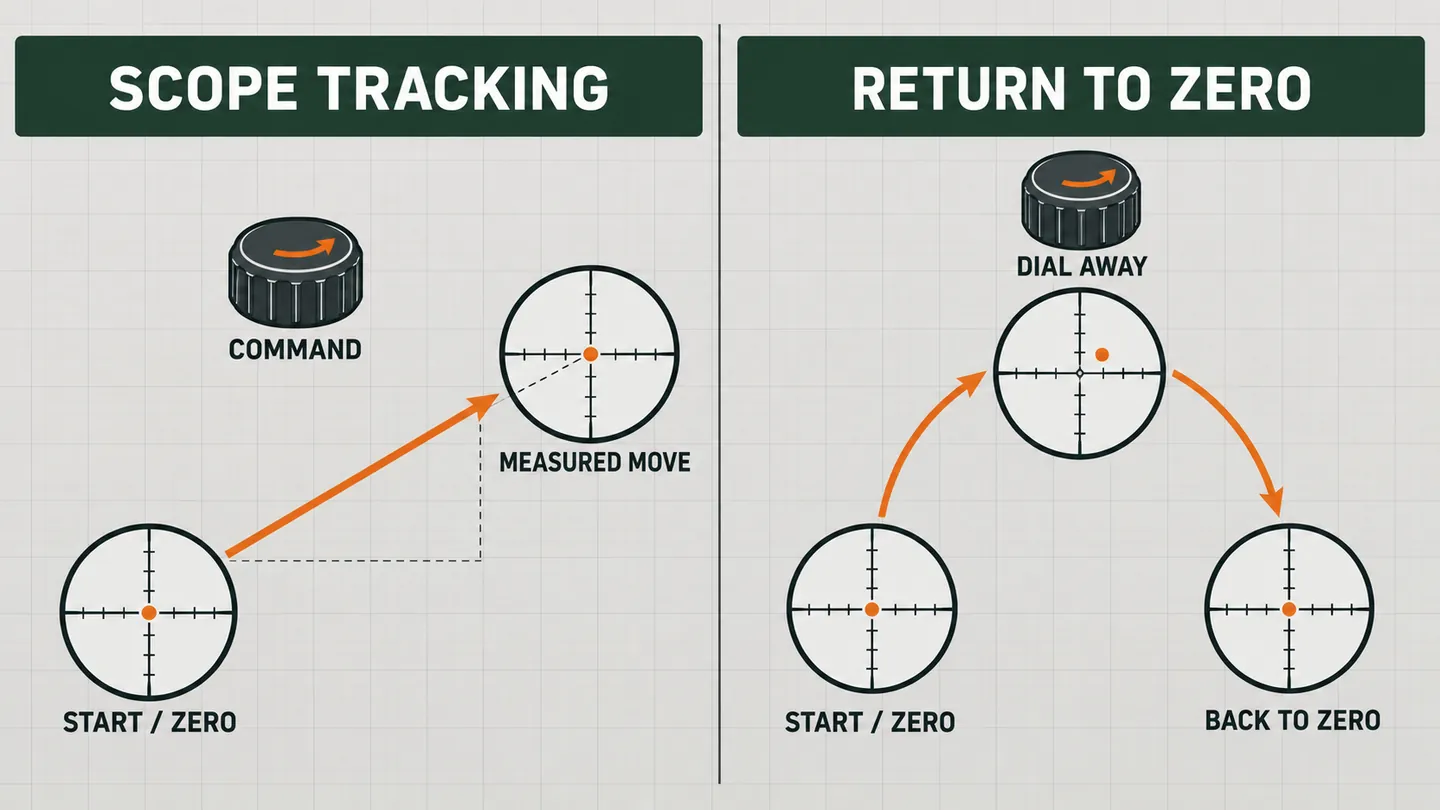 Tracking measures the commanded movement; return to zero checks whether the adjustment comes back to its starting reference.
What does scope tracking mean?
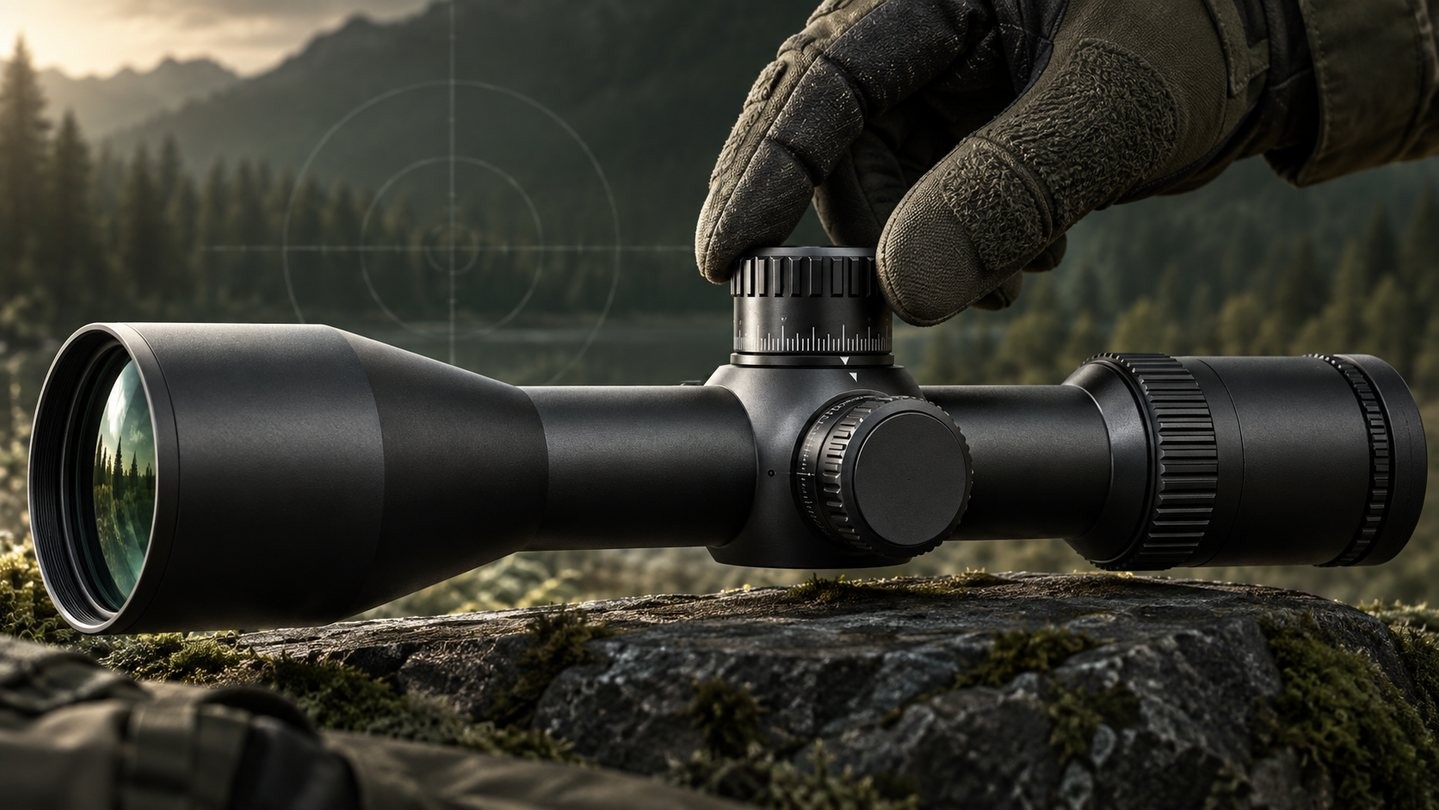
In plain language, tracking is the relationship between the adjustment you command at the turret and the movement produced by the scope's internal adjustment system.
If a turret is marked in 0.1 mrad clicks, ten clicks represent 1.0 mrad. If it is marked in quarter-MOA clicks, four clicks represent 1 MOA. Good tracking means the resulting movement is close to that stated value and remains consistent across the part of the adjustment range being used.
This is why tracking is more than a question of whether the clicks feel crisp. Tactile feedback tells you that the dial indexed. It does not, by itself, prove that the internal movement matched the marking.
If MOA and MRAD are still easy to mix up, our MOA vs MRAD guide explains the two systems without turning the choice into a contest.
What does return to zero mean?
Return to zero describes repeatability at the starting point. After you dial away from the established zero and then dial back, the scope should return to the same optical and mechanical reference.
That does not mean every shot must pass through one identical hole. A live-fire group includes ammunition variation, wind, support, aiming error and normal group dispersion. The useful question is whether the centre of the group returns to the same place within the limits of the test.
It also helps to separate return to zero from a zero stop. A zero stop is a physical reference or backstop that helps the user find the zero setting without counting all the way around the dial. It is a control feature, not proof of tracking accuracy. Our article on zero stop versus zero reset covers that distinction in more detail.
Tracking, repeatability and return to zero are not interchangeable
These terms overlap, but each describes a different part of turret behaviour.
| Term |
The question it answers |
What it does not prove |
| Tracking |
Did the internal movement match the amount dialled? |
That the scope will return to the same starting point after repeated cycles. |
| Repeatability |
Does the same input produce the same result again? |
That the stated click value is perfectly calibrated. |
| Return to zero |
After dialling away and back, did the system return to its starting reference? |
That every intermediate adjustment was exactly correct. |
| Zero stop |
Can the user find the zero position quickly and avoid turning below it? |
Tracking accuracy, repeatability or optical quality. |
The practical point is simple: a useful evaluation needs to say what was tested. “The turrets felt good” and “the scope tracked perfectly” are not equivalent statements.
How is tracking commonly checked?
Two broad approaches are common. Neither is automatically better; they simply control different variables.
A measured reticle-movement test
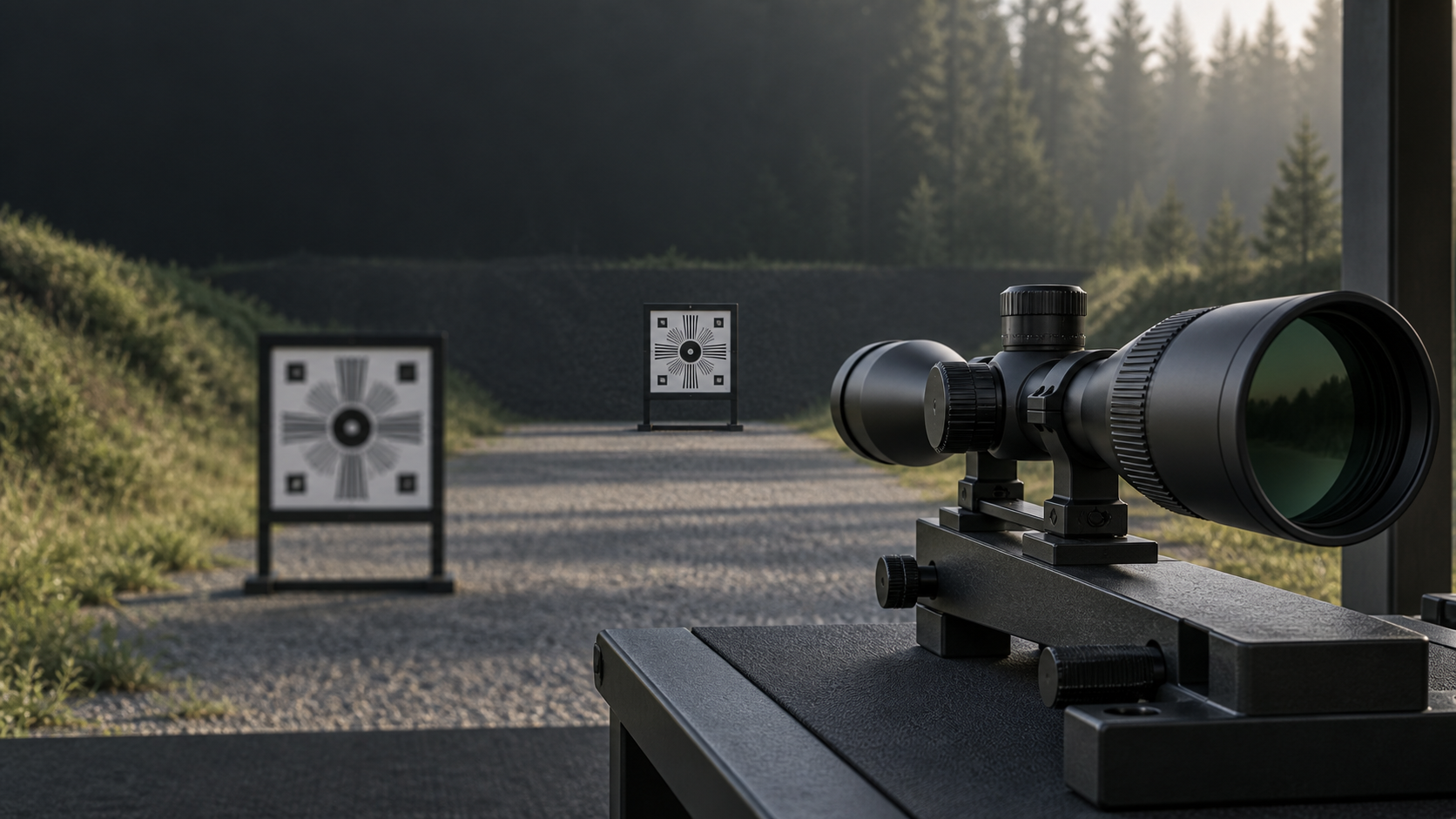
The scope is held securely and aimed at a target with a known scale. The tester dials a stated amount and compares the reticle's movement with the expected distance on that scale.
This approach reduces ammunition and shooter dispersion, but it still depends on careful setup. The target must be level, the scale must be accurate, the viewing distance must be known, and parallax should be controlled. A small alignment error can look like a tracking error.
A live-fire box test
A traditional box test starts from an established point, then dials elevation and windage in a rectangular sequence before returning to the starting setting. The resulting groups should form the expected pattern and the final group should return near the first.
Live fire tests the optic as part of the complete setup, which is useful, but it also adds variables. Group size, wind, ammunition, mounting stability and shooter consistency can hide a small mechanical error or create one that is not actually inside the scope.
For either method, write down the click value, number of clicks, distance, expected movement and measured movement. Without those details, “passed the box test” is difficult to evaluate.
A simple way to think about expected movement
The turret system and test distance must use matching units.
- One milliradian subtends about 10 centimetres at 100 metres.
- One MOA subtends about 1.047 inches at 100 yards.
- A 0.1 mrad click represents one tenth of a milliradian.
- A 1/4 MOA click represents one quarter of one MOA.
These relationships let you calculate the expected movement before the test. They do not tell you what amount of error is acceptable; that depends on the test method, intended use and the manufacturer's specification, if one is published.
Why apparently poor tracking may come from somewhere else
Before blaming the turret mechanism, check the rest of the setup.
Parallax and viewing position
If the reticle appears to move across the target when your eye shifts, the measurement can change even though the turret did exactly what it was asked to do. Set the diopter for the reticle first, then adjust parallax for the target distance. The difference is explained in our guide to parallax, focus and diopter adjustment.
Mounting movement
A loose base, shifting ring or stressed installation can move the entire optic. That can resemble a tracking or return-to-zero problem. Check the mounting system according to the relevant manufacturer's instructions rather than repeatedly adding torque.
Unit or distance mistakes
MOA and MRAD calculations are easy to mix, particularly when the target is measured in one system and the turret uses the other. An incorrect target distance also changes the expected linear movement.
Reaching a mechanical limit
Every scope has finite internal adjustment. Near the end of the available travel, the system may not behave in the same way it does around the centre. A zero stop can also prevent movement below the established zero even when additional internal travel exists.
Group size and environmental conditions
If the normal group is large compared with the movement being measured, a small tracking difference will disappear inside the dispersion. Wind and changing conditions can shift groups as well. That is why a single group rarely settles the question.
What a useful review should tell you
When a review makes a tracking claim, look for enough detail to reproduce the logic:
- the scope's stated click value;
- the number of clicks or total adjustment dialled;
- the actual test distance;
- the expected and measured movement;
- whether the test was optical or live fire;
- whether the scope was cycled more than once;
- whether the final return-to-zero result was measured separately;
- any obvious limits, such as group size or target-scale accuracy.
Missing one of these details does not make the review useless, but it changes how much weight the conclusion deserves.
Does every user need exposed, highly repeatable dialing turrets?
Not necessarily. Someone who establishes a zero and normally leaves the turrets alone may care more about protection from accidental movement. Someone who regularly dials for different distances will place more value on readable scales, repeatable movement and an easy return to the starting reference.
That is a use-pattern decision, not a simple quality ranking. Our comparison of capped, exposed and locking turrets explains the control choices, while the three-knob scope guide covers what each adjustment does.
The short version
Tracking asks whether the scope moved by the amount you dialled. Repeatability asks whether it does so consistently. Return to zero asks whether it comes back to the same starting reference. A zero stop helps you find that reference, but it does not certify the mechanism.
The most useful test is not the one with the most impressive label. It is the one with a clear method, controlled variables and enough measured information to understand the result. For more plain-language setup and comparison articles, visit our Buying Guides.




Leave a comment