A target can remain technically in focus while its darker details suddenly become harder to see. The view looks pale, black areas turn grey, and a bright patch or faint reflection may appear when the scope is pointed near strong sunlight. This is often described loosely as glare, but several different optical effects can be involved.
The most useful distinction is between light that belongs in the image and unwanted light that reaches the eye by reflection or scattering. The second type is called stray light. When it spreads a low-contrast haze across the view, it is often called veiling glare. When it forms a more defined duplicate spot or shape, it is commonly called a ghost image.
What stray light does to the scope image
The intended image is formed by rays that travel through the optical system along the designed path. Stray light follows an unwanted path: it may reflect between glass surfaces, scatter from dust, strike an internal mechanical surface, or enter the objective from a bright source just outside the visible field.
Edmund Optics defines stray light broadly as unwanted light in an optical system and notes that it can reduce image contrast or create ghost images. Nikon similarly describes it as unplanned reflection or scattering along the optical train. The practical result in a rifle scope is not always a bright flare. It may simply be a loss of separation between dark and light details.
This is why a view can look bright but still show poor detail. Brightness and contrast are related, but they are not the same measurement. More total light does not help if unwanted light lifts the dark parts of the scene and makes neighbouring tones harder to distinguish.
Veiling glare, flare and ghost images are not identical
Users often group every bright-light artifact under the word “flare.” It helps to describe what is actually visible:
- Veiling glare: a broad haze that lowers contrast across part or all of the image.
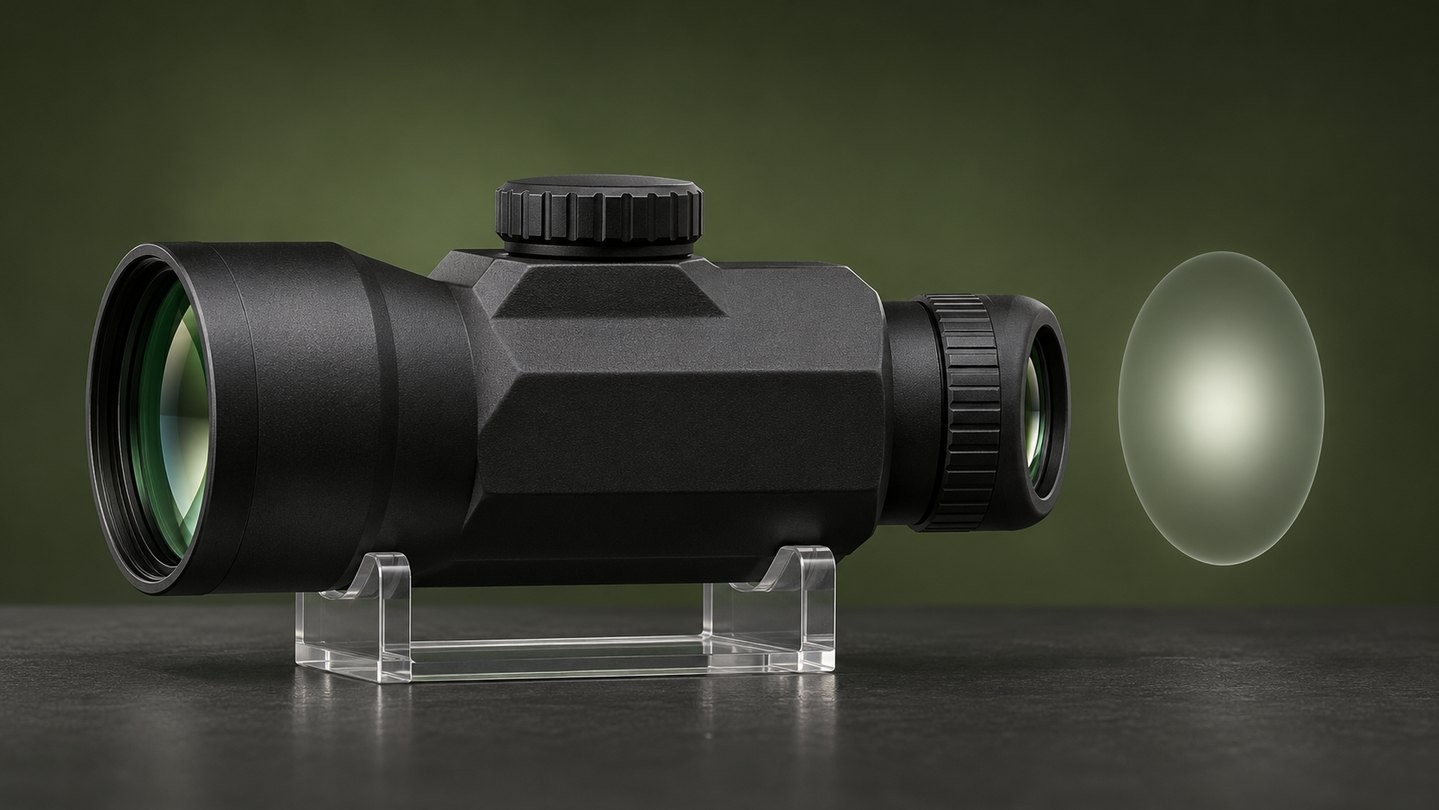
- Ghost image: a distinct spot, arc or duplicate shape caused by internal reflections.
- Localized flare: a bright patch or streak near a strong light source.
- External reflection: light reflecting from the front or ocular surface rather than forming part of the intended image.
ZEISS explains that veiling glare can result from undesirable reflections between optical surfaces and from scattering at internal barrel components. A highly defined ghost and a general washed-out view can therefore come from related but different paths inside the same system.
Describe the symptom before judging the cause. “The image loses contrast when the sun is just outside the field at the two-o’clock position” is more useful than saying only that the scope has glare.
Why bright off-axis light is a difficult test
A strong light source does not need to appear inside the visible field to affect the image. Light entering at an angle can reach the objective, reflect from a lens surface or illuminate the inside of the tube. The effect may change sharply when the scope moves only a few degrees.
This explains why an optic can look clean under even overcast light and then appear washed out near a low sun, bright window or strong artificial lamp. The relative angle matters, as do the position of the observer and the brightness difference between the source and the scene.
The comparison should be repeatable. Do not look directly at the sun through an optic. Instead, place the bright source safely outside the field and move the scope in small, controlled increments while watching a textured dark object. Compare the same target, angle and magnification.
What coatings and internal baffling can change
Every air-to-glass surface can reflect some light. Anti-reflection coatings are designed to reduce those reflections and improve useful transmission. Our guide to rifle-scope lens coatings explains why labels such as “multi-coated” need careful reading.
Coatings are only part of stray-light control. Optical designers can also use apertures, internal threads, matte black surfaces, lens-edge blackening and mechanical baffles to stop unwanted rays from reaching the image. Edmund Optics lists blackened components, lens edges and apertures among the methods used to reduce stray light.
These details are rarely visible in a product listing. A large objective, a high transmission percentage or a coloured lens reflection does not prove that the complete optical system will control off-axis light well. The result depends on the entire design and its execution.
A safe practical comparison
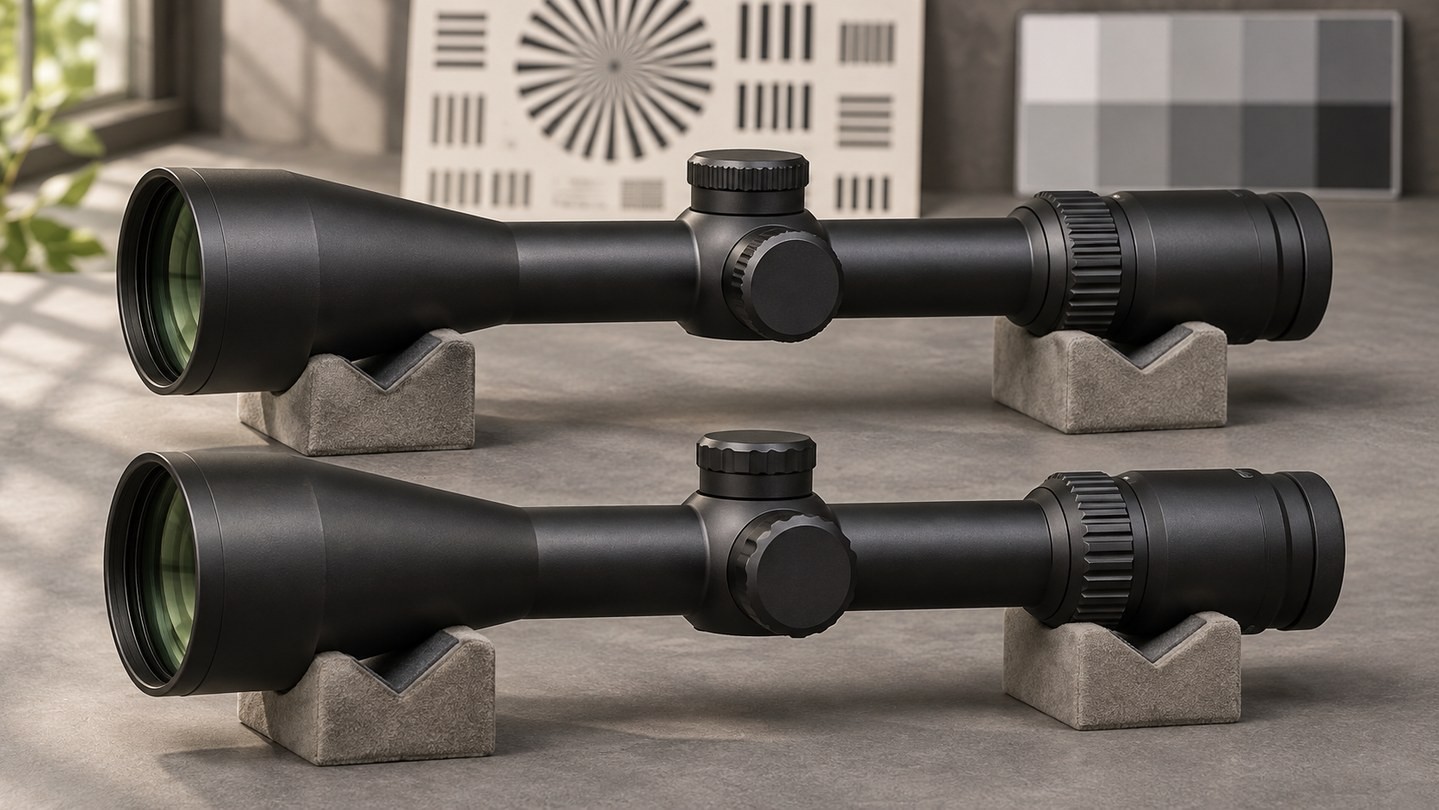
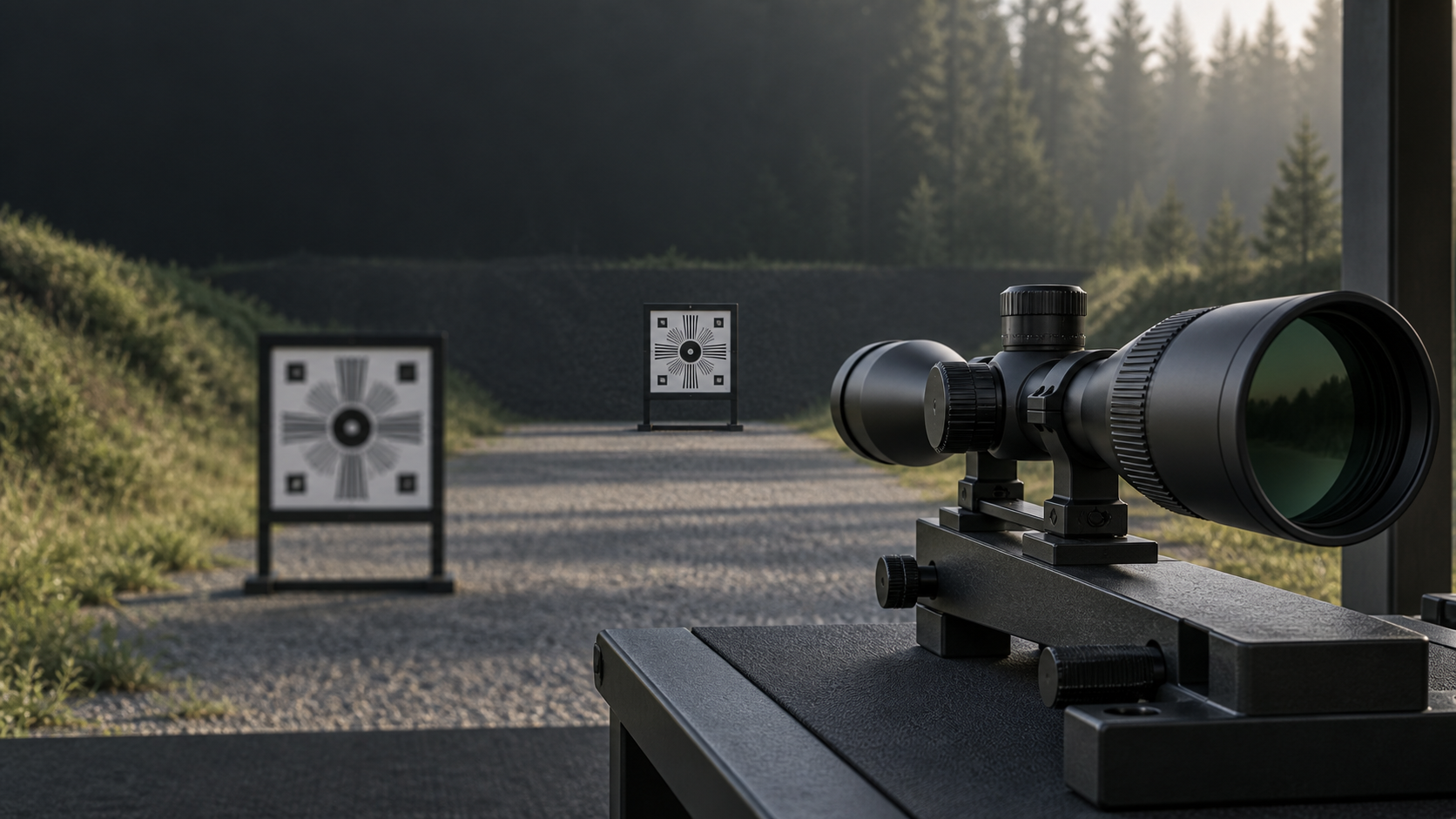
Use an inert support and compare two optics under the same conditions. Do not conduct the test while handling a loaded firearm.
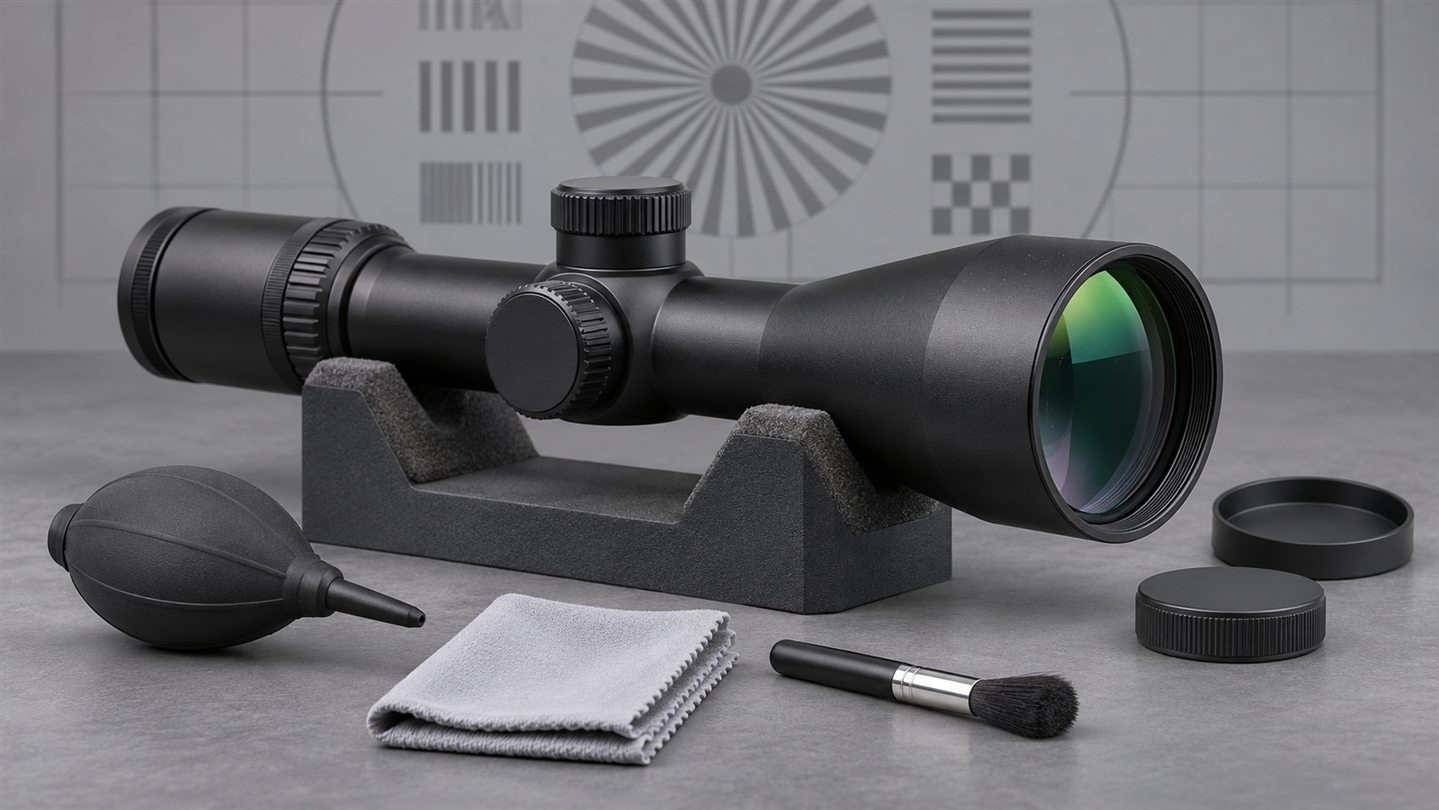
- Clean only obvious loose dust or fingerprints using a safe method; do not polish aggressively before testing.
- Set both optics to the same magnification and focus the reticle correctly.
- View the same dark, textured target with a bright light source outside—not inside—the field.
- Keep eye position and eye relief consistent.
- Rotate the setup or move the bright source through several off-axis positions.
- Note whether the symptom is a broad haze, a distinct ghost, a surface reflection or simple eye-position shadow.
- Repeat with a temporary shade around the objective without touching the glass or blocking the intended field.
If a short external shade greatly improves contrast, off-axis light entering the objective was probably contributing. If the symptom moves with your eye rather than with the light source, check eye relief and alignment instead.
Simple steps that may help in the field
A manufacturer-approved sunshade can reduce some off-axis light before it reaches the objective. The article on scope lens caps, sunshades and ARDs compares those accessories and their different jobs.
Also check the basics:
- Remove fingerprints, oil film and water spots using a proper lens-cleaning routine.
- Confirm that a cap, adapter or accessory is not partly intruding into the optical path.
- Reposition slightly so the bright source is shielded by terrain, a roof edge or another safe obstruction.
- Keep the ocular lens shaded from direct rear light when possible.
- Compare with and without a compatible sunshade before drawing conclusions.
An anti-reflection device can reduce visible objective reflection and may reject some angled light, but it can also change the view and is not a universal cure. See the separate guide to honeycomb ARDs for those trade-offs.
What a quick glare test cannot prove
A single bright-light observation does not establish overall optical quality. It does not measure resolution, tracking, durability, weather sealing, reticle accuracy or low-light performance. Phone photographs are also unreliable unless the camera position, exposure and angle are controlled; automatic exposure can make two similar views look very different.
Do not compare one optic with a dirty objective and another with a clean one. Do not compare different magnifications or different source angles. Most importantly, do not treat marketing phrases such as “fully multi-coated,” “high transmission” or “HD glass” as direct measurements of stray-light suppression.
Practical buying takeaway
When bright-light contrast matters, look beyond headline transmission figures. Check whether the view retains dark detail with a strong source just outside the field, whether any ghost moves predictably with the source, and whether a compatible shade changes the result.
The useful question is not simply “Is the image bright?” It is “Does the optic preserve contrast when unwanted light tries to enter the system?” A controlled side-by-side comparison answers that question more reliably than a coating colour, an objective diameter or a broad marketing claim.
Continue learning
Explore more practical optical concepts in Optics Field Notes.


Leave a comment