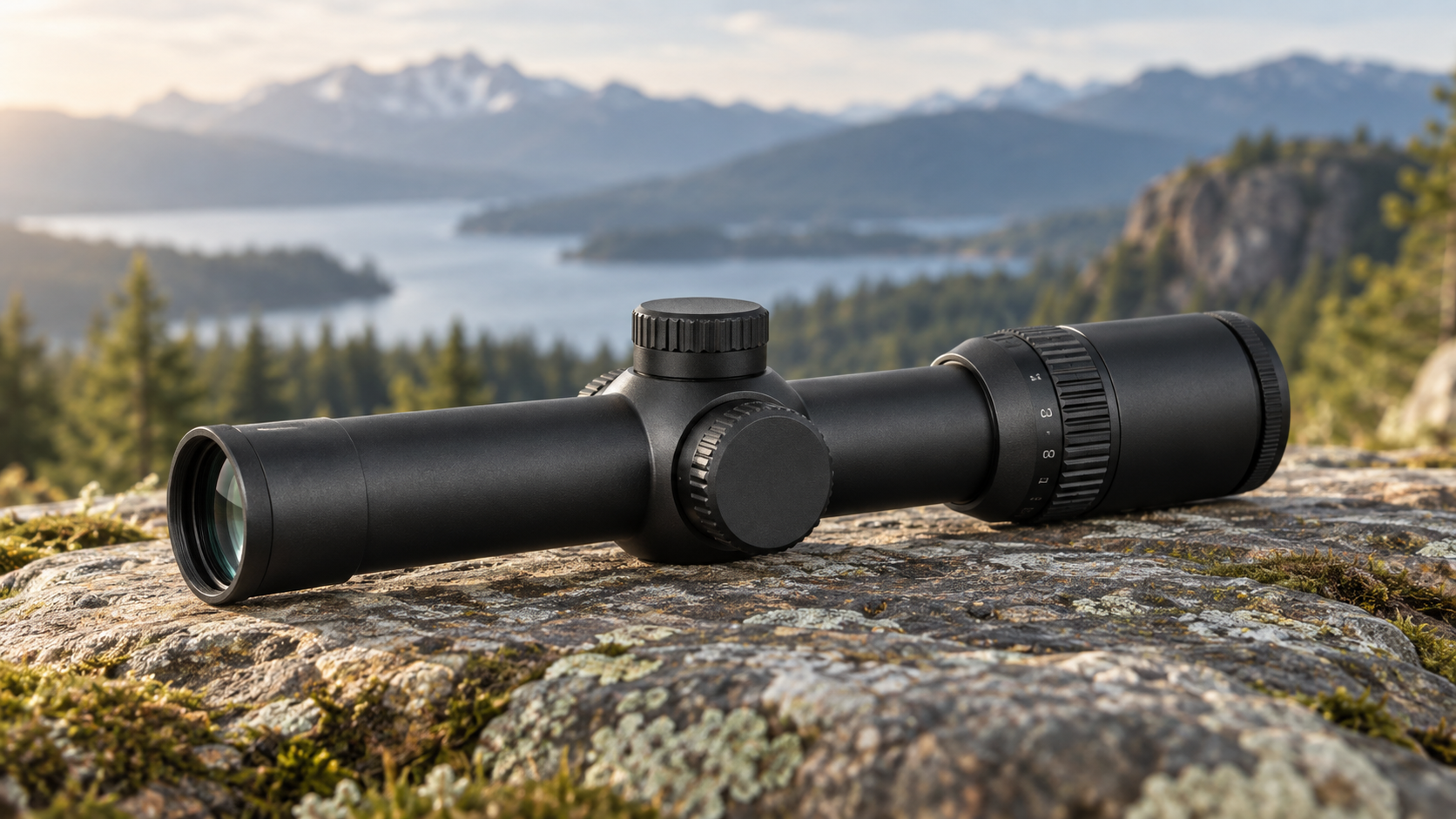
Turn a first focal plane LPVO from 1x to 8x and the reticle can seem to transform. At low power it may look compact and simple. At high power, fine references that were easy to miss become much easier to read. The reticle has not switched designs: it is being magnified with the target image.
That behavior is the defining feature of a first focal plane system, but it does not tell you whether a particular reticle will be easy to use at both ends of the zoom range. Here is what actually changes—and what does not.
What Changes as Magnification Increases?
In a first focal plane scope, the reticle and the target image grow or shrink together as magnification changes. The reticle therefore appears much smaller at 1x than it does at 8x. Thin lines, small numbers and closely spaced marks may be difficult to distinguish at the low end, then become clearly separated at the high end.
The field of view also narrows as magnification rises, while details within the remaining view appear larger. Eye position may feel less forgiving at higher power, depending on the scope's optical design. These are magnification effects, not evidence that the reticle's angular scale has changed.
If you are still comparing focal-plane layouts, start with our guide to FFP vs SFP rifle scopes.
What a Good FFP Reticle Must Do at 1x
At 1x, an FFP reticle needs a visible central reference without making the entire view feel crowded. Designers often use a bold outer feature, a circle, heavier posts or an illuminated center to guide the eye. The fine measuring marks may still be present, but they are not necessarily meant to be read individually at the lowest setting.
Illumination can help the center stand out, but “illuminated” and “bright enough for every daylight condition” are not the same promise. Brightness range, reticle geometry, lens tint and the background all affect how quickly the center is found. A buyer should evaluate the actual sight picture rather than assume that every illuminated FFP LPVO behaves like a red dot.
What Becomes Useful at 8x
At 8x, more of the reticle structure becomes readable. Small hash marks, reference numbers and hold points can separate visually, making the design easier to interpret. A well-balanced reticle provides enough detail for precise reference without covering too much of a small target.
Higher magnification does not automatically make a scope mechanically more accurate, nor does it correct an inconsistent mounting position or poor focus. It simply makes the target image and the FFP reticle appear larger. Image quality, eye box, focus and reticle line weight still determine how useful that extra scale feels.
Why the Angular References Stay Consistent
Because the target image and reticle change size together, a correctly designed MIL or MOA interval keeps the same angular relationship throughout the magnification range. That is why FFP measuring marks can normally be used without first returning the magnification ring to one special setting.
This does not make every mark a guaranteed impact point. A BDC-style reference still depends on the assumptions behind its design, including ammunition, velocity, distance and environmental conditions. The focal plane preserves the angular scale; it does not replace verification. For a closer look at this distinction, read reticle subtension explained.
Reticle Design Matters as Much as the Focal Plane
Two 1-8x FFP scopes can feel very different even when both preserve subtensions correctly. One reticle may emphasize a bright center and open view at low power. Another may favor detailed holds that become most useful near the top of the range. Neither approach is automatically better; the design must remain visible at 1x and readable at 8x for the way the optic will be used.
That is also why zoom ratio alone is an incomplete comparison. Our guide to 1-6x vs 1-8x vs 1-10x LPVOs explains the broader trade-offs around field of view, eye position and high-end detail.
A Practical Two-End Check Before Choosing
- At 1x: check whether the center is easy to find against both bright and dark backgrounds.
- At 8x: check whether fine marks are readable without obscuring too much of the target.
- Across the range: watch for a natural transition rather than judging the optic at only one setting.
- With illumination off: confirm that the etched structure remains usable for the conditions you expect.
- With your normal eye position: compare field of view, eye box and focus at both ends.
The useful question is not simply whether an LPVO is FFP. Ask whether its reticle remains findable at low power, informative at high power and proportionate throughout the range. Compare those qualities alongside the rest of the sporting optics system, rather than choosing from magnification numbers alone.


Leave a comment