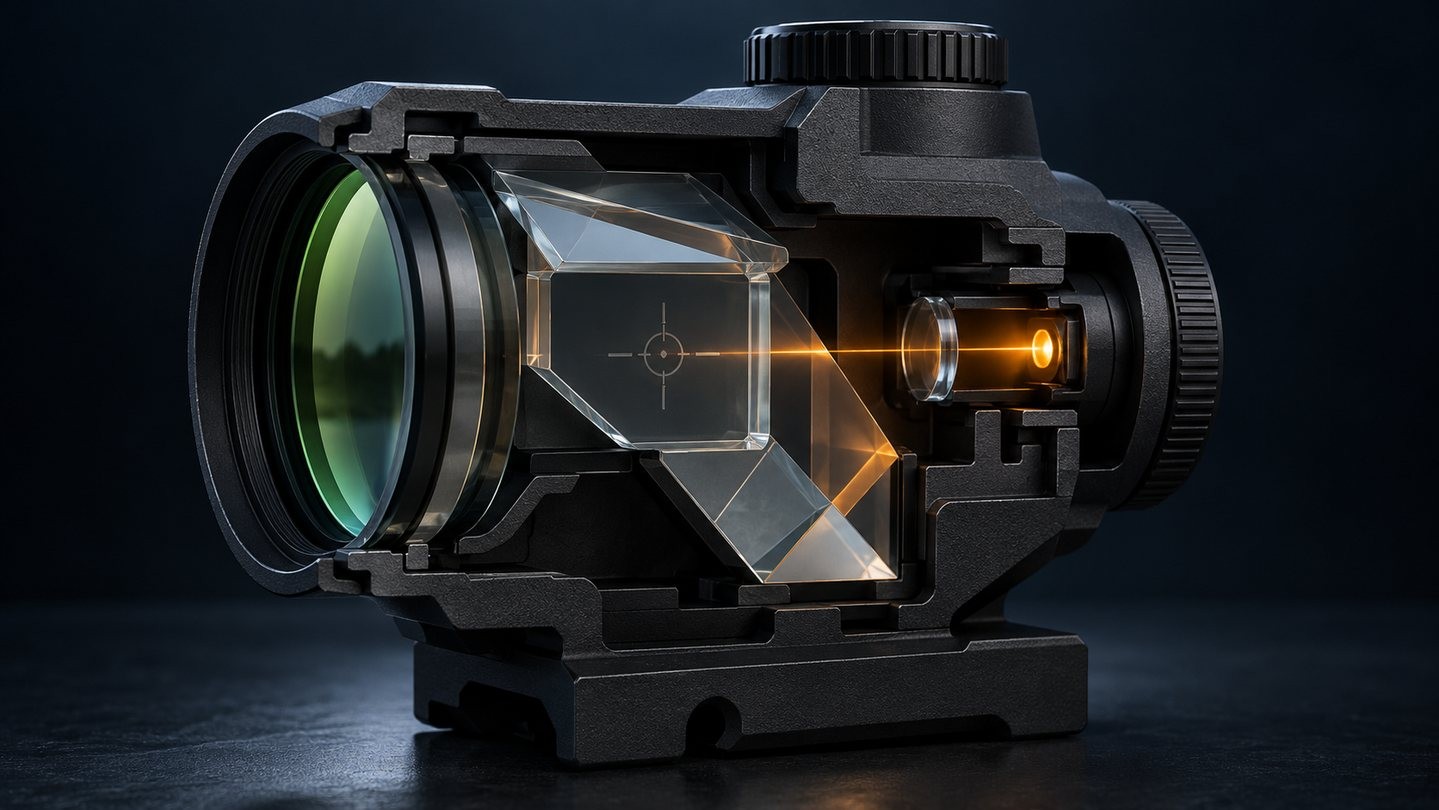
A prism scope can show a reticle even when its battery is removed. That is possible because the aiming pattern is etched into an optical element; illumination adds light to that pattern rather than creating the pattern from nothing.
Understanding the two functions makes it easier to judge brightness, battery condition and reticle design separately.
The etched reticle is the physical pattern
Fine lines, circles or reference marks are formed on a glass element inside the optic. In sufficient ambient light, they remain visible without electrical power. Their apparent sharpness depends on the diopter setting and the user’s eye.
Because the reticle is part of the optical system, it should not blink, flicker or disappear when the battery connection changes.
Illumination adds contrast
Illumination makes part or all of the etched pattern glow. It can improve visibility when the reticle and scene have similar tones or when the ambient light is low. It does not focus the reticle or increase magnification.
Too much brightness can cause blooming and make fine marks appear thicker. The same principle is discussed in our illumination brightness guide.
The diopter comes first
Set the reticle sharpness against a plain background with illumination low or off. Once the etched pattern is crisp, add only enough brightness for the conditions. Turning the illumination higher cannot correct a poor diopter setting.
Not every reticle illuminates in the same way
Some designs light a small center feature; others illuminate a larger pattern. Color, number of settings and off positions also vary. Check the exact manual and do not assume that every visible line is intended to glow.
The reticle layout itself matters more than the presence of illumination. The reticle types guide explains how line weight and references change the viewing experience.
Battery failure and illumination failure are not identical
A dark illuminated section may come from a depleted battery, reversed polarity, a loose cap, dirty contact or a control fault. The etched pattern can remain perfectly usable while the electrical layer needs attention. Work through the manual’s battery and contact checks before treating the reticle itself as damaged.
A practical check
- Verify the optic is safe to handle and point it at a plain bright background.
- Turn illumination off and set the diopter until the etched pattern is sharp.
- Move to a darker scene and raise brightness gradually.
- Remove the battery only if the manual permits it, then confirm the etched pattern remains.
- Inspect for flicker or intermittent contacts separately from reticle focus.
The etched reticle is the foundation. Illumination is a useful layer on top of it, not a replacement for the glass pattern or a substitute for correct focus.












Leave a comment