Rain starts halfway through a day outdoors, or a cold optic is brought into a warm room and the glass clouds over. This is usually when words such as waterproof and fogproof stop sounding like marketing and start sounding important.
The problem is that these words do not all describe the same thing. A waterproof claim is not automatically an IP rating. Fogproof does not mean that the outside of a lens can never mist. And an X in IPX7 does not mean the product has failed a dust test.
Here is a practical way to read the specification before you buy or use an optic.
Start With Three Separate Questions
When a product page mentions weather resistance, separate the claim into three parts:
- Can water enter the housing? This is the main question behind a waterproof or water-resistance claim.
- Can moisture condense inside the optical system? This is what fogproof construction is intended to address.
- Was the enclosure tested to a named ingress-protection level? This is where an IP code may provide a more specific reference.
A product may make one, two or all three claims. Do not assume that one automatically proves the others.
What “Waterproof” Tells You—and What It Does Not
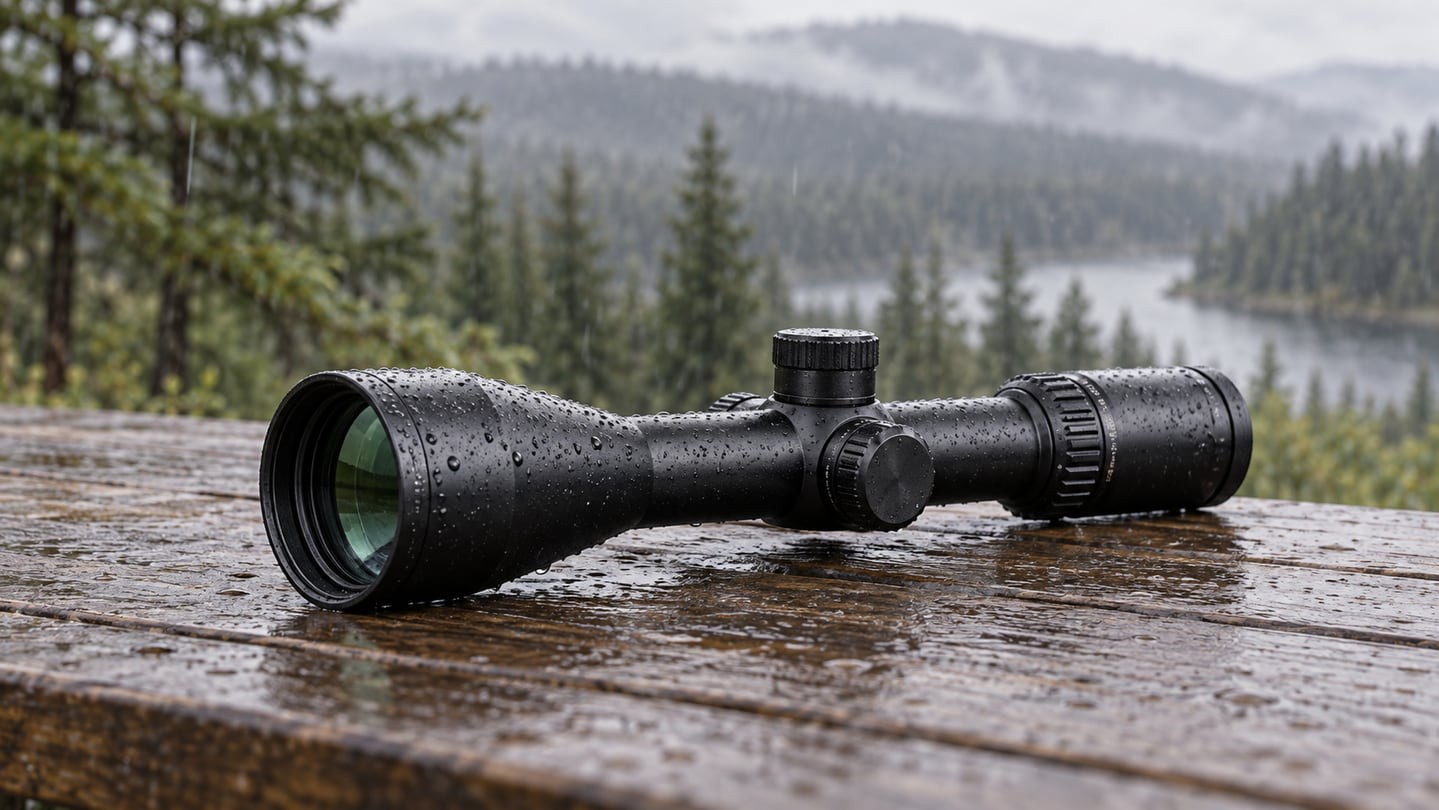
On its own, waterproof is a broad product claim. It may describe resistance to rain, splashing or immersion, but the word does not tell you the test method, depth, duration or condition of the controls and caps.
That does not make the claim meaningless. It means you need the next line of detail. Look for a named standard, a pressure rating, a depth-and-time statement or a model-specific test description. If none is shown, treat the word as a general claim rather than a precise limit.
Also check whether the stated protection depends on battery covers, turret caps or other closures being correctly fitted. A sealing claim should never be read as permission to leave a compartment open in the rain.
What “Fogproof” Usually Refers To
Fogproof construction is mainly about reducing internal condensation. Sealed optical products are often filled or purged with a dry gas such as nitrogen. ZEISS, for example, lists nitrogen purging as the fogproof method on specific binocular models. That is a model-specific construction detail, not a guarantee that every optic advertised as fogproof uses the same method.
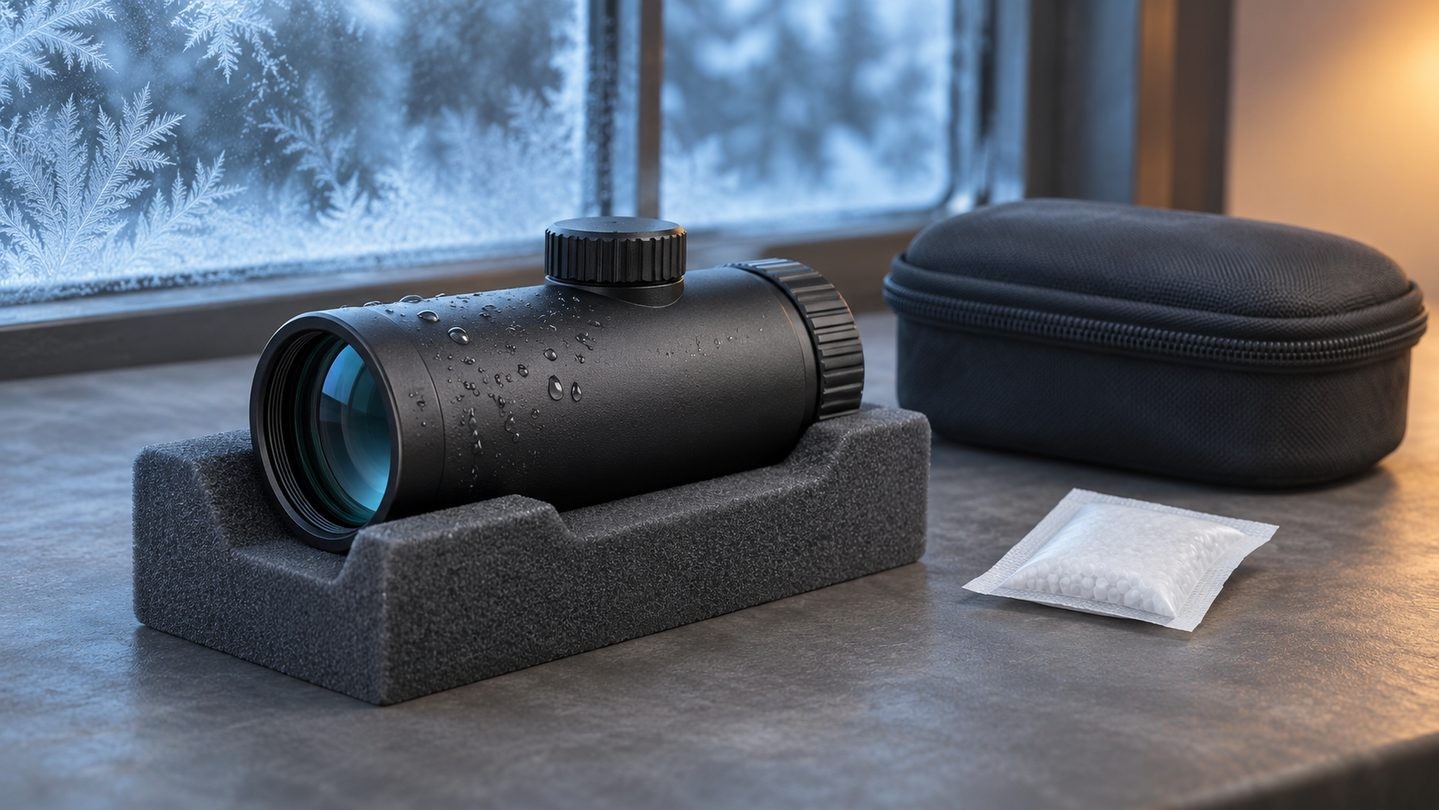
External condensation is different. Move a cold optic into warm, humid air and moisture can still form on the exposed lens surfaces—just as it can on glasses or a camera lens. That does not by itself prove that the seal has failed.
- Fog on the outside: often an environmental temperature-and-humidity effect.
- Haze or droplets between internal lens elements: a possible sealing or internal-moisture problem that should be checked under the maker’s service or warranty process.
If the outside glass is wet, remember that exterior water behavior and the sealed interior are separate issues. Our rifle-scope lens coating guide explains what coating labels do—and do not—tell you about the exposed glass surfaces.
How to Read an IP Code
The IP code comes from IEC 60529, a standard for classifying the protection provided by electrical-equipment enclosures. When an optics manufacturer applies an IP rating to an electronic optic or housing, the two characteristic positions answer different questions.
- The first numeral describes protection from solid objects and dust.
- The second numeral describes protection from harmful water ingress.
- An X means that a protection level is not being stated for that position. It is not the same as
0, which means unprotected.
So IP68 and IPX7 should not be read in the same way. IP68 states both a dust and water classification. IPX7 states the water classification while leaving the solid-particle position unspecified.
The Water Ratings Beginners See Most Often
The full standard contains more levels, but these are the labels that commonly appear in product specifications:
| Rating |
Plain-language meaning |
| IPX4 |
Protection against splashing water |
| IPX5 |
Protection against water jets |
| IPX6 |
Protection against powerful water jets |
| IPX7 |
Protection for temporary immersion under the specified test conditions |
| IPX8 |
Protection for continuous immersion under conditions specified for the product |
This table is a reading aid, not permission to invent a depth or time that the manufacturer never published. In particular, an IPX8 claim needs the product’s stated test conditions. A larger numeral also does not automatically describe every kind of real-world exposure, such as salt water, high-pressure cleaning, hot water or repeated impact.
For dust, IP5X means dust-protected and IP6X means dust-tight under the relevant test. If you see only IPX7, you have been given a water classification—not a dust classification.
Why a Higher Number Is Not the Whole Buying Decision
Ingress protection is useful, but it is one part of an optic’s design. It does not tell you optical resolution, adjustment quality, battery life, lens-coating durability or how well the product will survive a drop.
Nor does a laboratory enclosure test reproduce every field condition. Seals can be affected by damage, incorrect assembly or open caps. Temperature changes can put a product through conditions that a simple rain shower does not. Product care and the maker’s specific instructions still matter.
That is why two apparently similar claims should be compared by their supporting detail, not just by the largest number on the page.
A Five-Point Check Before You Buy
- Is the claim attached to this exact model? Do not borrow a rating from another size or version.
- Is a standard or test condition named? “Waterproof” alone is less specific than a model-specific test statement.
- Does the code cover dust, water or both? Read both IP positions and note any
X.
- Are there conditions or exclusions? Check caps, battery compartments, depth, duration and maintenance instructions.
- What does the warranty actually cover? A durability label and a water-damage warranty are not automatically the same promise.
If a listing leaves those points unclear, ask the seller for the exact test basis rather than assuming the strongest possible interpretation.
The Practical Bottom Line
Use the terms for the jobs they actually describe. Waterproof is a broad claim that needs supporting conditions. Fogproof normally concerns internal moisture control, not every drop of condensation on an exterior lens. An IP code is more structured, but only for the positions and test conditions it actually states.
Once you read the label this way, comparisons become much easier: you are no longer choosing the boldest word—you are comparing the evidence behind it.
Browse our Sporting Optics category to compare clearly listed specifications, or use the USEEIN Buying Guides for more beginner-friendly explanations before choosing an optic.


Leave a comment