

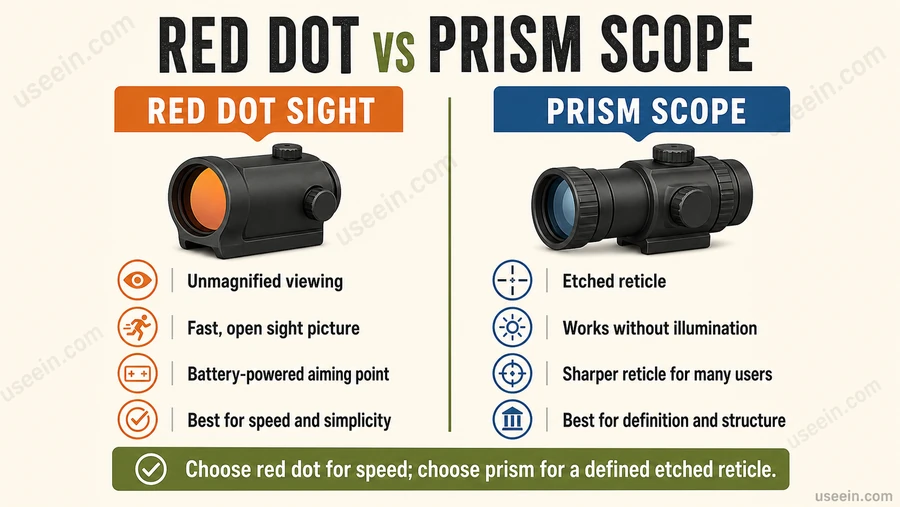
Red dot sights and prism scopes can both support close-range optic setups, but they create the aiming image differently. A red dot projects an illuminated point onto a lens; a prism uses an optical system with an etched reticle.
Red dot strengths
- Fast, heads-up viewing.
- Very forgiving eye position.
- Compact and lightweight designs.
- Options such as motion wake, enclosed emitters or solar assistance.
A red dot is often the simplest choice when speed, peripheral awareness and flexible head position are priorities.
Prism scope strengths
- The etched reticle remains visible without illumination.
- Reticles can include structured aiming references.
- Some users with astigmatism find an etched reticle clearer than a projected dot.
- Fixed magnification options can add useful target detail.
A prism normally has defined eye relief and may be heavier than a compact open red dot.
Key differences
- Eye relief: red dots are very forgiving; prisms require a more consistent eye position.
- Reticle without power: a prism reticle remains visible; a projected red dot usually does not.
- Magnification: red dots are normally 1×; prisms are available at 1× and fixed magnifications.
- Astigmatism: an etched prism reticle may look clearer, but individual results vary.
Open versus enclosed red dots
Open sights are light and can provide a generous viewing window. Enclosed designs protect the emitter from dust, moisture and debris. Match the housing style to environmental exposure and mounting constraints.
Which should you choose?
- Choose a red dot for maximum speed and a flexible viewing position.
- Choose a prism for an etched, battery-independent aiming reference.
- Check the real viewing experience if astigmatism affects dot clarity.
- Confirm footprint, rail compatibility, height and available space.
Compare our Red Dot Sights and Prism Scopes.