

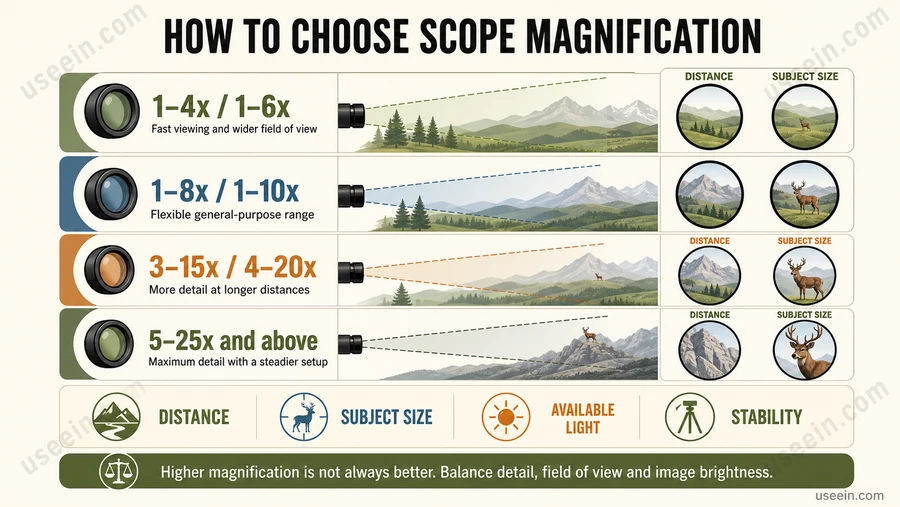
The right scope magnification is the lowest range that lets you identify the target and aim precisely under realistic conditions. More power can reveal detail, but it also narrows field of view and makes eye position less forgiving.
Magnification is not distance by itself
Target size, lighting, contrast and viewing position matter as much as distance. Heat shimmer and low light can also limit the usable top end of a scope.
Practical magnification ranges
- 1–4× to 1–6×: fast close-range viewing with useful medium-distance capability.
- 1–8× to 1–10×: broad versatility when both low and higher power matter.
- 2–10× to 3–15×: balanced general-purpose use.
- 4–16× to 6–24×: small targets and deliberate precision.
- 6–36× and above: fine detail, observation and specialized long-range use.
Why the low end matters
Minimum magnification controls field of view and acquisition speed. Choose a low setting that remains comfortable at your closest realistic distance.
Why the high end matters
Maximum magnification helps only when the image stays clear. Compare resolution, contrast and eye box at the highest setting; a clear 18× image is more useful than a soft 24× image.
Simple selection process
- Define the closest and farthest common viewing distances.
- Choose a minimum power that remains quick at the close end.
- Select enough maximum power for the smallest expected target.
- Check field of view, eye relief and clarity at both ends.
- Avoid paying for magnification you are unlikely to use.
Browse all Rifle Scopes to compare available ranges.